
Sign in
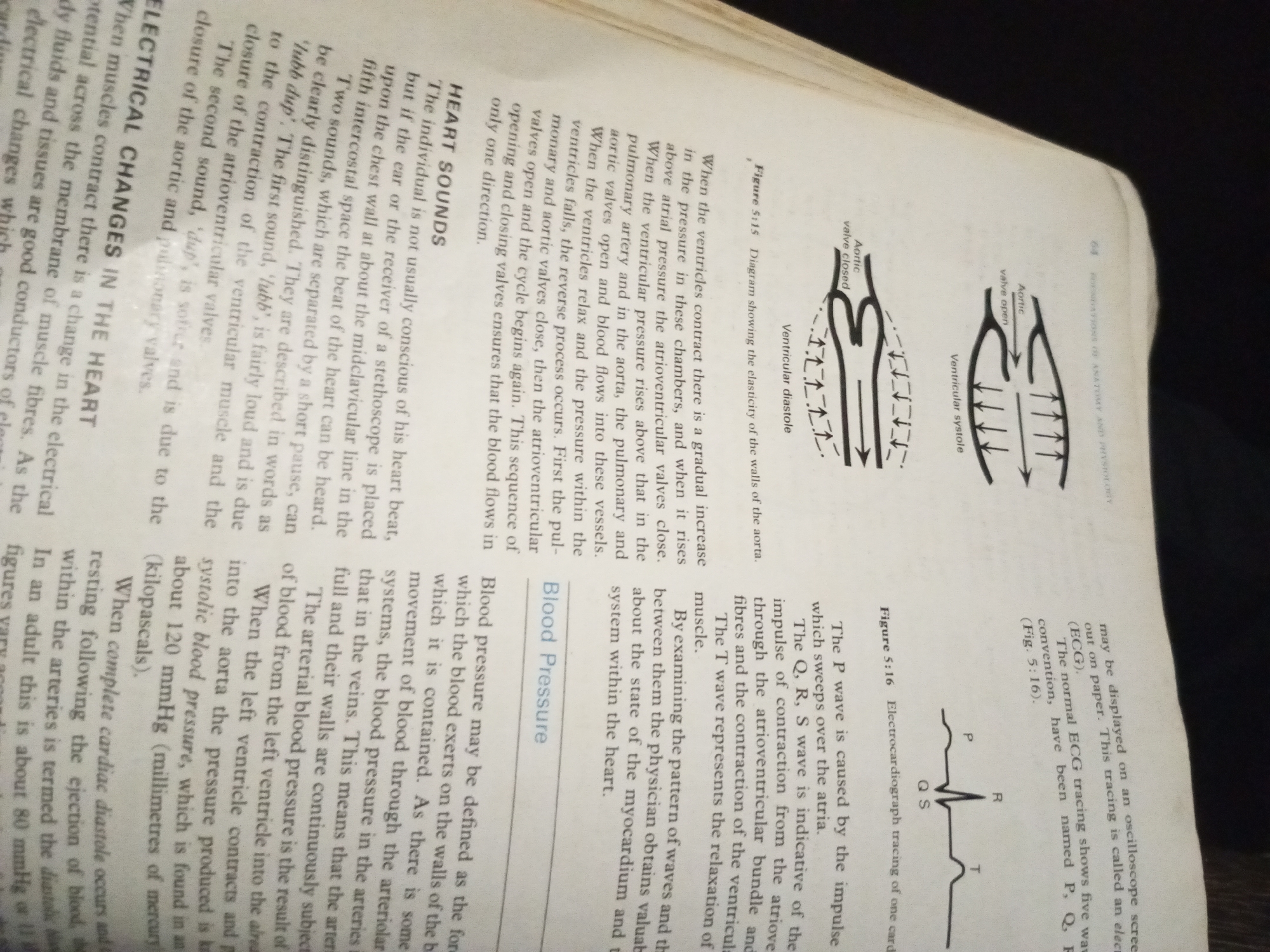
The image contains a page from a textbook with text and diagrams related to the circulatory system and electrocardiography. On the left side, there is a section titled "ELECTRICAL CHANGES IN THE HEART" followed by a paragraph describing the electrical activity of the heart. Below this, a heading "HEART SOUNDS" is followed by an explanation of the two main heart sounds. To the right of the text, there are two diagrams illustrating ventricular diastole and systole, with labels for aortic and ventricular valves. Further to the right, a caption refers to "Figure 5.15 Diagram showing the elasticity of the walls of the aorta." In the lower right section, there is a diagram labeled "Figure 5.16 Electrocardiograph tracing of one cardiac cycle (ECG)." This diagram shows a typical ECG waveform with P, Q, R, S, and T waves. The text discusses the P wave being caused by atrial contraction, and the Q, R, S wave indicating ventricular contraction. The overall image is a collection of educational material, likely from a biology or physiology textbook. There are no indications of a specific city or location.
FM-ceq5D2

Jun 28, 2026

Unknown, Unknown

Stake attention in this memory

educational
informative
scientific
health
medical

The image contains a page from a textbook with text and diagrams related to the circulatory system and electrocardiography. On the left side, there is a section titled "ELECTRICAL CHANGES IN THE HEART" followed by a paragraph describing the electrical activity of the heart. Below this, a heading "HEART SOUNDS" is followed by an explanation of the two main heart sounds. To the right of the text, there are two diagrams illustrating ventricular diastole and systole, with labels for aortic and ventricular valves. Further to the right, a caption refers to "Figure 5.15 Diagram showing the elasticity of the walls of the aorta." In the lower right section, there is a diagram labeled "Figure 5.16 Electrocardiograph tracing of one cardiac cycle (ECG)." This diagram shows a typical ECG waveform with P, Q, R, S, and T waves. The text discusses the P wave being caused by atrial contraction, and the Q, R, S wave indicating ventricular contraction. The overall image is a collection of educational material, likely from a biology or physiology textbook. There are no indications of a specific city or location.

transactions
revenues
stakers
Earliest
Latest
Highest stake

No transactions found

More from this user

More from Unknown

FM-ceq5D2

Jun 28, 2026

Unknown, Unknown

Licensed under Creative Commons Attribution 4.0 International License. You are free to share and adapt this content with proper attribution.