Sign in
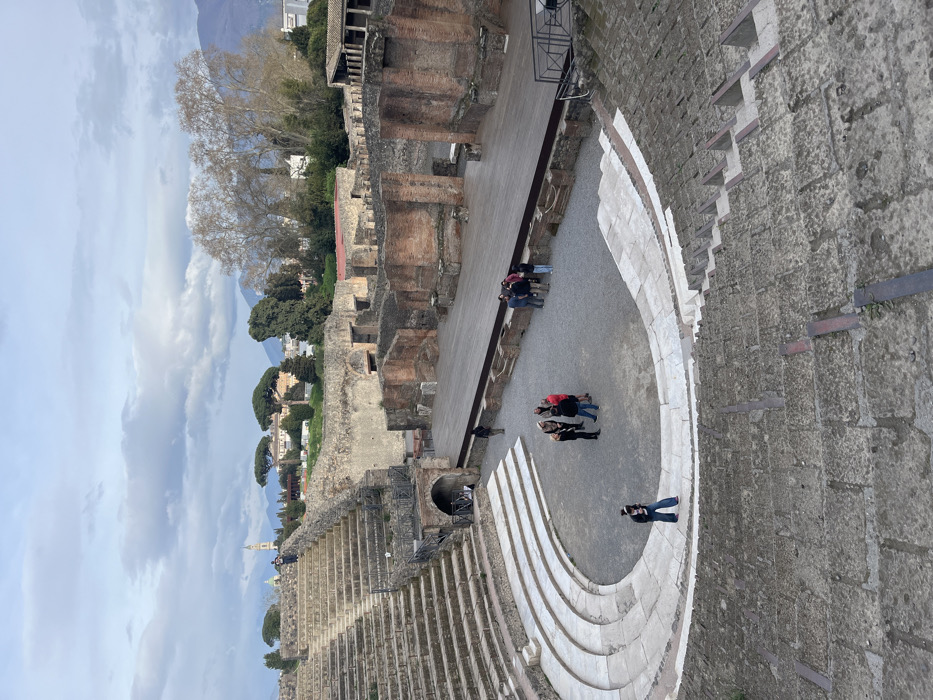
The image depicts the Grand Theater (Teatro Grande) within the ancient city of Pompeii, Italy. The scene is observed from an elevated position within the upper tiers of the theater.

The environment features an overcast sky with grey clouds, distant mountains, and trees. The theater consists of multiple tiers of stone seating (cavea), with the uppermost sections constructed from rough, grey stone blocks. A curved, lower section of seating, partially restored with white stone, defines the edge of the orchestra.

The orchestra, a large, semi-circular area, is covered with grey gravel. A single individual stands near the front of the white stone seating, facing away from the viewer, appearing to interact with a mobile device. Further into the orchestra, a group of approximately five individuals stands clustered, engaged in conversation.

Beyond the orchestra, a rectangular wooden stage platform (pulpitum) is visible. Behind this platform lie extensive ruins of the stage building (scaenae frons), characterized by walls of brick and rough stone, with some preserved archways and structural elements. Another group of approximately six individuals stands near the right side of the stage platform, observing the ruins. One solitary figure walks on the stage platform from the left, moving towards the stage ruins.

On the upper tiers of the stone seating to the left, a single person stands near the top, looking towards the center of the theater. Modern railings and fences are visible in various sections, providing safety barriers. In the background, beyond the ancient structures, modern buildings with red tile roofs and additional trees are visible. A distant bell tower rises above the modern landscape to the left.
Valli

Mar 16, 2026

Pompei, Italy

Short Term

Stake attention in this memory

Historical
Awe
Curiosity
Contemplative
Peaceful

The image depicts the Grand Theater (Teatro Grande) within the ancient city of Pompeii, Italy. The scene is observed from an elevated position within the upper tiers of the theater. The environment features an overcast sky with grey clouds, distant mountains, and trees. The theater consists of multiple tiers of stone seating (cavea), with the uppermost sections constructed from rough, grey stone blocks. A curved, lower section of seating, partially restored with white stone, defines the edge of the orchestra. The orchestra, a large, semi-circular area, is covered with grey gravel. A single individual stands near the front of the white stone seating, facing away from the viewer, appearing to interact with a mobile device. Further into the orchestra, a group of approximately five individuals stands clustered, engaged in conversation. Beyond the orchestra, a rectangular wooden stage platform (pulpitum) is visible. Behind this platform lie extensive ruins of the stage building (scaenae frons), characterized by walls of brick and rough stone, with some preserved archways and structural elements. Another group of approximately six individuals stands near the right side of the stage platform, observing the ruins. One solitary figure walks on the stage platform from the left, moving towards the stage ruins. On the upper tiers of the stone seating to the left, a single person stands near the top, looking towards the center of the theater. Modern railings and fences are visible in various sections, providing safety barriers. In the background, beyond the ancient structures, modern buildings with red tile roofs and additional trees are visible. A distant bell tower rises above the modern landscape to the left.

Symbol

A45F8

Volume

15,870

Creator

+$0.56

Revenue

+$0.95

TVL

$46.33

1D
1W
1M
All
transactions
revenues
stakers
Earliest
Latest
Highest stake

1

B🟢I🟢G🟢💰

Staked 2d ago

$45.84 USD

+$0.49 USD

+1%

2

Rev Bot 🤖💰

Injected revenue 2d ago

Revenue bonus for the last stake.

+$1.05 USD

More from this user

More from Pompei

Valli

Mar 16, 2026

Pompei, Italy

Licensed under Creative Commons Attribution 4.0 International License. You are free to share and adapt this content with proper attribution.