Sign in
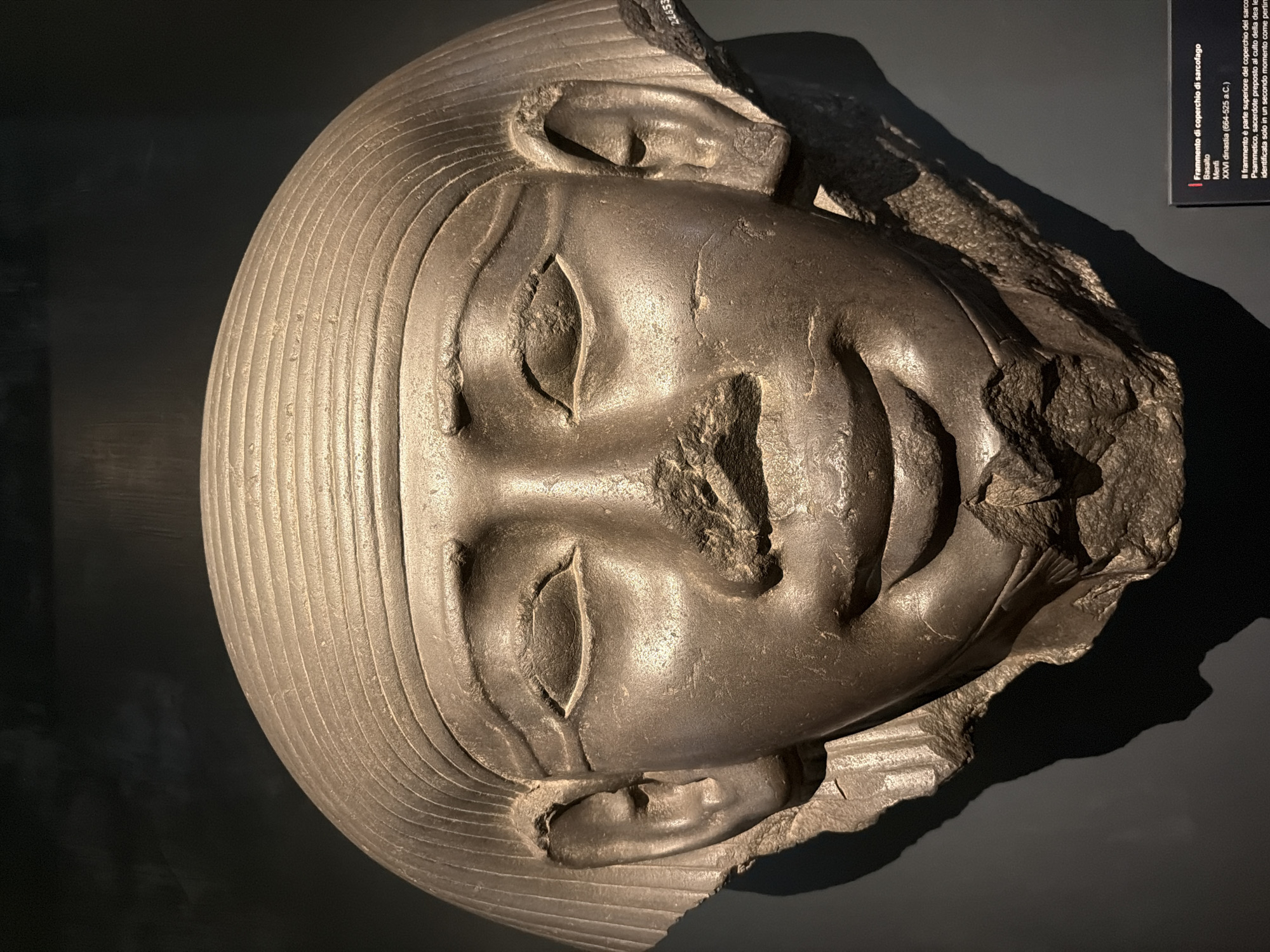
A dark, ancient Egyptian stone sarcophagus lid fragment, depicting a human face, is displayed against a dark, plain background. The face, likely carved from basalt, features closed, serene eyes, a broad nose, and a slight, upturned smile. The ears are large and well-defined, and a stylized, striped wig or headdress covers the head, with horizontal grooves indicating individual strands. The fragment shows signs of age and damage, particularly around the lower jaw, nose, and edges, where the stone is chipped and eroded. Strong, directional lighting from above illuminates the face, creating pronounced highlights on the forehead, cheekbones, nose, and chin, and casting deep shadows beneath the chin and behind the fragment.

In the lower right corner, a white information plaque with Italian text is visible. The text identifies the artifact as a "Frammento di coperchio di sarcofago" (Fragment of a sarcophagus lid) made of "Basalto" (Basalt) from "Menti" (likely a reference to the god Montu or a person named Mentu). It dates to the "XXVI dinastia (664-525 a.C.)" (26th Dynasty, 664-525 BC). Partially visible text below mentions "Psammetico, sacerdote preposto al culto della dea le..." (Psammetichus, priest in charge of the cult of the goddess...). The artifact is located in the Vatican Museums, Città del Vaticano, Vatican City.
Animonka

Jun 5, 2026

Città del Vaticano, Vatican City

Stake attention in this memory

ancient
mysterious
stoic
regal
enigmatic

A dark, ancient Egyptian stone sarcophagus lid fragment, depicting a human face, is displayed against a dark, plain background. The face, likely carved from basalt, features closed, serene eyes, a broad nose, and a slight, upturned smile. The ears are large and well-defined, and a stylized, striped wig or headdress covers the head, with horizontal grooves indicating individual strands. The fragment shows signs of age and damage, particularly around the lower jaw, nose, and edges, where the stone is chipped and eroded. Strong, directional lighting from above illuminates the face, creating pronounced highlights on the forehead, cheekbones, nose, and chin, and casting deep shadows beneath the chin and behind the fragment. In the lower right corner, a white information plaque with Italian text is visible. The text identifies the artifact as a "Frammento di coperchio di sarcofago" (Fragment of a sarcophagus lid) made of "Basalto" (Basalt) from "Menti" (likely a reference to the god Montu or a person named Mentu). It dates to the "XXVI dinastia (664-525 a.C.)" (26th Dynasty, 664-525 BC). Partially visible text below mentions "Psammetico, sacerdote preposto al culto della dea le..." (Psammetichus, priest in charge of the cult of the goddess...). The artifact is located in the Vatican Museums, Città del Vaticano, Vatican City.

transactions
revenues
stakers
Earliest
Latest
Highest stake

No transactions found

More from this user

More from Città del Vaticano

Animonka

Jun 5, 2026

Città del Vaticano, Vatican City

Licensed under Creative Commons Attribution 4.0 International License. You are free to share and adapt this content with proper attribution.