NERMEEN SALEH, roma and reham
Khan Yunis, PalestineSunday, February 22, 2026 · Updated Sunday, February 22, 2026
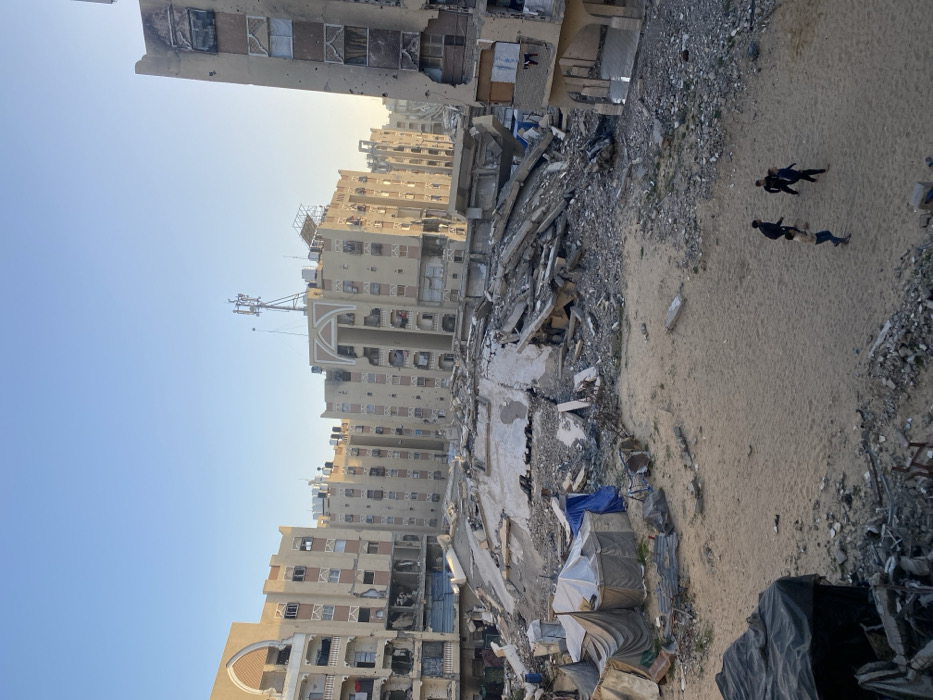
Khan Yunis, PalestineKhan Yunis, a city in the Palestinian Territory, stands as a stark testament to the enduring impact of conflict. Its landscape, profoundly reshaped by widespread destruction, tells a somber story of devastation, yet simultaneously reveals the unwavering spirit of its inhabitants. This is a place where every street and structure bears the scars of a humanitarian crisis, painting a vivid picture of a community grappling with immense hardship.
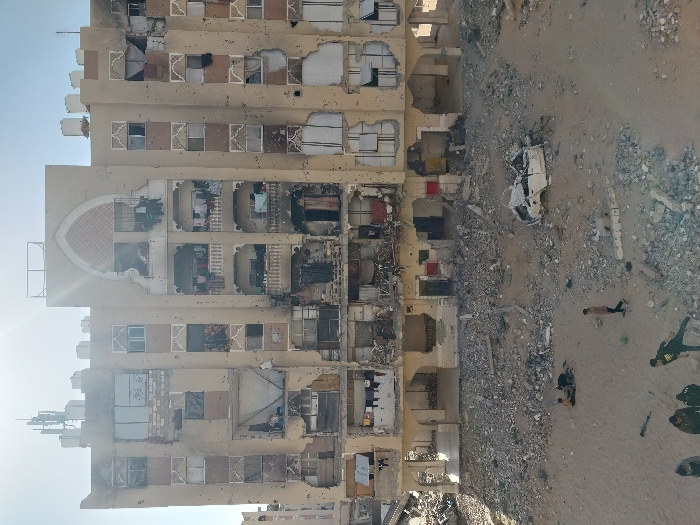
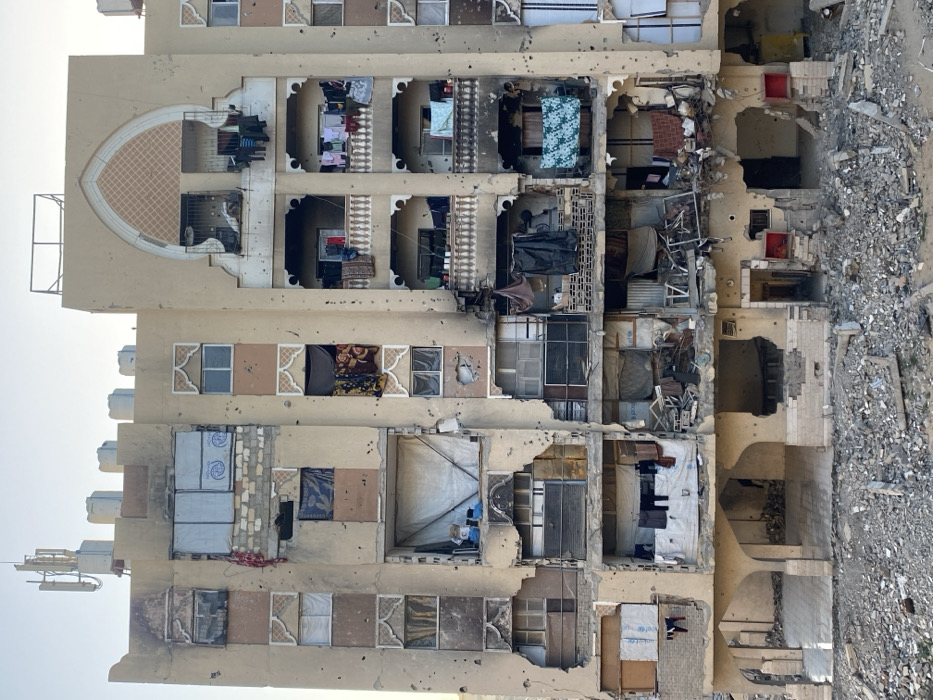
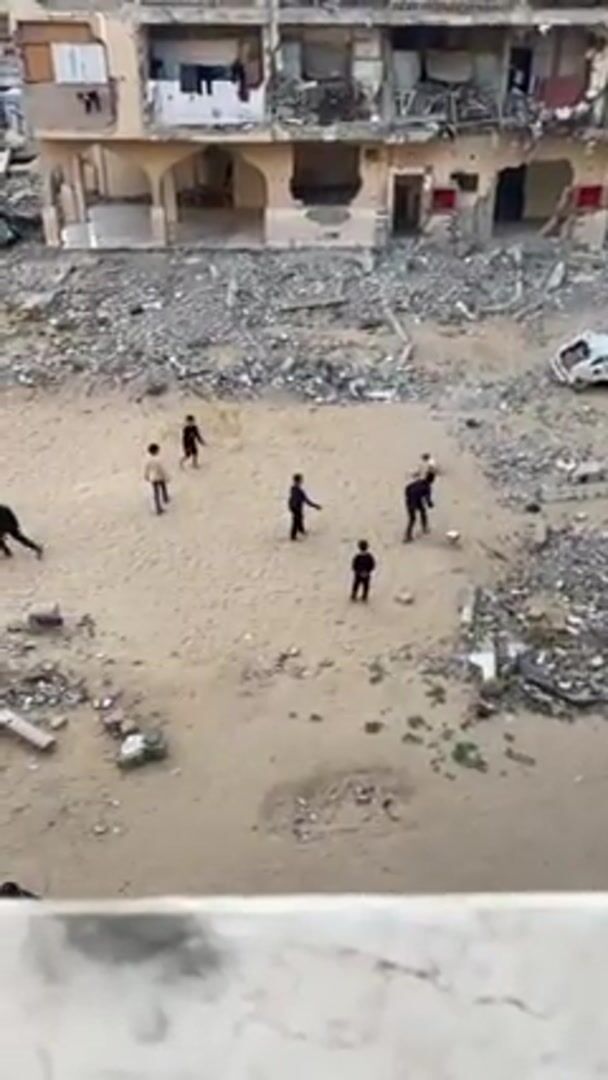
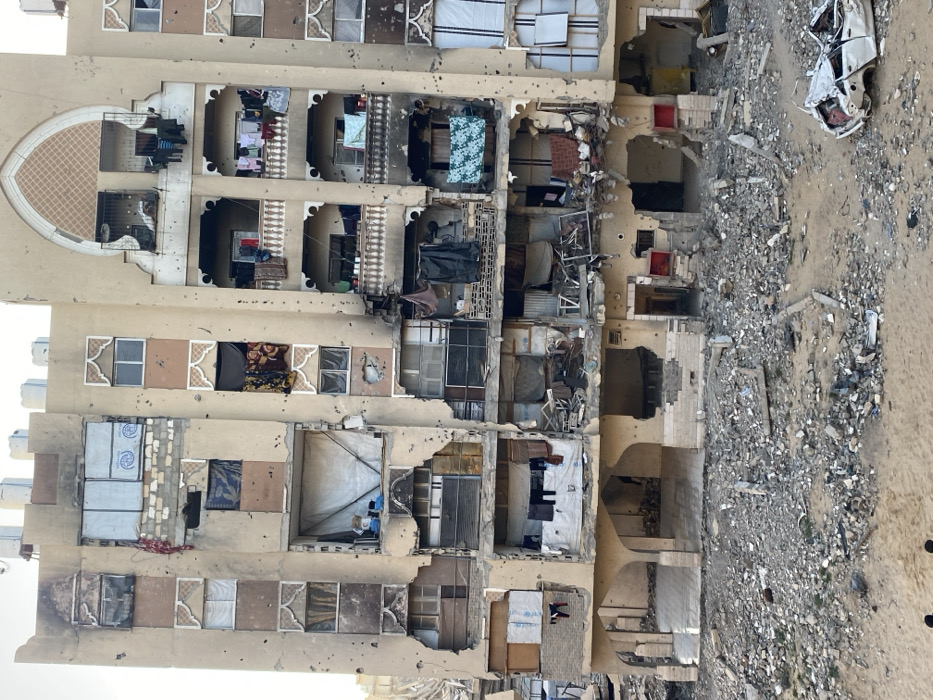
This image depicts a multi-story building in Khan Yunis, Palestinian Territory, exhibiting extensive structural damage. The light-colored building, approximately six to seven stories tall, is heavily pockmarked with numerous bullet holes and larger impact craters across its facade. Many windows are shattered, missing, or boarded up, exposing interiors filled with debris. Several balconies show visible damage, with some areas appearing charred and sections of laundry hanging on lines. The rooftop features multiple communication antennae and white water tanks. The ground in front of the building is a desolate expanse of sand and construction rubble. A severely damaged white sedan, appearing crushed and twisted, lies amidst the debris in the mid-ground. Five individuals are visible on the ground: three in the lower left corner, one of whom is in mid-stride, seemingly kicking an object on the ground. A fourth individual walks towards the right in the central foreground. Two other individuals are seated on the sandy ground to the left of the crushed car. The environment is characterized by widespread destruction and debris.
reham
Khan Yunis, Palestinian Territory · Feb 22, 2026, 12:13 PM
The urban environment is dominated by severely damaged multi-story concrete buildings. Many structures exhibit shattered or missing windows, exposing dark, hollow interiors, while sections of walls have collapsed, revealing twisted rebar and vast piles of debris. Massive heaps of rubble, composed of pulverized building materials, concrete slabs, and twisted metal, signify the complete collapse of numerous homes and businesses, transforming once-vibrant neighborhoods into desolate expanses.

Brown tabby cat photographed resting with head tilted upward
· Saturday, May 16, 2026
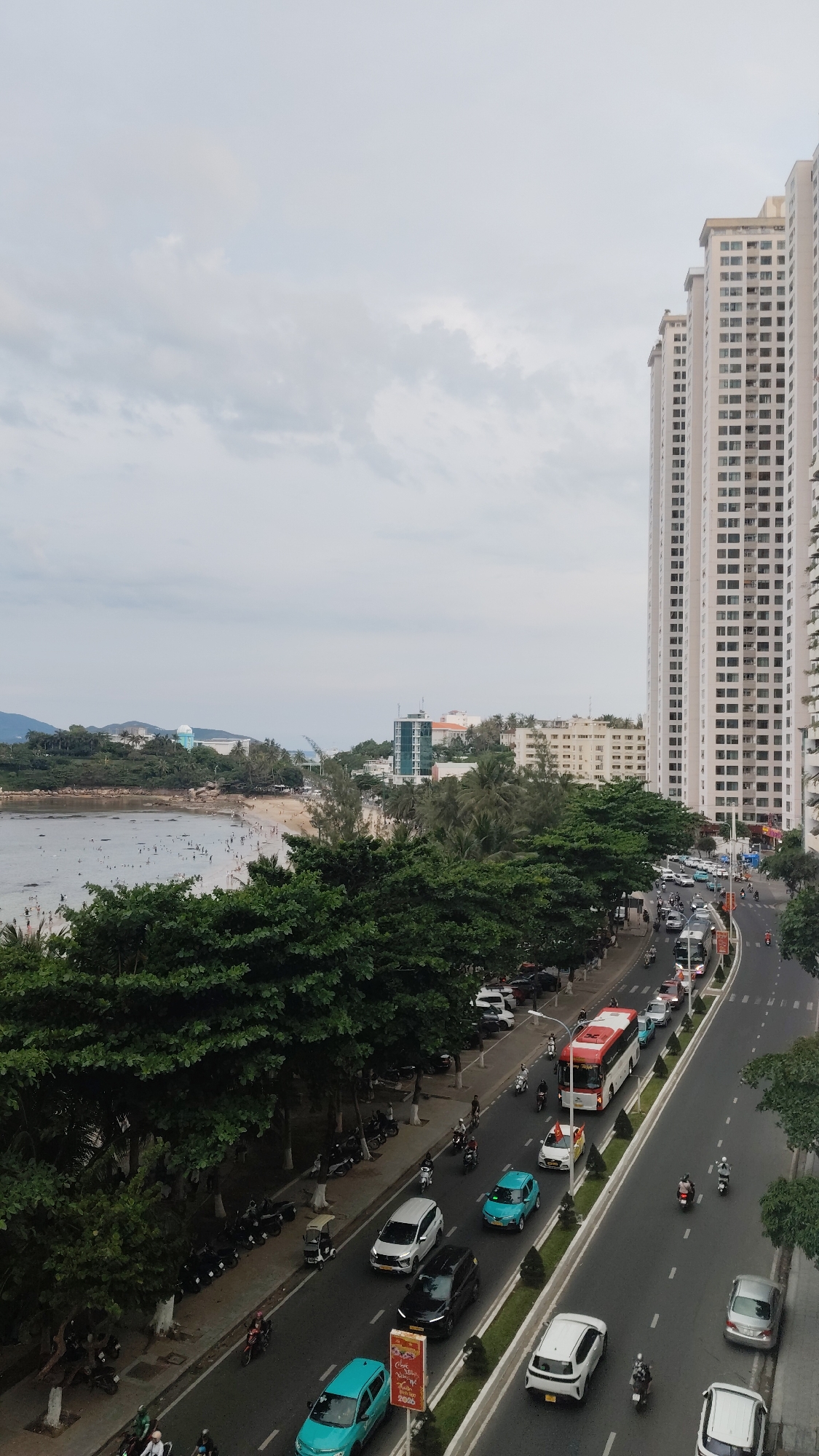
Daily life scenes captured across Nha Trang Ward
Bac Nha Trang Ward, Vietnam · Saturday, May 16, 2026
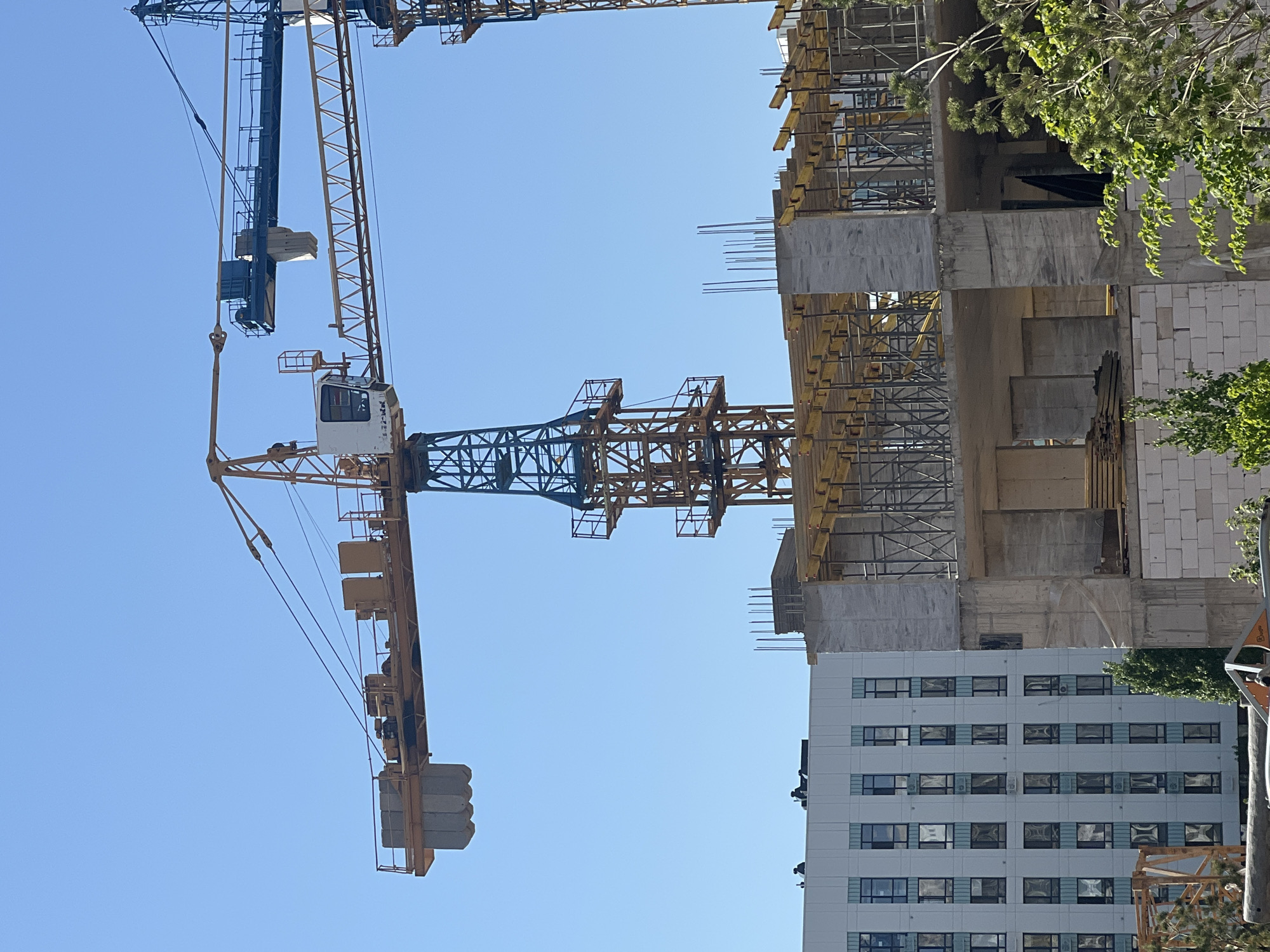
Construction and award statuette documented in Astana Kazakhstan
Astana, Kazakhstan · Saturday, May 16, 2026Two black dogs spotted wagging tails, looking upward

· Saturday, May 16, 2026
Water distribution and baby supplies amid Gaza destruction
Khan Yunis, Palestinian Territories · 45 memories
Daily life continues amid widespread destruction in Khan Yunis
Khan Yunis, Palestinian Territories · 13 memoriesDaily life in Khan Yunis: carts, water, and quiet moments
Khan Yunis, Palestinian Territories · 9 memoriesDaily life and destruction across Khan Yunis displacement camps
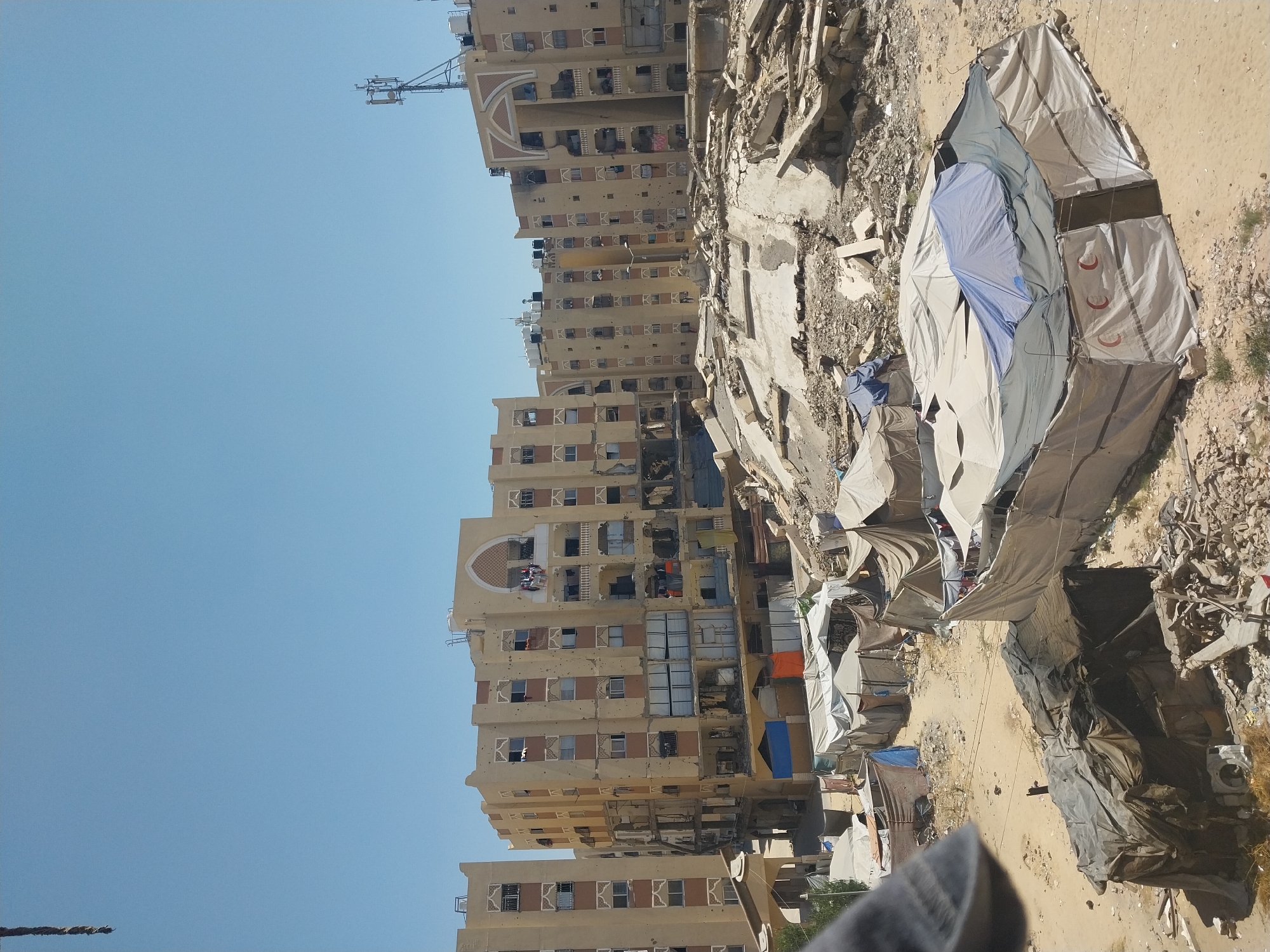
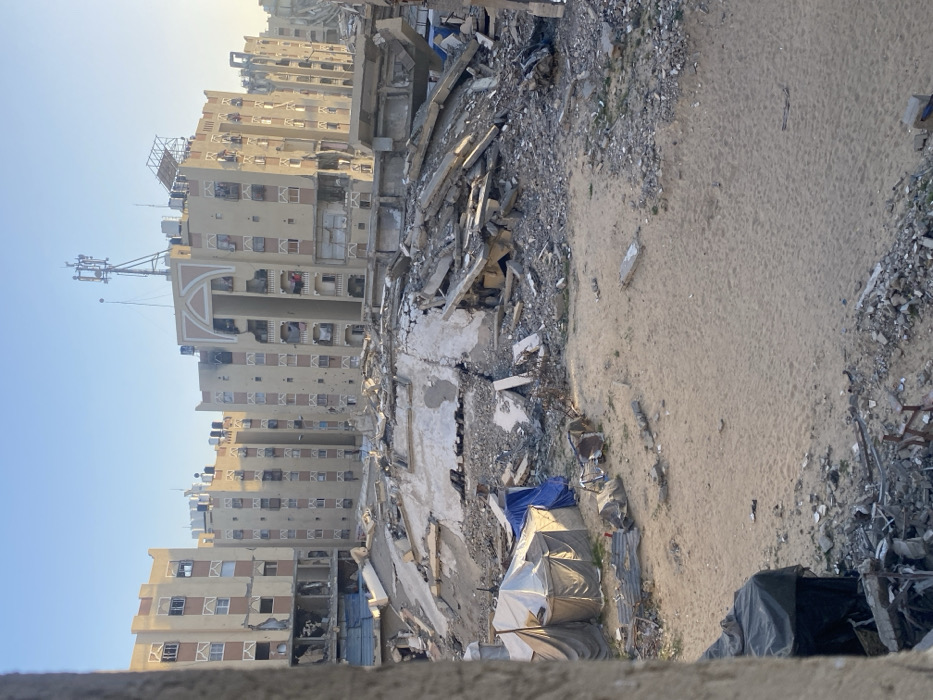
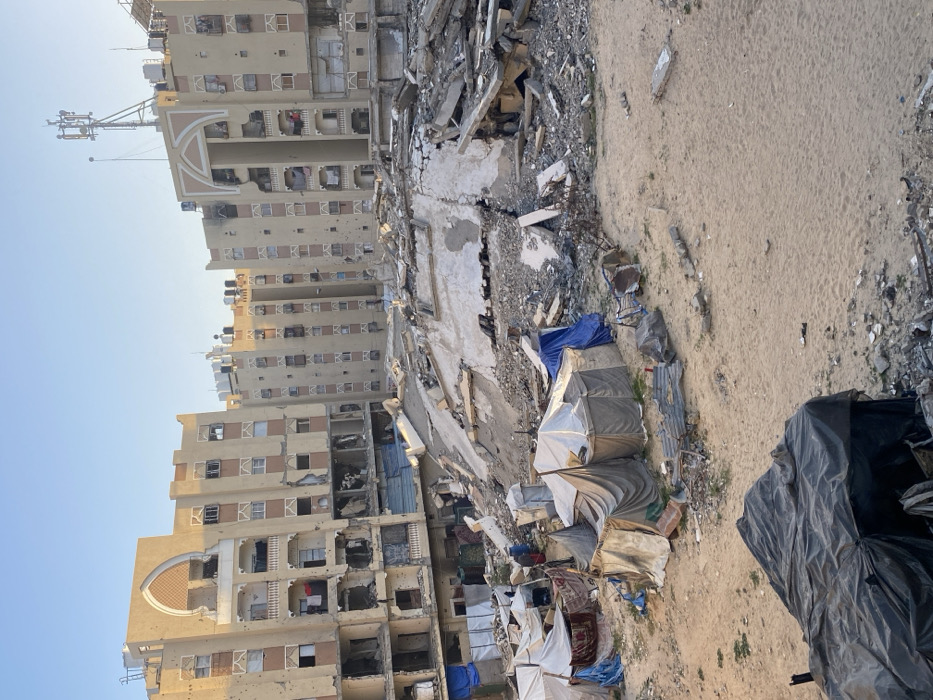
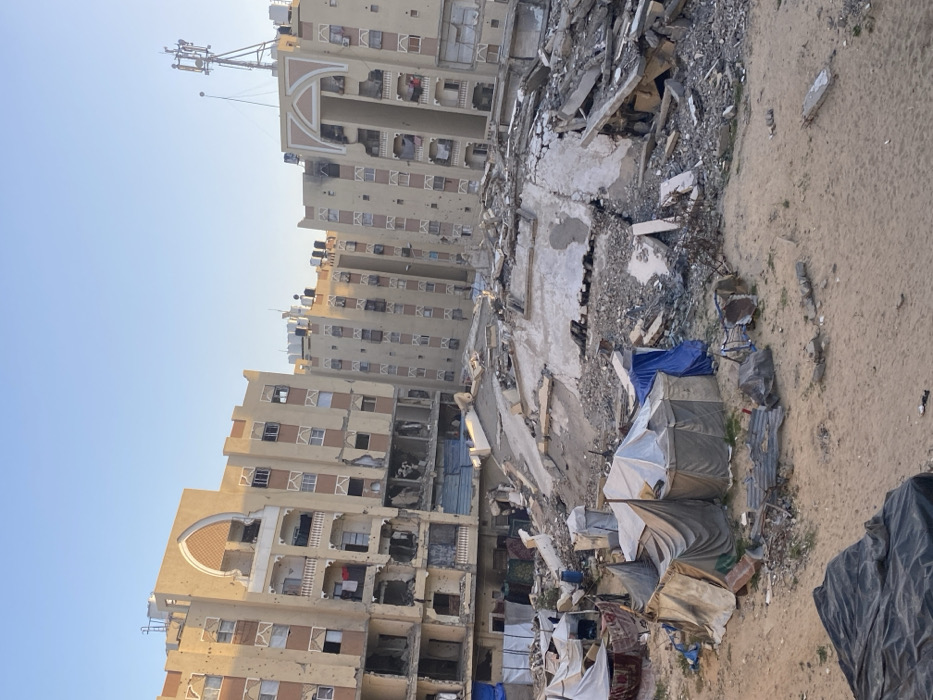
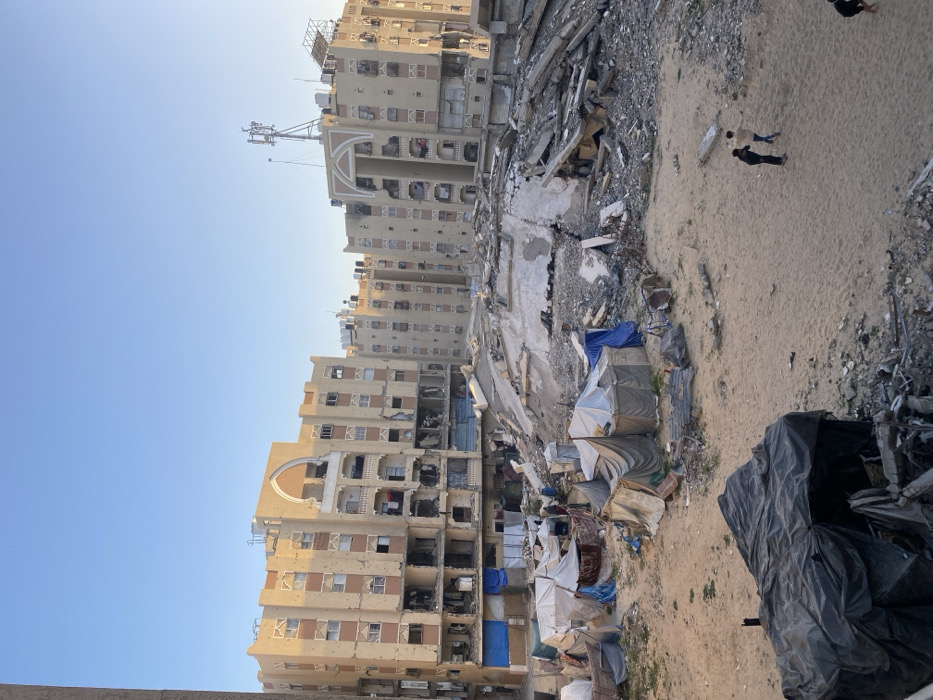
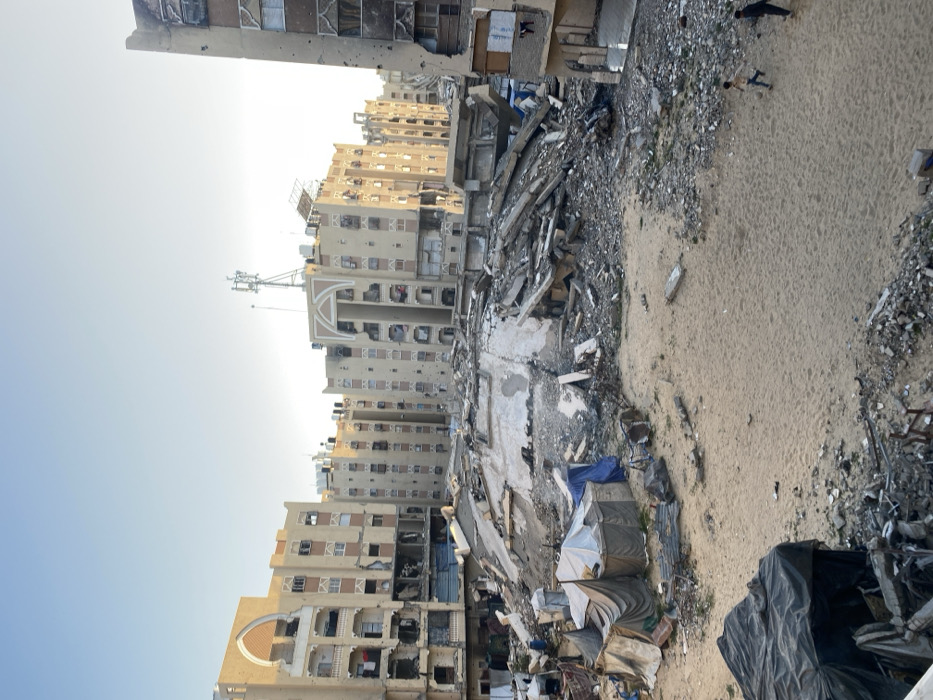
Khan Yunis, Palestinian Territories · 49 memoriesThe scene in Khan Yunis, Palestinian Territory, under a clear sky, shows a severely damaged urban landscape. In the background, multi-story, light brown residential buildings display extensive structural damage, including numerous impact holes, shattered windows, and partially collapsed sections; a cellular tower stands on one rooftop. The midground contains a substantial mound of concrete rubble from demolished structures and a cluster of approximately ten makeshift tents, constructed from various tarpaulins (blue, tan, grey), on sandy terrain. Several indistinct individuals are present near these tents. The immediate foreground consists of sandy earth with minimal vegetation and a large object covered by a black tarp.
reham
Khan Yunis, Palestinian Territory · Feb 22, 2026, 12:14 PM

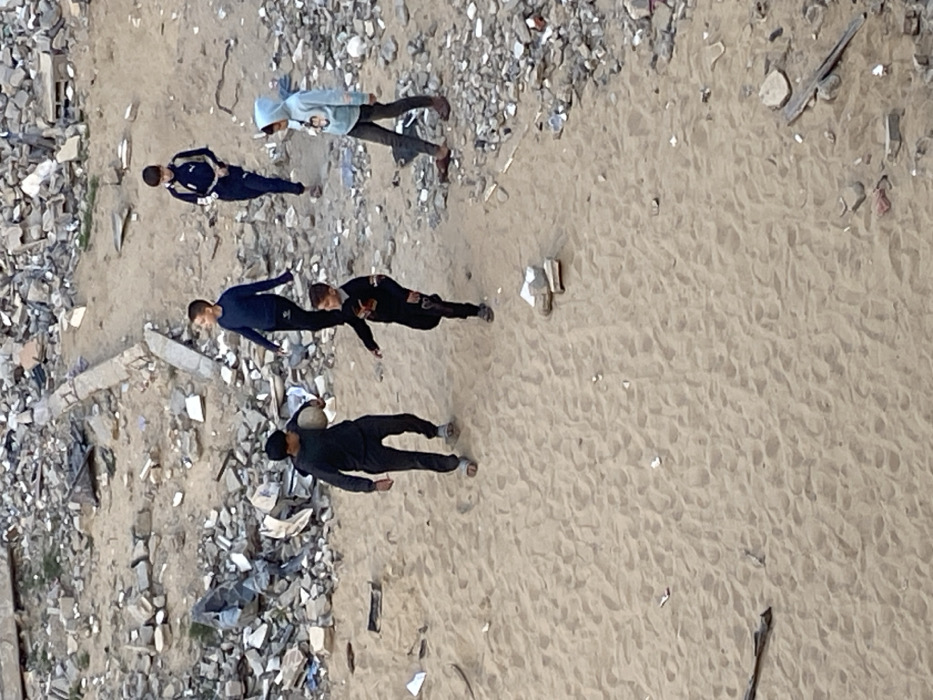
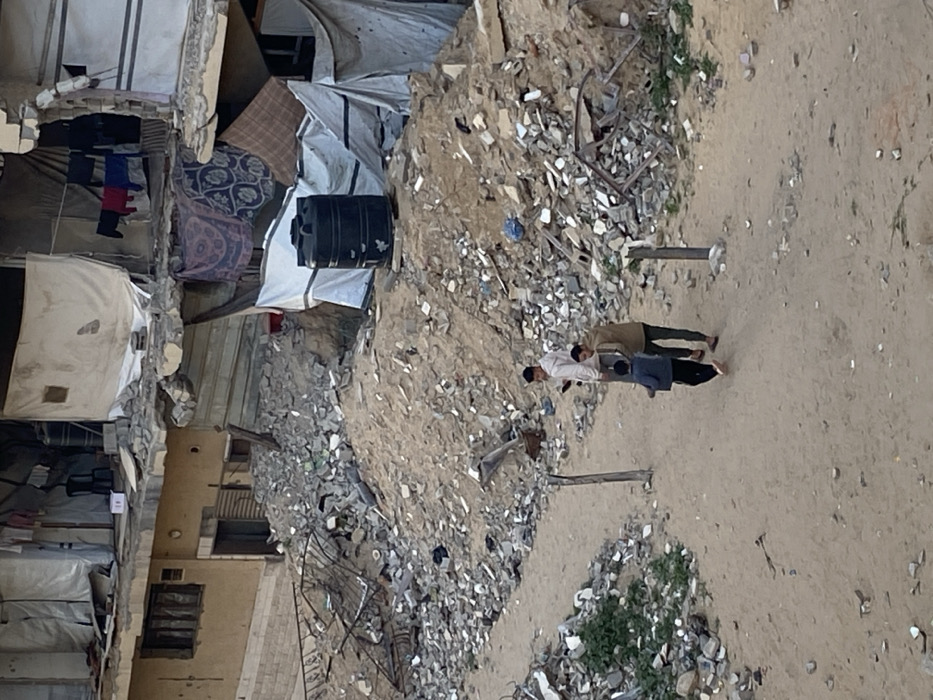
Yet, amidst this profound devastation, life finds a way to persist. Figures are seen navigating sandy paths that wind alongside the debris, their daily routines unfolding against a backdrop of ruin. Makeshift shelters and tents dot the landscape, often adorned with hung laundry and equipped with basic necessities like water tanks, symbolizing the resourcefulness required for survival. Even children, despite their surroundings, find moments of play in sandy areas bordering the rubble, a poignant reminder of resilience.

The aerial shot reveals a desolate landscape of debris next to a damaged building. Several bodies are scattered across the rubble and sandy ground, suggesting a scene of devastation and loss. The overall tone is somber, with the destruction and presence of bodies painting a grim picture.
roma
Khan Yunis, Palestinian Territory · Feb 22, 2026, 12:15 PM

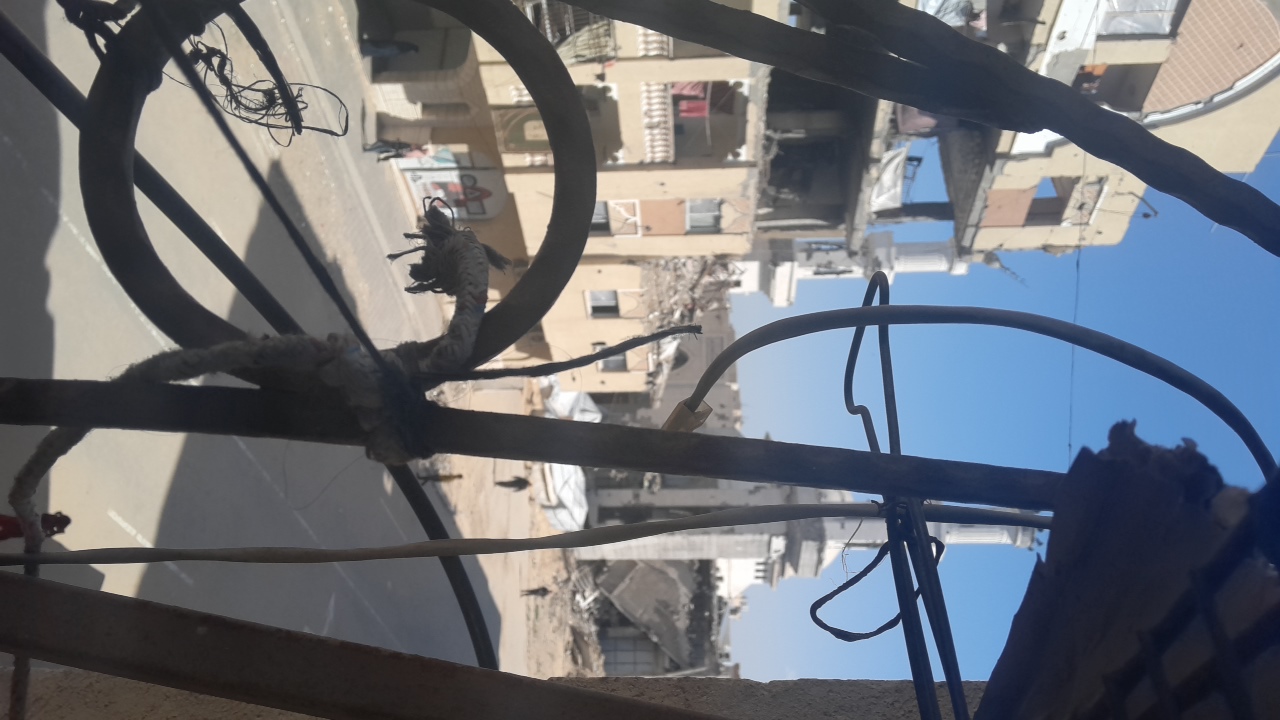
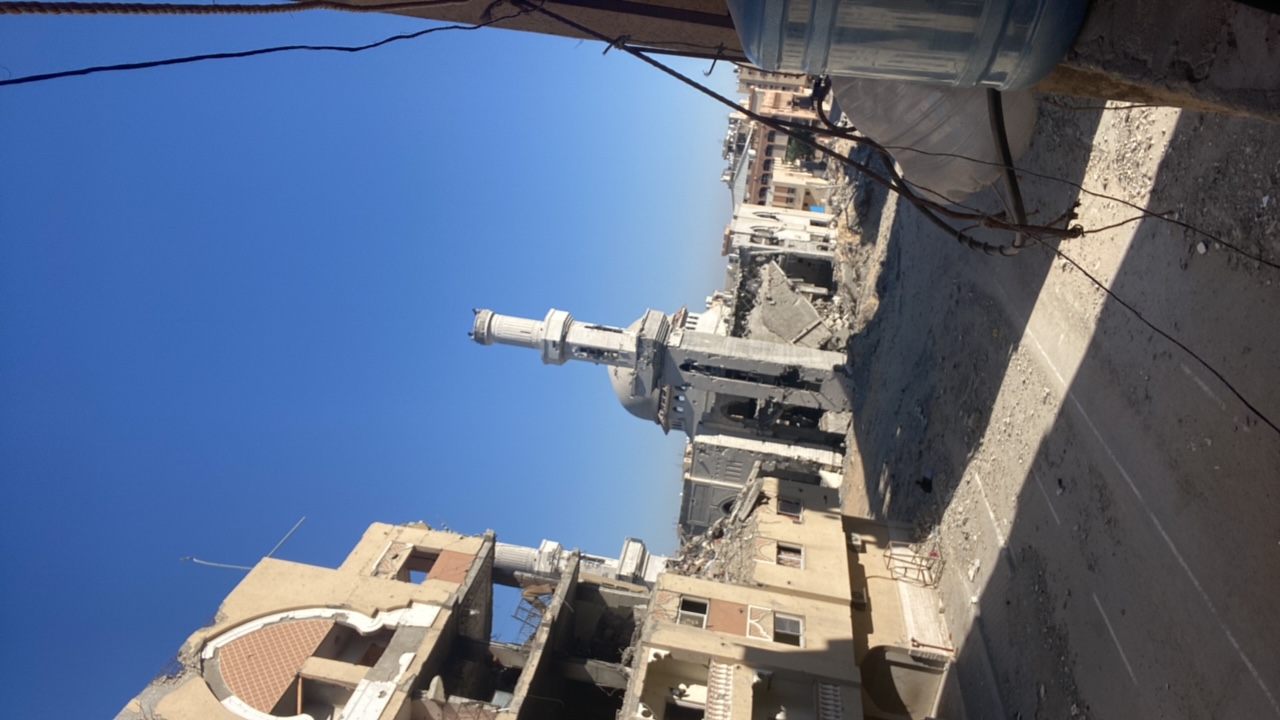
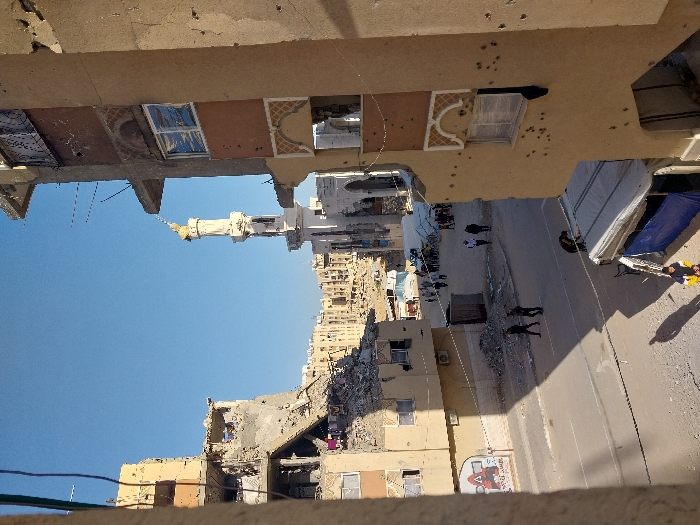
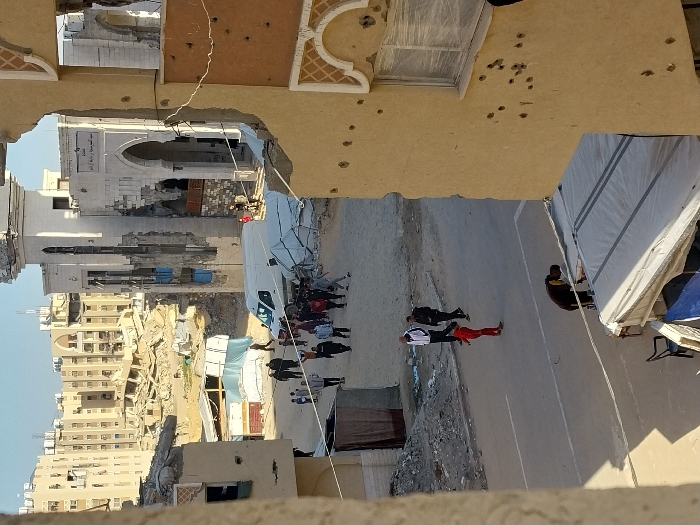
The image depicts a street scene with buildings in disrepair, possibly due to conflict or natural disaster. A mosque minaret rises in the distance. People walk along the street, and tents are set up along the side. The perspective is from an elevated position, looking down onto the street and surrounding buildings. Some structures are heavily damaged, with visible debris and structural damage. The sky is clear and blue.
reham
Khan Yunis, Palestinian Territory · Feb 22, 2026, 1:43 PM
The images collectively portray a powerful narrative of human presence in a harsh environment. Men are observed surveying the aftermath, their expressions reflecting the weight of loss and the ongoing struggle. Groups of people walk through debris-strewn landscapes, their collective journey a testament to an enduring spirit. Khan Yunis, though scarred, continues to breathe, showcasing the profound human capacity to adapt and carry on in the face of unimaginable adversity.

The scene reveals a street in a war-torn urban area. Buildings are damaged, with rubble visible. People are walking in the street alongside vehicles. Tents are erected on the right side of the street. Bullet holes mar the facade of a structure, suggesting recent conflict. Overall, the image depicts a scene of devastation and displacement.
reham
Khan Yunis, Palestinian Territory · Feb 22, 2026, 1:43 PM

The image depicts a desolate urban landscape showing extensive destruction, likely the aftermath of conflict or a major disaster. The scene is viewed from an elevated perspective, looking down and across a wide area. In the foreground, a concrete or stone ledge, partially out of focus, frames the bottom of the image. Directly below this ledge, on what appears to be a ground level amidst rubble, are several makeshift shelters or covered piles of belongings. These are made of tarpaulins, with one being blue and others grey or silver. The midground is dominated by a vast expanse of debris and open, sandy ground. To the left, a large area is completely leveled, covered by immense piles of pulverized concrete, twisted rebar, and assorted building wreckage. This suggests the complete collapse or demolition of structures. Adjacent to this rubble, a wide patch of uneven, sandy earth forms an open space, which appears to have been cleared or was once part of the destroyed area. More scattered rubble and debris line the edges of this sandy patch. In the background, a row of multi-story residential buildings stands, though many show significant signs of damage. These buildings are predominantly light brown or beige. Visible damage includes numerous shattered or missing windows, large holes in their facades, and dark impact marks on their exterior walls. Some sections of these buildings appear partially collapsed or severely compromised. On the rooftops, numerous black or dark-colored water tanks are visible, as are air conditioning units mounted on walls. One prominent building in the mid-left features a distinct, ornate arched architectural detail near its upper floors and hosts a tall communication tower with multiple antennas on its roof. Despite standing, these buildings convey a strong sense of abandonment and structural distress. The sky, visible in the upper left portion of the image, is clear and light blue, indicating fair weather and a bright daytime setting, likely late morning or early afternoon given the soft shadows. The overall impression is one of widespread devastation and silence, with no people or vehicles visible, emphasizing the scale of the destruction. No discernible text is visible within the image.
NERMEEN SALEH
Khan Yunis, Palestinian Territory · Feb 22, 2026, 2:58 PM

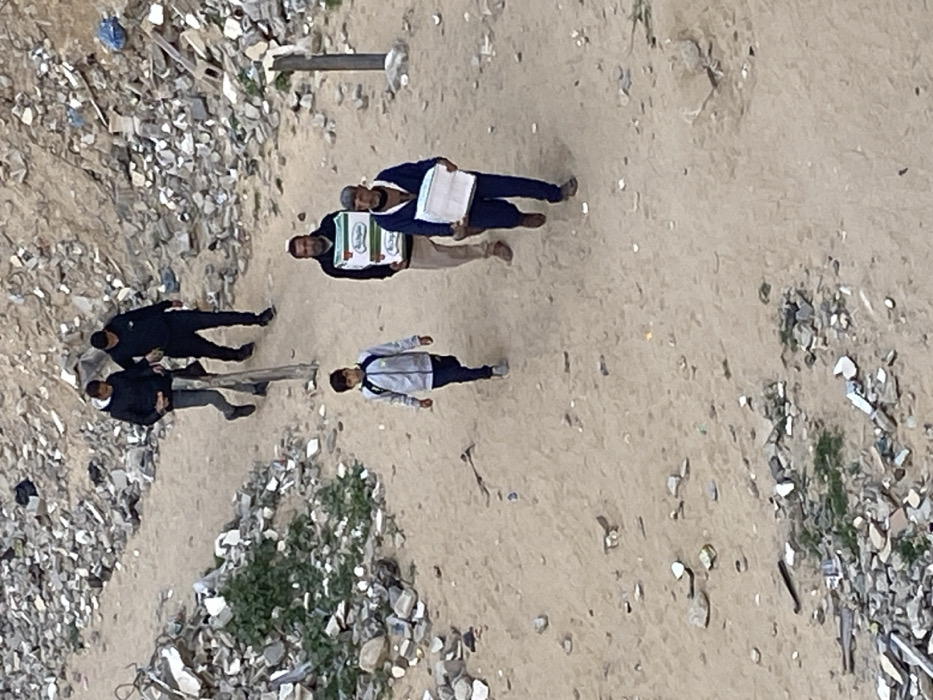
The image, captured from an elevated perspective looking down, shows five individuals on a sandy or dirt ground amidst scattered rubble and debris. For ease of description, the image will be described as if rotated 90 degrees clockwise, placing the sandy path horizontally across the scene. On the left side of the frame, two adult men are standing. The man further to the left, wearing a blue long-sleeved garment and a light-colored skullcap or kufi, has a beard and is holding a white, possibly folded, document or cloth in front of him. To his right and slightly in front, another adult man, also bearded and wearing a light-colored long-sleeved shirt, holds a white rectangular box or package with distinctive green designs and faint text, possibly in Arabic. The green design features what appears to be a leaf or plant motif. In the middle of the sandy path, a young male, likely a child or teenager, stands alone. He is wearing a grey and white track jacket over a darker shirt and dark trousers. His gaze seems directed towards the two men on the left with the packages. Further to the right, near a significant pile of rubble, stand two more adult men. Both are dressed in dark long-sleeved tops and dark trousers. The man in front is facing generally towards the center of the image, while the man behind him is partially obscured. The ground consists largely of sand or light-brown dirt, with extensive amounts of light-colored rubble, broken concrete, and other debris scattered across the scene, particularly in the top left (which would be the upper part of the image when rotated upright) and bottom right corners. There are also small patches of green vegetation growing amongst the debris. The overall setting suggests a desolate, possibly damaged or neglected area. The lighting indicates daylight, but the specific time of day is not discernible. No strong shadows are visible, suggesting either an overcast sky or an overhead sun. No specific emotions are clear on the faces of the individuals due to the distance and resolution. The visible text on the white box is too indistinct to be fully read but appears to be in Arabic.
NERMEEN SALEH
Khan Yunis, Palestinian Territory · Feb 22, 2026, 2:58 PM
The image presents a desolate urban landscape marked by extensive destruction. Multiple multi-story buildings, constructed primarily of concrete, dominate the scene. Many of these structures exhibit severe damage: windows are shattered or missing, exposing dark interiors; sections of walls have collapsed, revealing rebar and debris; and facades are peppered with small, dark pockmarks, consistent with bullet holes or shrapnel impacts. In the center of the image, a massive pile of rubble, composed of concrete slabs, twisted rebar, and pulverized building materials, signifies the complete collapse of one or more structures. This debris stretches across the mid-ground, separating the more intact buildings from a large, sandy expanse in the foreground and to the right. The ground in this sandy area is light brown and appears mostly barren, though scattered pieces of smaller debris and gravel are visible. A blue tarp or fabric lies near the edge of the rubble pile closest to the sandy ground. Three individuals, all appearing to be adult males dressed in dark clothing, are present in the sandy area. One man stands alone in the middle of this open space, facing away from the camera, seemingly observing the devastation. Further to the right, closer to the rubble, two other men are seen; one appears to be standing, while the other is less distinct, possibly bent over or sitting. Their presence suggests they are surveying the aftermath of the destruction. The sky above is clear and light blue, indicating fair weather. The sunlight casts soft shadows and has a slightly warm hue, suggesting either early morning or late afternoon. On the roof of one of the prominent, taller buildings in the mid-ground, a large antenna or cell tower structure is clearly visible, along with multiple external air conditioning units on its windows. The overall scene conveys a profound sense of devastation and the quiet aftermath of a destructive event, likely a conflict or disaster. There is no visible text in the image.

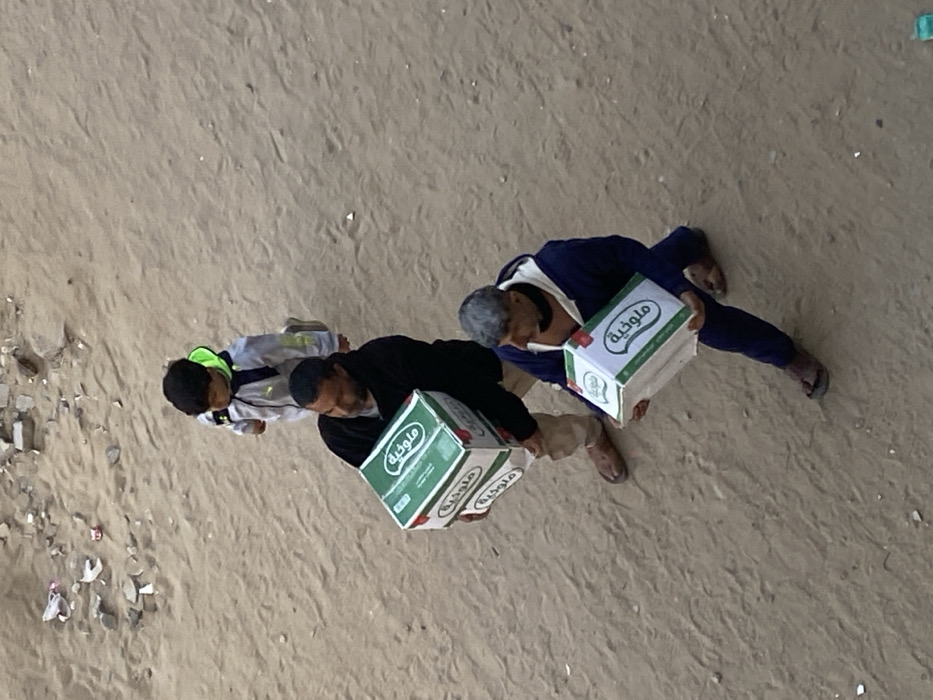
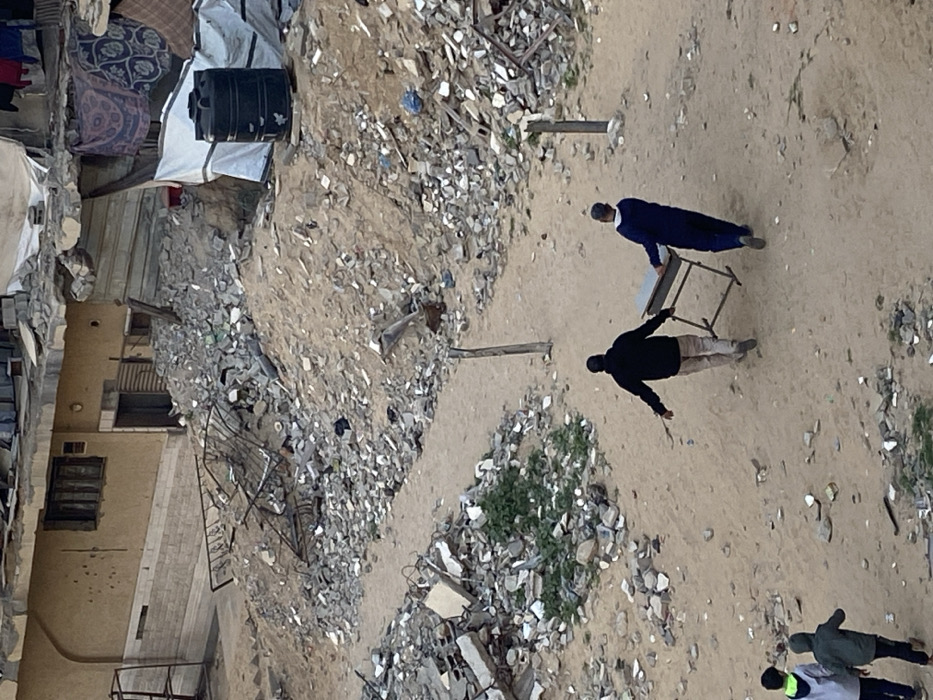
The image presents a high-angle view, looking down at three individuals — two adult men and one child — walking across a sandy or dusty outdoor terrain. The setting appears unpaved and somewhat rugged. To the left, a child is visible, wearing a light-colored long-sleeved top with a bright neon green hood or collar. The child's back is mostly to the viewer, and they appear to be walking in the same general direction as the adults. In the center, an adult man is seen from a slightly elevated, overhead perspective. He wears a black long-sleeved shirt and light-colored trousers. He is actively carrying a stack of at least two white cardboard boxes in his arms. To the right, another adult man is also seen from a similar high angle. He has short, gray hair and is wearing a dark blue long-sleeved top, possibly with a white undershirt or hood lining visible. He is also carrying a stack of at least two white cardboard boxes, identical to those carried by the other man. His footwear appears to be sandals or flip-flops. Both stacks of boxes prominently display green branding and Arabic text. The visible text on the boxes clearly reads "ملوخية" (Molokhia), indicating the contents are Molokhia, a leafy green vegetable used in Middle Eastern and North African cuisine. The ground is predominantly a light tan or beige color, characteristic of sand or dry earth, with some subtle undulations. In the lower-left portion of the frame, there is a scattering of small debris, including what looks like fragments of concrete or rubble, mixed into the sand. The individuals appear to be in motion, transporting these boxes across the open area. The lighting suggests it is daytime, with a relatively even distribution of light, consistent with an overhead perspective. Their faces are largely obscured due to the angle and their downward gaze or the items they are carrying, making their expressions unclear. The scene depicts a moment of physical labor or transport activity.
Khan Yunis, Palestinian Territory · Feb 22, 2026, 2:59 PM
This image depicts a multi-story building in Khan Yunis, Palestinian Territory, exhibiting extensive structural damage. The light-colored building, approximately six to seven stories tall, is heavily pockmarked with numerous bullet holes and larger impact craters across its facade. Many windows are shattered, missing, or boarded up, exposing interiors filled with debris. Several balconies show visible damage, with some areas appearing charred and sections of laundry hanging on lines. The rooftop features multiple communication antennae and white water tanks. The ground in front of the building is a desolate expanse of sand and construction rubble. A severely damaged white sedan, appearing crushed and twisted, lies amidst the debris in the mid-ground. Five individuals are visible on the ground: three in the lower left corner, one of whom is in mid-stride, seemingly kicking an object on the ground. A fourth individual walks towards the right in the central foreground. Two other individuals are seated on the sandy ground to the left of the crushed car. The environment is characterized by widespread destruction and debris.

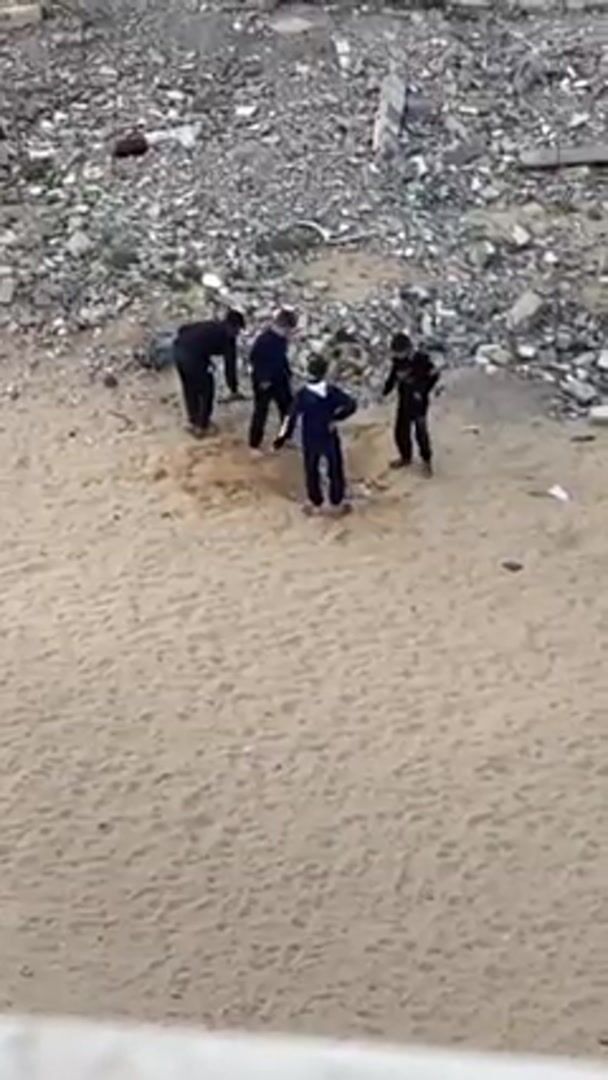
The image presents an aerial or high-angle view of five young individuals standing on a sandy area, which borders a vast expanse of debris and rubble. The scene suggests a desolate environment, possibly a demolition site, a neglected urban area, or a region affected by conflict. The ground is sharply divided: - On the left side, there is a large collection of broken concrete, rocks, and fragmented building materials, forming a barren and chaotic landscape. - On the right side, a wide stretch of light brown sand covers the majority of the frame. Numerous footprints are visible on the sand, indicating recent activity. Scattered small pieces of litter, such as paper or plastic, can also be seen on the sandy surface. Five individuals, appearing to be young males (children or teenagers), are present in the image. They are all standing on the sandy ground, generally positioned near the boundary with the rubble. Their attire is casual. From left to right across the image: 1. The leftmost person wears a dark blue long-sleeved shirt and matching dark blue trousers. He stands facing slightly to the right of the frame. 2. Next to him, slightly further back, is another individual in a dark blue long-sleeved shirt, which features a white number "7" on the chest, and dark blue trousers. He also faces towards the right. 3. The third person from the left wears a dark black long-sleeved top and black pants. His head is turned towards the left side of the frame. His right arm is slightly extended downwards. 4. Standing directly to the right of this person is another individual, dressed entirely in black, including a long-sleeved top and pants. He is carrying a light-colored, possibly deflated, spherical object that resembles a ball, tucked under his right arm. He wears a dark cap or hat and light-colored sandals. He is facing towards the left. 5. The fifth individual, furthest to the right, is wearing a light blue hooded sweatshirt with the hood up, and dark pants. He also faces towards the left. He is wearing brown shoes. The individuals do not appear to be engaged in a specific, unified activity. They seem to be standing, possibly conversing, or in the process of moving through the area. The presence of the ball might suggest recreational activities, though the overall backdrop is somber. The lighting indicates it is daytime, with soft shadows suggesting either morning or afternoon. There are no clear indications of extreme weather conditions. No discernible text is visible in the image. The general impression is one of human presence in a harsh, possibly damaged, landscape.
NERMEEN SALEH
Khan Yunis, Palestinian Territory · Feb 22, 2026, 2:59 PM
The scene in Khan Yunis, Palestinian Territory, under a clear sky, shows a severely damaged urban landscape. In the background, multi-story, light brown residential buildings display extensive structural damage, including numerous impact holes, shattered windows, and partially collapsed sections; a cellular tower stands on one rooftop. The midground contains a substantial mound of concrete rubble from demolished structures and a cluster of approximately ten makeshift tents, constructed from various tarpaulins (blue, tan, grey), on sandy terrain. Several indistinct individuals are present near these tents. The immediate foreground consists of sandy earth with minimal vegetation and a large object covered by a black tarp.

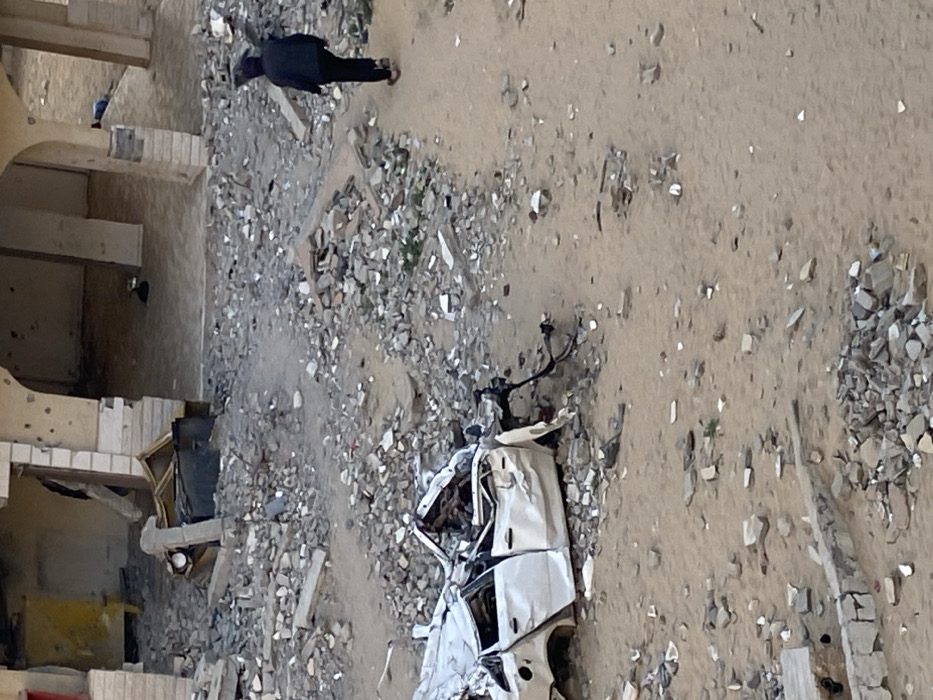
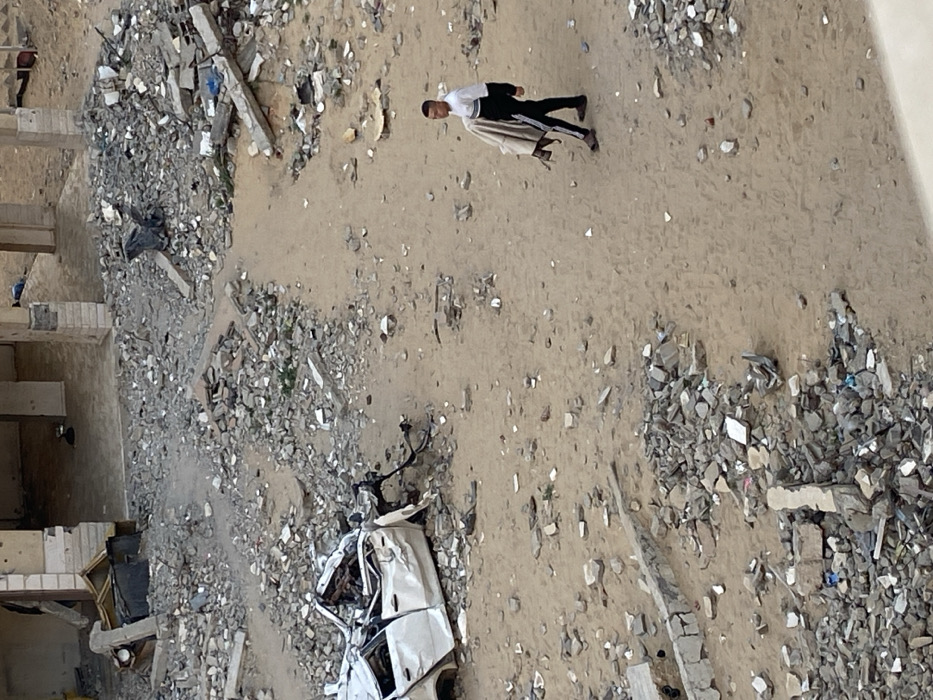
The image displays an outdoor scene of extensive destruction and rubble, likely an aftermath of a significant event like a conflict or natural disaster. The image is oriented sideways, but when viewed upright, it shows a sandy, unpaved ground covered almost entirely by a dense layer of varied debris. In the upper-middle section of the image, a person is standing amidst the rubble. They are dressed in dark clothing, possibly a dark top or jacket, paired with light-colored trousers, and light-toned footwear. The person's posture suggests they are either standing still or slowly moving through the difficult terrain. To the right and slightly below the person, a severely damaged white vehicle, identifiable as a car, lies in a crumpled and mangled state. Its bodywork is extensively destroyed, with parts ripped away, and internal components, such as twisted metal and wiring, are exposed. The vehicle is a wreck, flattened and distorted by impact or collapse. The ground throughout the scene is dominated by debris. This includes countless fragments of broken concrete, bricks, plaster, and other building materials, varying in size from small pieces to larger chunks. Mixed in are what appear to be shattered glass, twisted metal scraps, and general refuse, indicating widespread structural failure. On the left side of the image, the remains of damaged buildings are visible. These structures appear to be made of light-colored material, possibly stucco or concrete blocks. They show significant signs of damage, with large sections missing, walls perforated, and interiors exposed. One section of a building features a distinct arched opening. The architectural style, combined with the sandy ground, hints at a possible location in the Middle East or North Africa. The lighting suggests it is daytime, with soft shadows indicating either an overcast sky or the sun being not directly overhead. The overall atmosphere is one of desolation and the quiet aftermath of devastation. There is no discernible text visible in the image.
NERMEEN SALEH
Khan Yunis, Palestinian Territory · Feb 22, 2026, 2:59 PM
The aerial shot reveals a desolate landscape of debris next to a damaged building. Several bodies are scattered across the rubble and sandy ground, suggesting a scene of devastation and loss. The overall tone is somber, with the destruction and presence of bodies painting a grim picture.

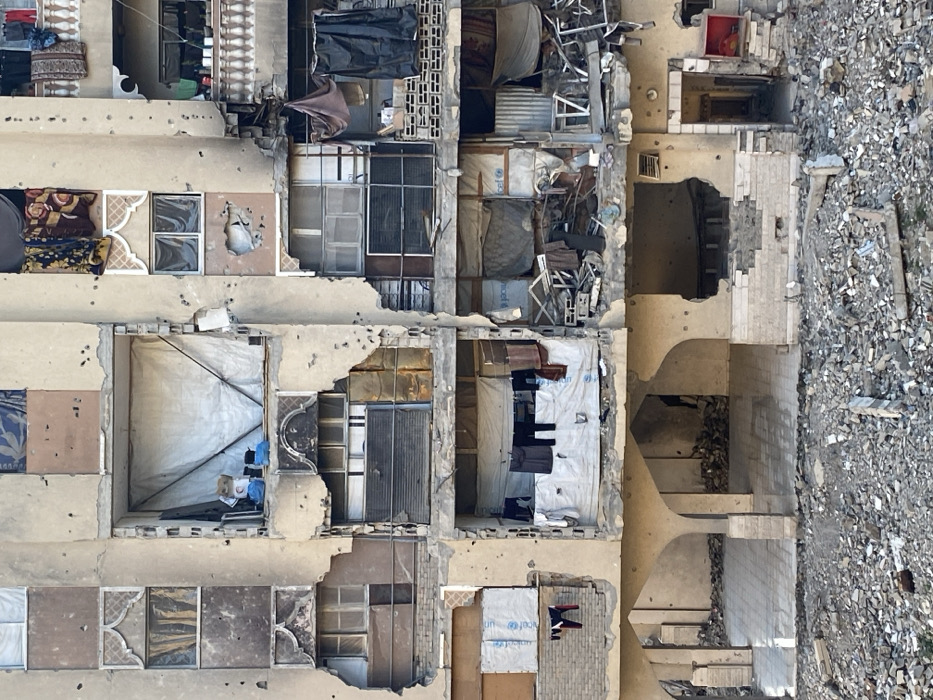
This image presents a high-angle or aerial view looking down into multiple floors and sections of severely damaged multi-story buildings, likely residential. The overall scene conveys widespread destruction and makeshift adaptations in what appears to be an urban environment affected by conflict or disaster. The image is oriented such that the buildings appear to lie on their left side, with the street level or a large pile of rubble running vertically along the right edge. The structures are predominantly made of concrete or plaster, painted in muted beige and grey tones. Extensive damage is visible across all sections: * **Walls:** Many walls are crumbling, with plaster stripped away to expose underlying concrete and structural elements. Numerous small, dark holes consistent with bullet or shrapnel impacts are scattered across many surfaces. * **Windows:** Many window openings are empty, lacking glass or frames, while others contain broken panes or makeshift coverings. * **Overall Structural Integrity:** While some sections of the buildings remain standing, the adjacent area to the right is reduced to a vast pile of pulverized concrete and debris, suggesting a significant collapse. **Visible Details by Section (from top-left to bottom-right):** * **Top Left Section:** Shows a room or open area containing several patterned blankets or textiles, possibly bedding, piled against a wall. The surrounding walls are damaged and pitted. * **Upper Middle Section:** Features a room covered by a dark tarp, and next to it, a room filled with miscellaneous clutter, including metal frames and what appears to be a white plastic chair. A blue tarpaulin with the white "UNICEF" logo is prominently draped over items in this cluttered space. * **Upper Right Section:** This area transitions into the large, extensive pile of light-colored rubble, indicating a completely destroyed section or adjacent structure. Deeper, dark recesses suggest collapsed internal spaces. * **Middle Left Section:** A room with patterned floor tiles or wall coverings and what looks like a broken window with decorative arch patterns. The exterior wall here is heavily peppered with impact marks. * **Central Section:** Includes rooms with broken or boarded-up windows and dark-colored, possibly metal, door structures. One room is largely covered by a large white sheet or tarp, stretched to form a temporary ceiling or wall, with a blue object visible inside. Another room appears to have clothes hanging on a line or draped over items, also partially covered by a white sheet. * **Lower Right Section:** Continuing the theme of makeshift living, a section is partially covered by a white tarp, featuring another "UNICEF" logo in blue. A red object, possibly a piece of furniture, is visible near the bottom right corner of this section. The massive rubble pile continues along the far right edge of the image. **Notable Details:** * **Makeshift Living:** The repeated use of tarpaulins and sheets, some bearing the UNICEF humanitarian aid logo, strongly suggests that these damaged structures are either being used as temporary shelters or are being salvaged. * **Evidence of Conflict:** The pervasive bullet/shrapnel holes and extensive structural damage point to a recent conflict or violent event. * **Personal Belongings:** The presence of blankets, clothes, and various household items indicates that the area was inhabited or is still being used despite the devastation. * **Perspective:** The high-angle view provides an unusual cross-sectional insight into the interior spaces of the damaged buildings. The lighting suggests it is daytime, with diffused light illuminating the scene, preventing harsh shadows. No specific location is identifiable beyond it being an urban, war-affected, or disaster-stricken area.
NERMEEN SALEH
Khan Yunis, Palestinian Territory · Feb 22, 2026, 3:00 PM
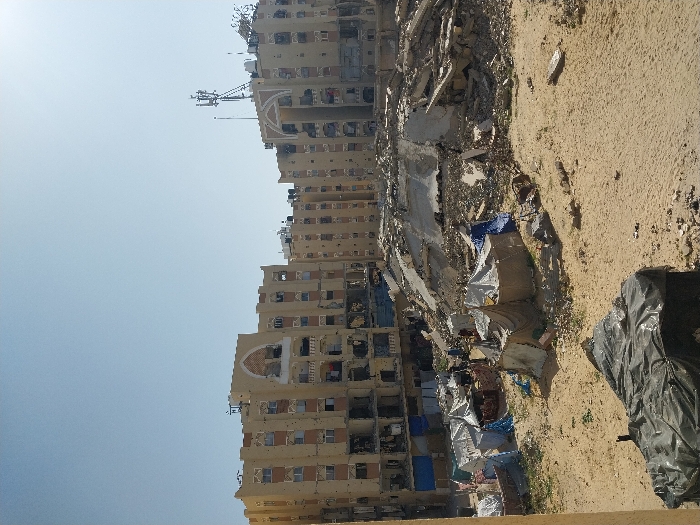
The image depicts a street scene with buildings in disrepair, possibly due to conflict or natural disaster. A mosque minaret rises in the distance. People walk along the street, and tents are set up along the side. The perspective is from an elevated position, looking down onto the street and surrounding buildings. Some structures are heavily damaged, with visible debris and structural damage. The sky is clear and blue.
Five young people are gathered on a sandy area next to a rubble-strewn patch. One is wearing a light-colored hat and a dark jacket with a light-colored stripe along the sides of the arms. One is wearing a dark jacket and dark pants. One is wearing a dark jacket, dark pants, and white socks. The other two are wearing dark clothing. Suddenly there is a loud popping noise and the young people scatter, then huddle back together. The rubble-strewn patch is composed of concrete, bricks, trash, and other debris.
NERMEEN SALEH
Khan Yunis · Feb 22, 2026, 3:00 PM

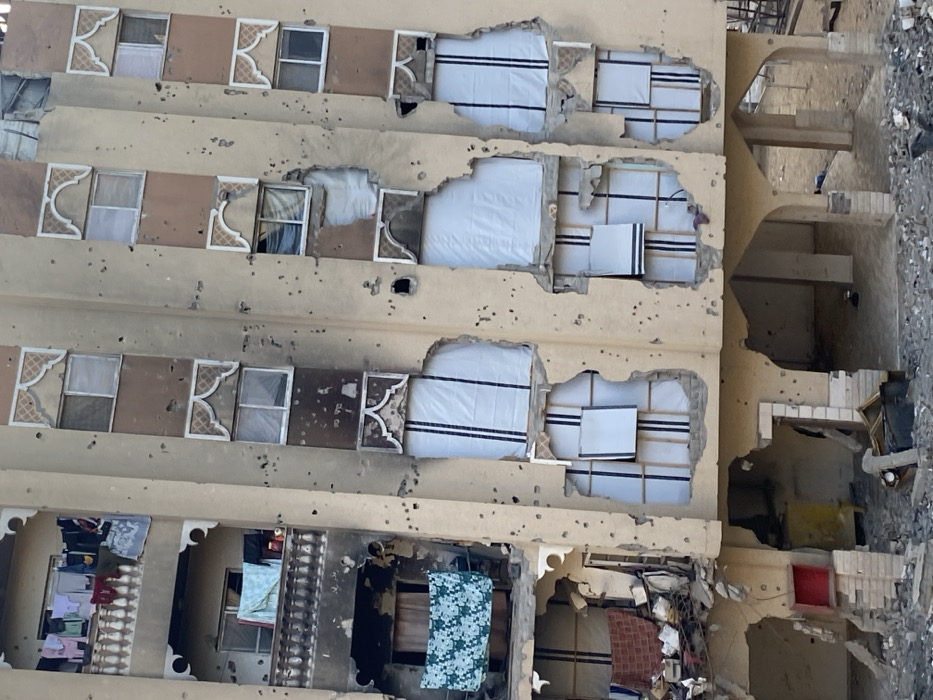
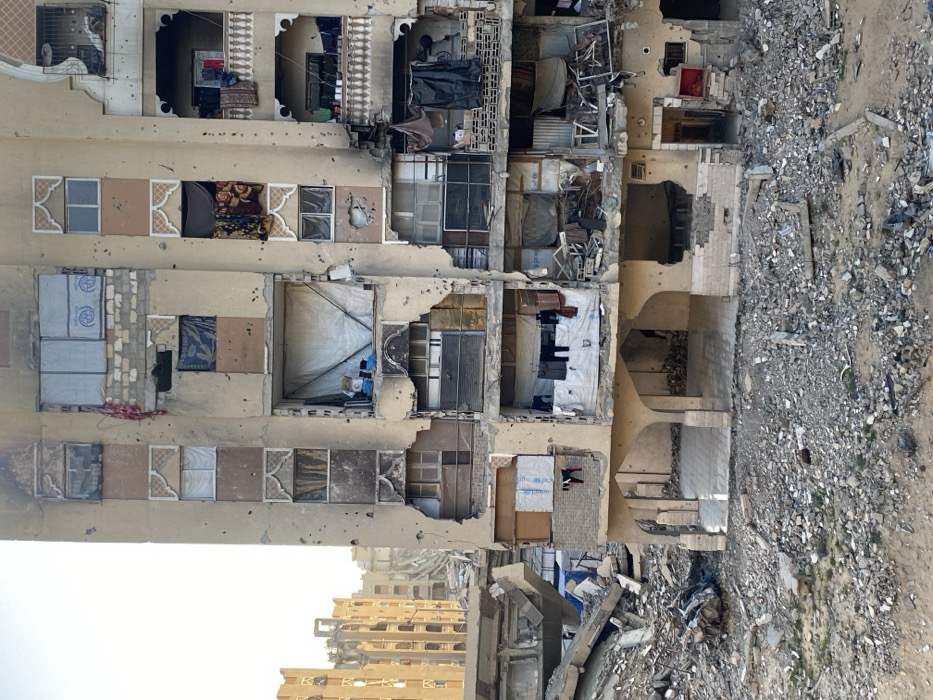
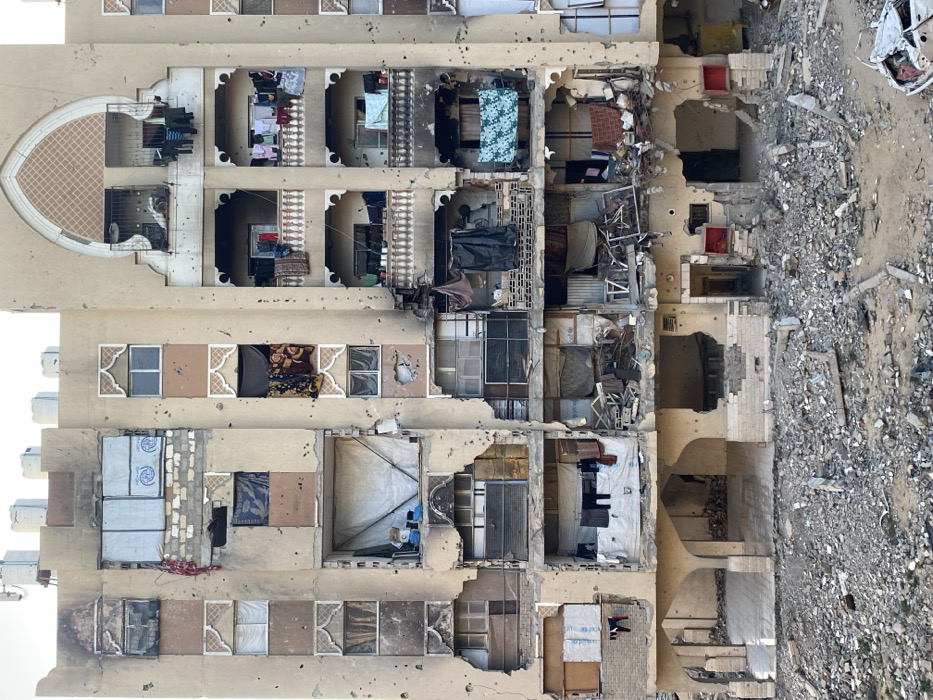
A damaged building with several floors shows signs of war. Windows are missing, and some have been patched with white material. Clothes hang from balconies, contrasting with the building's destruction marked by bullet holes and structural collapse. A section of the building's side has been completely destroyed, exposing interior spaces. Debris surrounds the building's base.
NERMEEN SALEH
Khan Yunis, Palestinian Territory · Feb 22, 2026, 3:00 PM

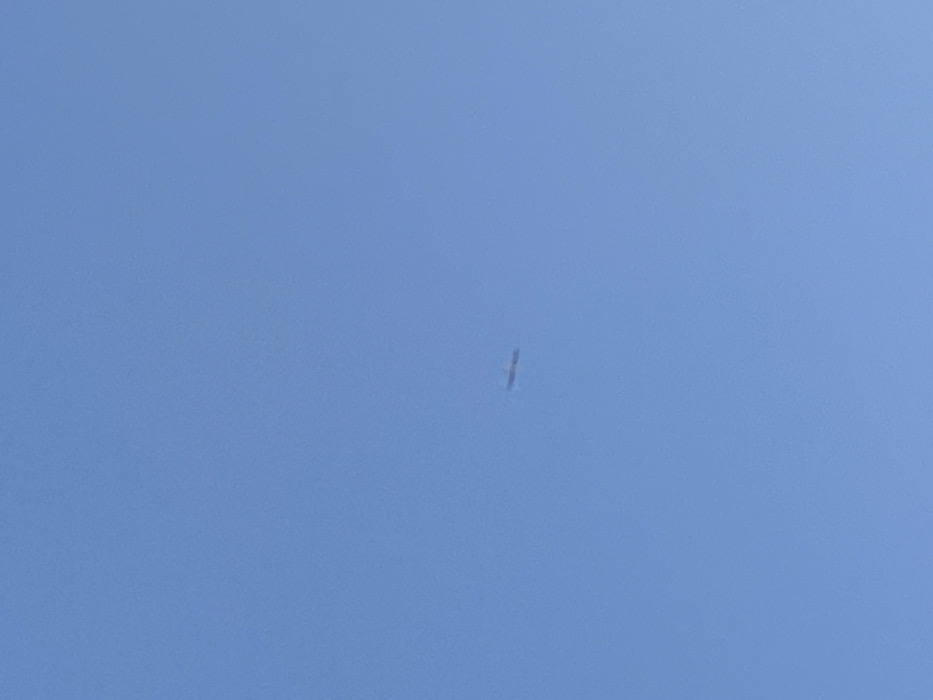
A single, thin object is suspended in a clear, blue sky. The object appears elongated and dark against the uniform backdrop. It's oriented vertically in the frame. The surrounding sky is smooth and featureless, emphasizing the singularity of the object's presence. The object is relatively small in the frame, implying it is at a great distance.
NERMEEN SALEH
Khan Yunis, Palestinian Territory · Feb 22, 2026, 3:01 PM

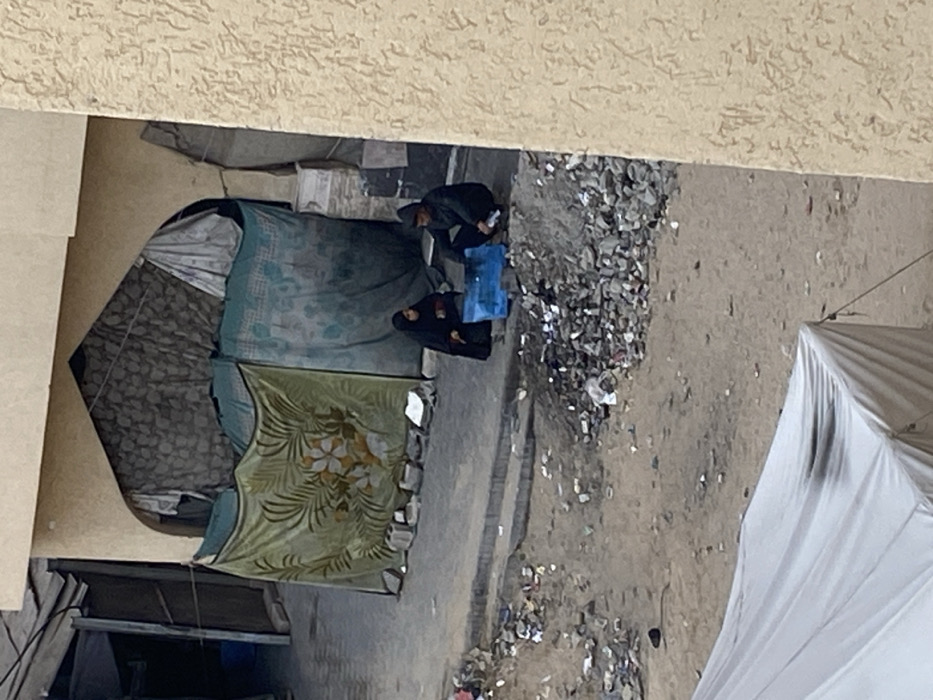
The image displays an outdoor scene, viewed from an elevated perspective, looking down onto a ground-level area. The setting appears to be a neglected or makeshift living space. On the left side of the frame, a textured, light-colored wall of a building is visible. Against this wall, a makeshift sleeping or resting area is set up on the ground. This area is covered with several fabric items: a dark grey patterned blanket or tarp serves as a base, topped with a blue-green blanket featuring a subtle design. Adjacent to this, an olive-green blanket with a prominent floral pattern of white flowers and green foliage is spread out. Two individuals are present near this improvised sleeping arrangement. Both are dressed in dark, loose-fitting clothing. One person is in a stooping or kneeling position, facing away from the viewer, seemingly interacting with something on the ground near their feet. A bright blue reusable bag rests on the ground beside them. The second person is sitting or kneeling closer to the green patterned blanket, also in dark attire. The ground covering most of the central and right portions of the image is a light brown, dusty or sandy surface. A large pile of debris, consisting of what appears to be broken concrete, rocks, and various pieces of trash (such as plastic bags and wrappers), is concentrated in the middle ground and scattered across the area. This indicates a heavily littered and unkempt environment. In the lower right corner of the image, a section of a white, fabric tent-like structure or tarp is visible, further suggesting a temporary or informal settlement. The lighting indicates it is daytime, though direct sunlight is not apparent, suggesting either an overcast sky or a shaded area. No discernible text is visible anywhere in the image. The overall impression is one of a harsh or improvised living condition in an outdoor, debris-strewn space.
NERMEEN SALEH
Khan Yunis, Palestinian Territory · Feb 22, 2026, 3:02 PM

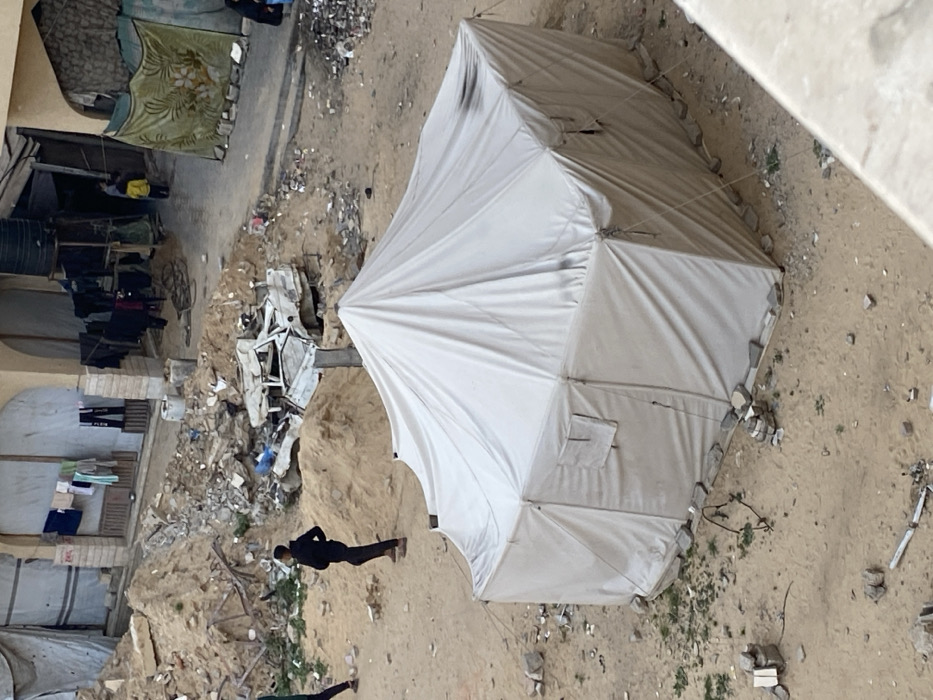
The image captures an outdoor scene, rotated approximately 90 degrees counter-clockwise, depicting a makeshift encampment or an area affected by disarray, viewed from a high vantage point looking downwards. In the foreground and center-right of the rotated image, a large, white, polygonal tent stands prominently on sandy, dusty ground. The tent appears to be made of canvas or a similar material, with visible seams and support poles. Its base is secured by numerous stones placed along the perimeter, holding down the tent fabric or guy lines. Small, rectangular flap-like features, possibly vents or windows, are visible on some of its panels. The ground around the tent and extending throughout the visible area is mostly sandy or dirt, interspersed with a significant amount of debris. This debris consists of broken concrete pieces, small rocks, dirt mounds, and scattered refuse, creating a rugged and unkempt environment. Small patches of green vegetation manage to grow in some areas of the sandy ground. To the left and further back from the tent, several structures are visible. These appear to be parts of buildings or makeshift shelters. One structure has a green blanket with a floral pattern draped over an opening, serving as a covering. Nearby, laundry is seen hanging on lines to dry, indicating human habitation. A black water barrel is also visible in this area. In the mid-ground, a severely damaged white vehicle, possibly a car or van, is distinguishable amidst a large pile of rubble and debris. Its frame is twisted and broken, suggesting it has been wrecked or abandoned. Two individuals are present in the scene, appearing as dark silhouettes against the lighter ground. One person, wearing dark clothing, stands upright in the mid-ground, facing away from the viewer, positioned between the tent and the damaged vehicle. Another person is partially visible further to the lower left. The lighting suggests it is daytime, possibly morning or afternoon, with a generally bright but diffused light, as there are no harsh shadows. No specific text is visible in the image. The overall atmosphere conveys a sense of hardship, displacement, or recovery in a challenging environment.
NERMEEN SALEH
Khan Yunis, Palestinian Territory · Feb 22, 2026, 3:02 PM

The image depicts a scene of extensive urban destruction and makeshift living conditions under a clear sky. On the left side of the frame, several multi-story residential buildings stand, though many show significant damage. Their facades, made of light-colored material, are pockmarked with holes, and numerous windows are broken or missing, revealing darkened interiors. Some sections of these buildings appear to be structurally compromised, with visible concrete and rebar. One building features a distinctive arched design near its roofline. Rooftops are cluttered with antennas, satellite dishes, and water tanks. Stretching across the middle of the image, between the damaged buildings and the foreground, is a wide expanse of rubble and debris. This area consists of a chaotic mix of broken concrete slabs, twisted metal, bricks, and other construction materials, indicating a recently demolished or collapsed structure. The ground here is uneven and covered in pulverized remnants of buildings. In the right foreground and extending towards the middle ground, a sandy, unpaved area is visible. Scattered across this sandy terrain are numerous makeshift shelters or tents. These temporary structures are constructed from various materials, including blue, white, grey, and black tarpaulins, as well as sheets of corrugated metal. They appear to be hastily assembled and vary in size and shape, suggesting temporary dwelling or displacement. Some fabric items, possibly laundry or blankets, are draped near these shelters. A large black tarpaulin structure is prominent in the bottom right corner of the frame. The sky overhead is a clear, light blue, suggesting daylight hours. The lighting appears bright, casting soft shadows, consistent with late morning or early afternoon. There are no visible people or discernible text within the image. The overall impression is one of widespread devastation and resilience in the face of destruction, with temporary housing emerging amidst the ruins of what were once permanent structures.
NERMEEN SALEH
Khan Yunis, Palestinian Territory · Feb 22, 2026, 3:03 PM

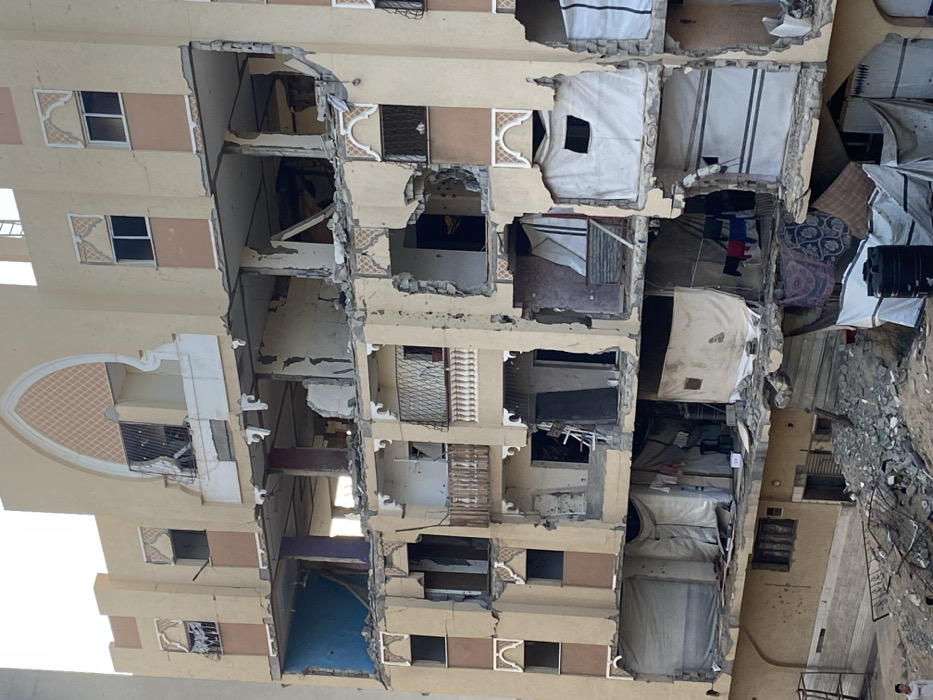
The image depicts a multi-story building, severely damaged, likely from conflict or a major explosion. The building appears to be made of light-colored (beige or tan) concrete or stucco, with decorative architectural elements around some windows and balconies, including arched patterns. The image is oriented such that the building stands tall vertically, with the ground level on the far right. The extent of the damage varies significantly across the building. The right side of the building, which would be the front or a side facade facing an impact, is largely destroyed, with massive sections of walls and floors missing. This exposes the internal structure and contents of multiple rooms across several stories. This area is reduced to a chaotic pile of rubble, broken concrete, twisted rebar, and debris at what would be ground level. Moving left from the most damaged section, the destruction gradually lessens, but the entire structure bears scars. Many windows are shattered or completely missing, with some openings covered by blankets, tarps, or makeshift materials. Small, circular impact marks, possibly from bullets or shrapnel, are scattered across the facade. Across the visible stories, numerous residential units are exposed. Inside these units, remnants of daily life are visible amidst the devastation. In some rooms, laundry hangs on lines, suggesting continued habitation or recent activity. Other rooms contain jumbled furniture, personal belongings, mattresses, and various household items. Tarps and sheets are used as temporary coverings or partitions in several damaged units. On the second and third floors from the top, toward the center-left, clothes are clearly seen drying on a line. On a lower floor, a blue patterned blanket is visible, and further down, a large white tarp covers a room. On the bottom-left section of the building, several blue and white containers or packages are visible, bearing the "UNICEF" logo and text, indicating humanitarian aid. The top of the building features visible antenna structures or similar equipment. The overall scene conveys a sense of destruction and resilience. The lighting is bright and even, indicating daytime conditions. There is no visible text apart from the "UNICEF" logo on the aid packages.
Khan Yunis, Palestinian Territory · Feb 22, 2026, 3:03 PM

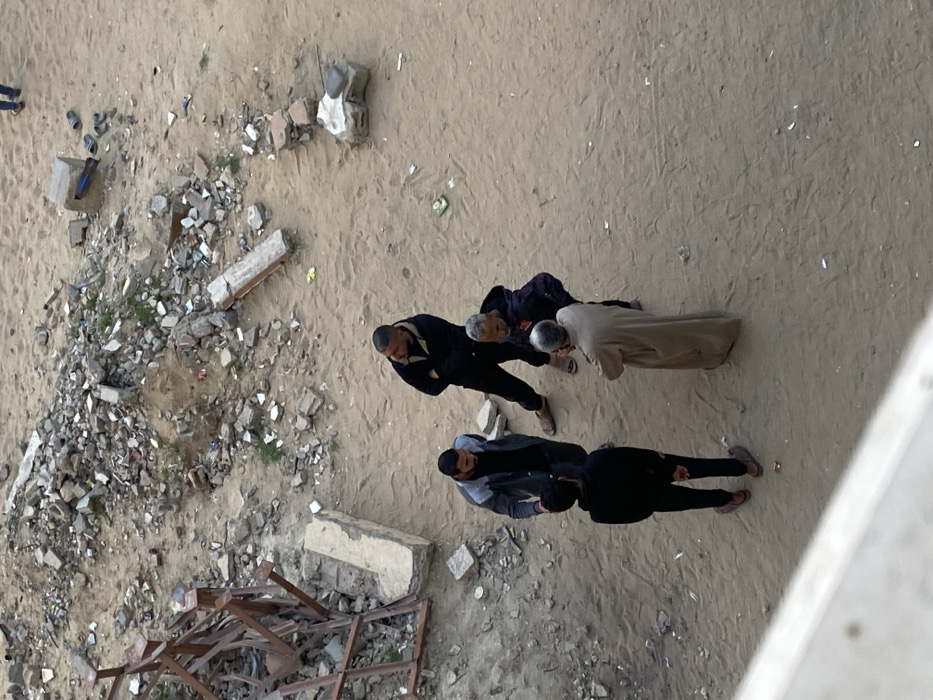
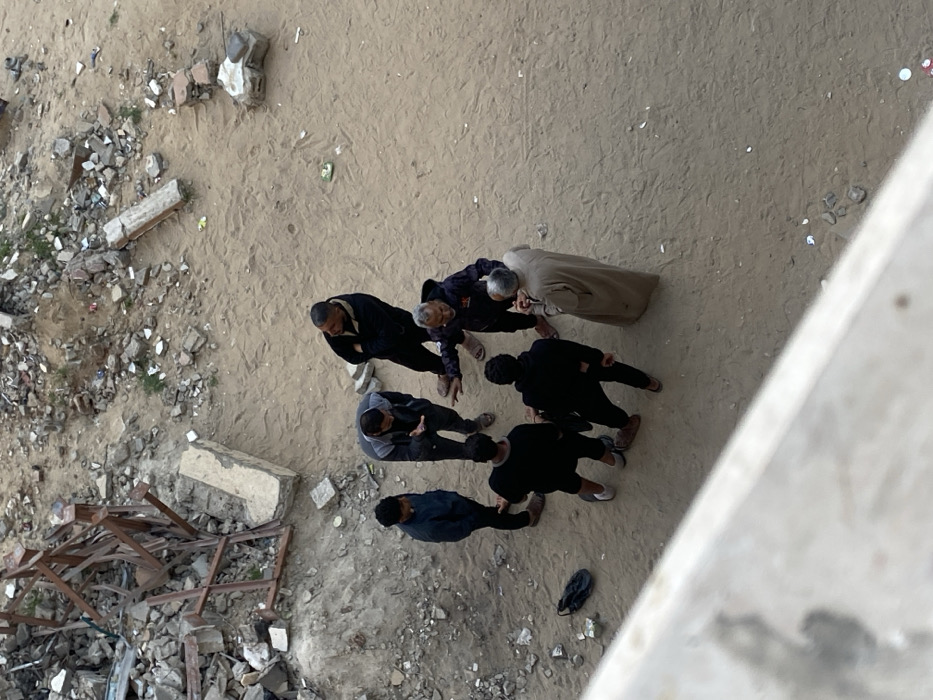
The image presents an overhead view of an outdoor scene, likely taken from a window or balcony looking down onto a ground area. The image is oriented with a roughly 90-degree clockwise rotation, making the people appear to be standing sideways relative to a typical upright viewing. The ground surface is predominantly light brown, appearing to be sand or dirt. A significant portion of the left side of the frame is covered in various forms of debris, suggesting an area that is either under construction, undergoing demolition, or simply an undeveloped and unkempt plot of land. This debris includes numerous broken concrete blocks, smaller pieces of rubble, some patches of sparse green vegetation growing through the cracks, and a partially collapsed metal structure, possibly rebar or a frame, located in the lower left corner. Scattered small pieces of trash or remnants are also visible across the sandy ground. On the far upper left, only the feet and lower legs of one or two additional individuals are partially visible, clad in shoes or sandals. Towards the right side of the frame, five men are gathered on the clear sandy ground. Three men are clustered together in what would be the upper right section of a re-oriented image. One man wears a light beige or off-white, long, loose garment (possibly a thobe) and appears to be slightly bent forward or looking down at the ground. Next to him, two other men, both with grey hair and wearing dark jackets or shirts, are standing. One is looking towards the man in the thobe, while the other is looking across the scene towards the left. Slightly further down and to the right from this group, two more men are standing. Both are dressed in dark jackets and trousers. One man has a beard and is looking downwards and slightly to his left. The second man stands slightly behind him, also appearing to look towards the ground. The men appear to be casually gathered, possibly engaged in conversation or observing something on the ground beneath them. Their posture and gazes are generally directed downwards. The overall lighting suggests it is daytime, with relatively soft shadows, but the exact time of day or weather conditions are not distinctly apparent. There is no visible text in the image. A light-colored wall or structure is visible along the far right edge of the frame, indicating the boundary from which the photograph was taken.
NERMEEN SALEH
Khan Yunis, Palestinian Territory · Feb 22, 2026, 3:04 PM

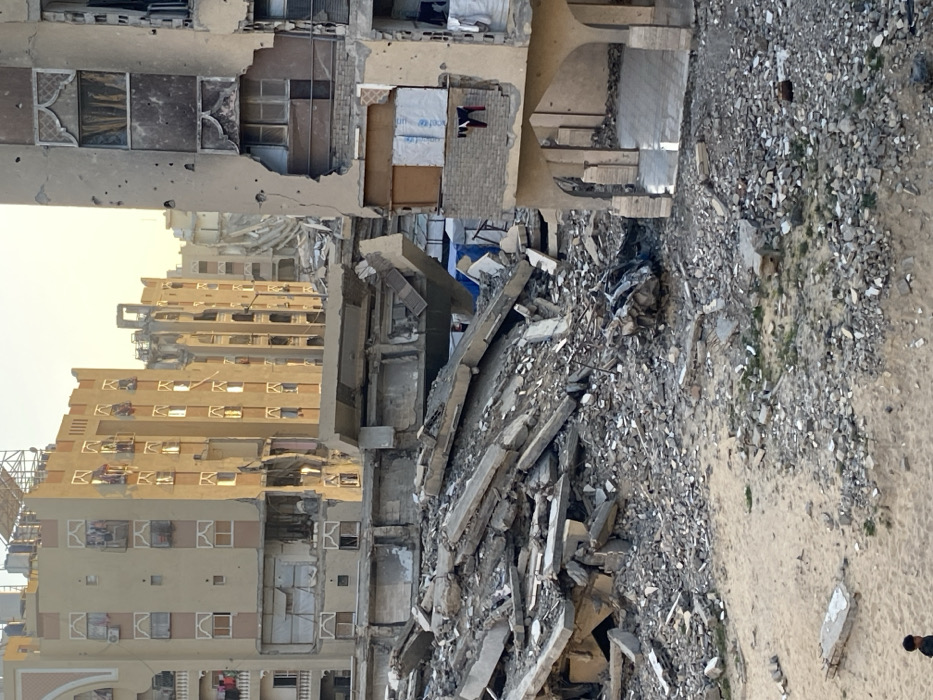
The image depicts a scene of extensive urban destruction, likely a consequence of conflict or disaster, under a clear, bright sky. The perspective is slightly elevated, looking down over a landscape of ruined buildings and debris. In the background and mid-ground, a series of multi-story buildings line what appears to be a street or pathway. Many of these buildings show significant damage: numerous windows are shattered or missing, exposing interior rooms; facades are scarred with visible holes and impact marks; and some sections appear partially collapsed. The buildings are primarily light-colored, possibly concrete or stucco, with multiple balconies and rectangular window openings. On the roof of one of the more central buildings, a communication tower or antenna structure is visible. The lighting suggests late afternoon or early morning, with the sun casting a warm glow on some of the building surfaces and the sky transitioning from a brighter hue near the horizon to a deeper blue overhead. Dominating the mid-ground and extending into the foreground on the left is a massive pile of rubble, concrete slabs, twisted rebar, and other debris, indicating the complete collapse of one or more structures. This debris field is extensive, creating an impassable barrier. Adjacent to this rubble, closer to the foreground, are several makeshift shelters or covered structures made of tarpaulins (blue and grey) and corrugated metal, suggesting temporary habitation or storage in the midst of the destruction. To the right of the central debris field, a large, relatively flat expanse of sandy, dusty ground is visible, interspersed with smaller pieces of rubble and debris. Four individuals are present on this sandy ground in the mid-ground right. They appear to be walking or standing, dressed in dark clothing. Their posture suggests movement across the damaged landscape. The overall impression is one of a devastated urban environment, with buildings reduced to rubble and others severely damaged, while life continues amidst the destruction. No discernible text is visible in the image.
NERMEEN SALEH
Khan Yunis, Palestinian Territory · Feb 22, 2026, 3:05 PM

The image captures an outdoor scene depicting a distressed urban or camp environment, characterized by dilapidated structures, extensive rubble, and sandy ground. The composition, viewed as if upright, shows buildings and makeshift shelters on the left, a large mound of debris in the center, and a group of people on the sandy ground to the right. On the left side of the image, several structures are visible, appearing damaged or partially destroyed. Exposed interiors reveal bare walls, and what looks like a patterned rug or fabric hangs from an upper level. Below this, clothes in red, blue, and black are seen hanging on a line to dry. Further down, there are rudimentary shelters made from white tarps and possibly corrugated metal, indicating makeshift living conditions. A black cylindrical barrel, likely used for water storage, rests on top of one of these tarp-covered structures. Below these shelters, a more solid, light-brown building with visible window openings and minimal details suggests a permanent structure that may also be in disrepair. The central part of the image is dominated by a substantial mound of rubble and dirt. This pile consists of broken concrete pieces, small stones, fragments of building materials, and general debris, hinting at destruction or a long-standing state of neglect. Sparse, green vegetation sprouts in small patches within this debris, and a few metal rods or poles stick out from the ground. The right side of the image features a relatively flat expanse of sandy or dirt ground, stretching towards the foreground. Standing on this ground, in the mid-right section, is a group of three individuals, appearing to be males. One person wears a light-colored (possibly white) long-sleeved top and dark pants. Another, dressed in a light brown or tan long-sleeved shirt and dark pants, stands close by, possibly with an arm around the first individual. The third person, who appears to be shorter (potentially a child), wears a dark blue or gray long-sleeved top and dark pants and is positioned very close to the other two, facing away from the viewer. Their attire is simple and casual. The lighting throughout the image is soft and diffused, suggesting it is daytime, possibly an overcast day, or during the early morning or late afternoon, as there are no harsh shadows. The overall atmosphere conveys a sense of hardship and resilience in an environment that has likely experienced significant damage or poverty. No discernible text is visible in the image.
NERMEEN SALEH
Khan Yunis, Palestinian Territory · Feb 22, 2026, 3:05 PM
A severely damaged building stands against a clear sky, riddled with holes and missing sections. Adjacent to it, a pile of rubble and debris extends toward a sandy ground. Makeshift shelters, possibly tents covered with tarps, are clustered at the edge of the ruins, implying displacement or temporary housing. The scene evokes a sense of destruction and displacement.
NERMEEN SALEH
Khan Yunis, Palestinian Territory · Feb 22, 2026, 3:05 PM


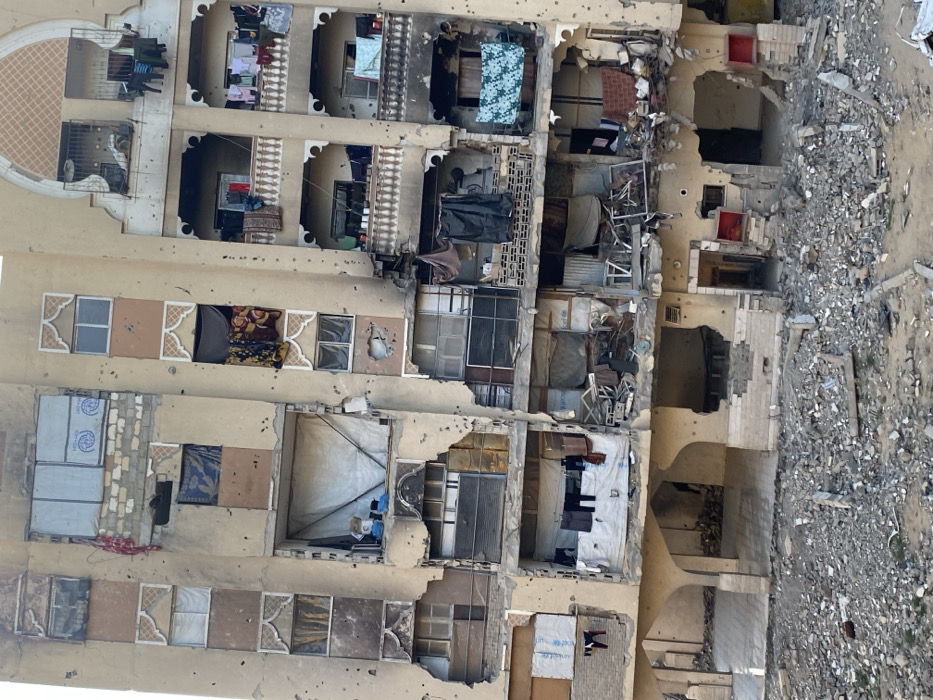
A multi-story building stands dilapidated, showing signs of severe damage. Some sections are reduced to rubble. Intact portions reveal inhabited apartments with windows, laundry lines, and furniture. The building's facade is riddled with bullet holes. Debris fills the ground around the structure, contrasting with the visible signs of continued habitation within the partially destroyed building.
NERMEEN SALEH
Khan Yunis, Palestinian Territory · Feb 22, 2026, 3:06 PM

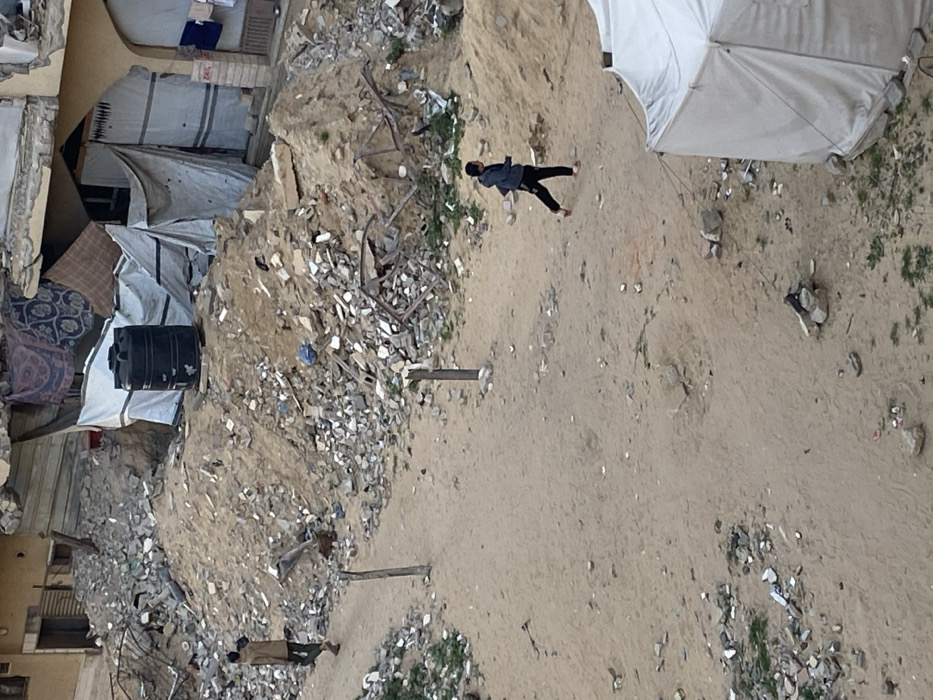
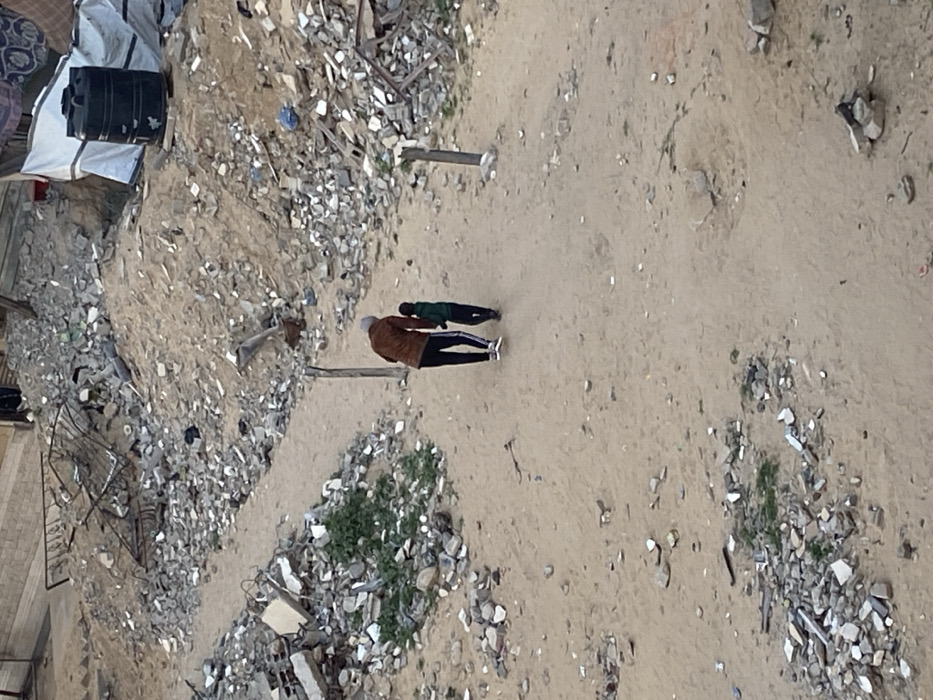
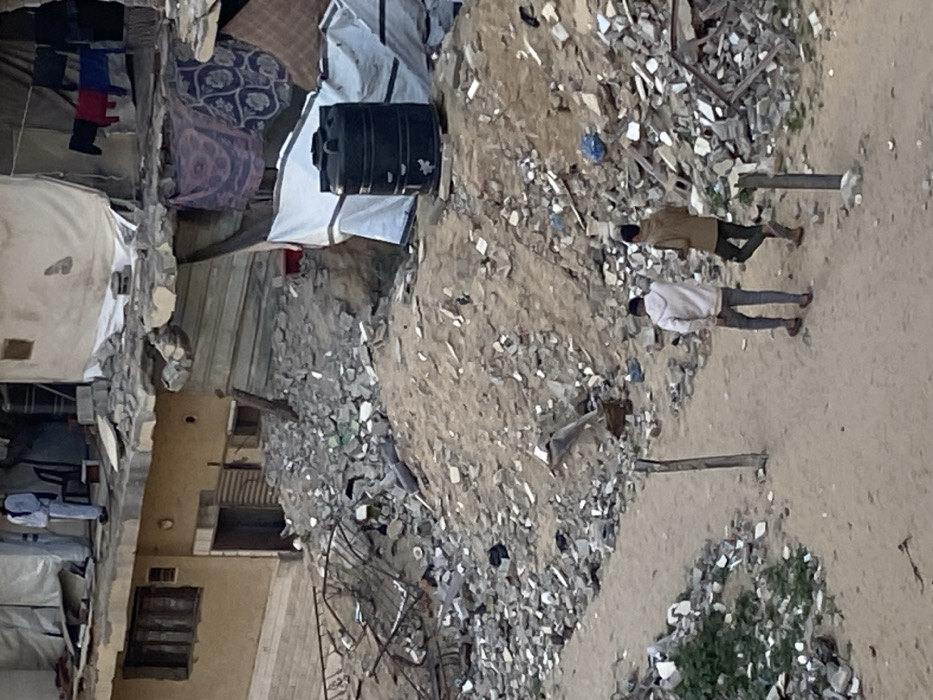
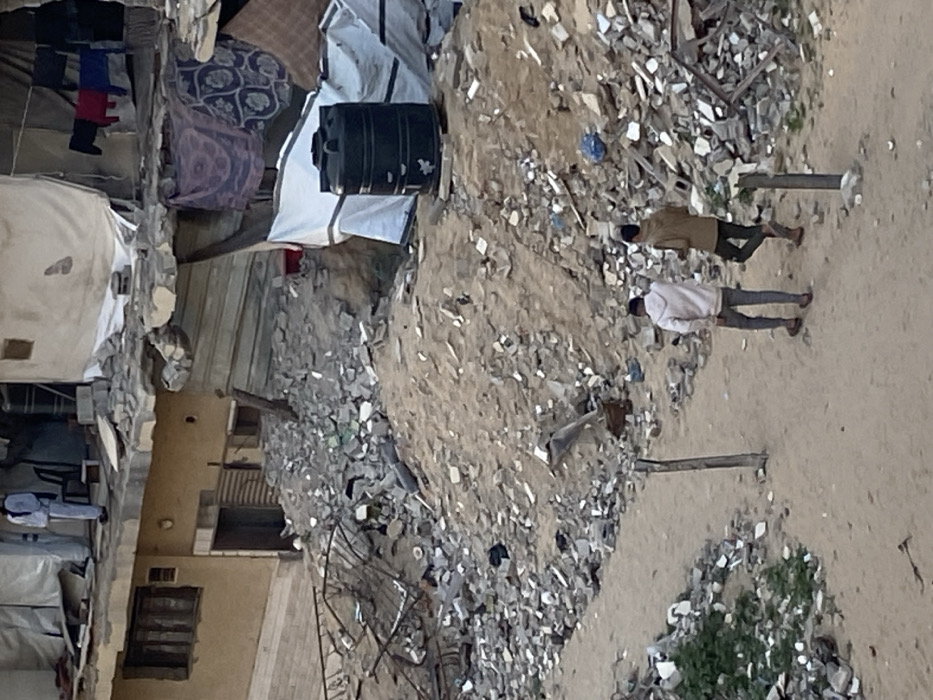
The image shows a scene of devastation, possibly after a conflict or natural disaster. Debris and rubble are scattered around. Tents offer makeshift shelter amidst the destruction. Two people walk in the scene, one in the upper section wearing black pants and a gray jacket, the other at the bottom, wearing khaki pants and a brown jacket. The overall impression is one of hardship and displacement.
NERMEEN SALEH
Khan Yunis, Palestinian Territory · Feb 22, 2026, 3:06 PM

The damaged facade of a multi-story building reveals extensive destruction. Sections of the building's interior are exposed, showcasing remnants of dwellings like curtains, furniture, and personal belongings. The exterior walls are crumbled and cracked, indicating severe structural damage. Debris and rubble surround the building, further emphasizing the extent of the catastrophe. Some windows are still intact while others are broken or missing completely. The image depicts the aftermath of a destructive event.
NERMEEN SALEH
Khan Yunis, Palestinian Territory · Feb 22, 2026, 3:06 PM

Damaged buildings with numerous visible holes stand beside rubble-filled areas where makeshift tents have been erected. Debris is scattered across the scene, creating a stark contrast with the relatively clear blue sky. Three figures are walking on the right of the image in a sand covered area. The scene evokes a sense of destruction, displacement, and resilience.
NERMEEN SALEH
Khan Yunis, Palestinian Territory · Feb 22, 2026, 3:07 PM

The image captures an overhead view of seven men gathered on a barren, dusty ground littered with debris. The perspective is taken from a high vantage point, looking directly down, and is slightly tilted, showing a diagonal white concrete structure or wall partially obscuring the view on the right side. The ground beneath the men is a light brown, sandy or unpaved surface. A significant amount of rubble and broken concrete pieces are scattered across the left and bottom-left portions of the frame. This debris includes larger chunks of concrete, smaller gravel-like fragments, what appears to be twisted metal or rebar structures, and some miscellaneous trash. A large, rectangular concrete block is visible in the mid-left. Small patches of green vegetation occasionally break through the detritus. The seven men are standing in a loose semi-circular or circular formation, suggesting they are engaged in conversation or observing something on the ground between them. Most of the men are dressed in dark clothing, appearing to wear dark jackets or shirts over pants. One man, located in the upper right of the group, stands out in a light-colored, long, flowing garment, possibly a thobe or jilbab. Another man with gray hair is visible among the group, also wearing a dark jacket. Their heads are generally oriented downwards or towards the center of their circle, indicating focus. One man in the upper left has his hands clasped in front of him, while others have their arms at their sides or in subtle gestures. A dark object, possibly a shoe, is lying on the ground near the feet of the men on the bottom right. The lighting is bright and appears to be natural daylight, possibly diffused or from an overhead sun, as shadows are minimal or not sharply defined. The overall atmosphere conveyed is one of a casual but engaged gathering in a somewhat neglected or undeveloped area. No text is visible in the image.
NERMEEN SALEH
Khan Yunis, Palestinian Territory · Feb 22, 2026, 3:07 PM

The image displays a multi-story building, severely damaged, appearing to be an apartment complex. The photograph is oriented vertically, rotated 90 degrees clockwise, making the building appear horizontal with the ground running along its right side. If viewed upright, the building would stand tall, exhibiting extensive structural damage. Many of its exterior walls are blown out or have collapsed, exposing the interiors of numerous rooms and apartments across multiple floors. The building's facade is primarily a light, sandy beige color, with visible bullet holes or impact marks scattered across its surface, especially on the less damaged sections. Inside the exposed rooms, remnants of daily life are visible amidst the destruction. These include: * Blankets, rugs, and various fabrics, some draped over furniture or used as makeshift coverings. * Clothes hanging or piled. * Beds or mattresses, some covered in white sheets. * Broken furniture and general debris. * Temporary coverings like white tarps, cardboard, or metal sheets are used to block windows and openings, suggesting attempts to create shelter or privacy within the damaged structure. * In one mid-left section of the building, a panel or box with a blue background and the word "Unicef" clearly visible in white lettering is used to cover a window opening, indicating the presence of humanitarian aid materials. * Some windows have decorative surrounds, featuring arches and patterned tiles, hinting at the building's original architectural style. To the right of the building (if upright), a vast expanse of rubble and debris covers the ground. This area is a chaotic mix of broken concrete, bricks, dust, and twisted rebar, indicative of widespread destruction. A small, dark, indistinct object, possibly an animal or a larger piece of debris, can be seen in the middle of this rubble field. In the background, to the left (if upright), a bright, clear sky is visible, suggesting daytime. Below the sky, partially obscured, are other buildings, some of which also appear to be damaged or under construction. The scene conveys a strong sense of devastation and hardship, likely in a conflict zone or post-disaster area. Despite the severe damage, the presence of personal belongings and makeshift coverings suggests that people might be continuing to live in or salvage items from the ruined structure.
Khan Yunis, Palestinian Territory · Feb 22, 2026, 3:07 PM

The image presents a high-angle, top-down view of a severely damaged multi-story building, likely an apartment complex. The building itself is a light tan or beige color, showing extensive structural compromise, particularly on its right side, which appears to be partially collapsed or blown open, exposing the interiors of numerous rooms across multiple floors. On the left side of the building, which seems relatively less destroyed but still significantly impacted, several balconies with distinct arched openings are visible. On these balconies, laundry lines are set up with clothes hanging to dry, including shirts, pants, and colorful garments, suggesting recent human presence or an attempt to maintain normalcy amidst the destruction. The exterior walls on this side are pockmarked with numerous small holes, consistent with bullet impacts or shrapnel. Some windows are either shattered or missing. Moving towards the right, the damage becomes increasingly severe. Entire sections of outer walls are missing, revealing the complete layouts of apartments. Inside these exposed rooms, a chaotic scene of debris, broken furniture, and scattered personal belongings is evident. Items such as beds with mattresses, chairs, tables, and what appear to be storage units are overturned, broken, or covered in dust and rubble. Various textiles, including blankets, rugs, and tarps, are scattered throughout, with some seemingly used as makeshift covers or partitions within the damaged structures. The far right edge of the building shows even more catastrophic destruction, with entire floor slabs and internal walls collapsed into a vast field of rubble. This debris field extends beyond the building itself, filling the ground to the right, composed of shattered concrete, metal, and other remnants. In the upper right corner of the image, amidst this extensive debris, a severely damaged and overturned vehicle, possibly a car, is visible. Within some of the exposed rooms on the lower right floors, further details can be observed: * In one room, a white tarp or sheet is visible, upon which partial text, "UNICE[F]," can be discerned, indicating the presence of humanitarian aid materials. * Other rooms contain jumbled personal items, including what look like suitcases, boxes, and clothing. The lighting suggests it is daytime, with bright, clear conditions, indicated by the absence of heavy shadows and the overall illumination of the scene. The pervasive damage, bullet holes, and the extensive debris field point to a major destructive event, most likely a result of conflict or heavy shelling, rather than a natural disaster. The juxtaposition of hanging laundry on one side and catastrophic destruction on the other paints a grim picture of resilience in the face of widespread devastation.
NERMEEN SALEH
Khan Yunis, Palestinian Territory · Feb 22, 2026, 3:07 PM

The image captures an overhead view of an outdoor scene, likely an unpaved area or yard, characterized by sandy or dusty light brown ground. The environment appears desolate, with significant amounts of rubble, broken concrete, and various debris scattered across the landscape, suggesting either construction waste, a demolition site, or an area affected by damage. Small patches of green vegetation, possibly weeds or resilient plants, are sparsely growing amidst the debris. In the upper left portion of the frame (if oriented vertically), a makeshift structure is visible. It consists of a white tarpaulin draped over something, possibly forming a temporary shelter or roof. A black barrel, commonly used for water storage, is placed on top of or next to this structure. More piles of rubble and what appear to be twisted metal frames are in this area. The central focus of the image is two figures on the open ground. One is an adult, standing upright, seen from a high angle. They are wearing a light-colored head covering, a brownish or tan long-sleeved top or jacket, dark trousers (possibly track pants), and white sneakers. Their back is partially turned, and they appear to be looking towards the child in front of them or slightly to their right. In front of the adult, a smaller figure, likely a child, is lying prone on the ground. The child is dressed in a dark green top (possibly a hoodie or jacket) and dark trousers. Their arms are extended forward on the ground. The child's posture could suggest playing, such as pretending to fly or swim, or simply resting on the ground. The lighting indicates natural daylight, suggesting it is daytime. The absence of strong, distinct shadows implies either an overcast sky or the sun being relatively high, without harsh direct sunlight. No text is visible anywhere in the image. The overall impression is of an exposed, rugged environment, possibly an area experiencing hardship or undergoing reconstruction, with a quiet moment unfolding between an adult and a child.
NERMEEN SALEH
Khan Yunis, Palestinian Territory · Feb 22, 2026, 3:08 PM

The image depicts a scene of extensive destruction, likely in an urban or semi-urban environment, characterized by severely damaged buildings and widespread rubble under a bright, clear sky. The overall impression is one of devastation, suggesting a conflict zone or the aftermath of a major disaster. In the immediate foreground, a vast area is covered in large piles of shattered concrete, broken masonry, twisted rebar, and various debris. This rubble forms an uneven, chaotic landscape, extending across the bottom right portion of the frame. Beyond the dense rubble, to the far right, there is an expanse of sandy ground or dirt. A small, dark figure, possibly a person, is partially visible standing on this sandy patch at the very bottom right corner. In the midground, a heavily damaged multi-story building stands prominently. Its facade is severely compromised, with large sections missing, revealing the exposed interiors of multiple floors. Many windows are broken or missing entirely, and the structure appears unstable. On one section of this damaged building, white tarps or coverings have been installed over an opening. A blue logo, clearly visible on one of these white coverings, identifies it as "unicef," indicating the presence or involvement of the United Nations Children's Fund. Closer inspection of the building's remaining walls shows small, circular impact marks or bullet holes. Further in the background, a cluster of taller, multi-story residential or commercial buildings can be seen. These buildings also exhibit significant signs of damage, including missing walls, broken windows, and exposed structural elements. One building on the left has a distinct light tan color with white trim around its windows, some of which feature decorative "K"-shaped elements directly beneath them. The upper parts of these background buildings appear to be less affected than the central structure, but still show signs of distress. The lighting suggests it is daytime, with bright, even illumination across the scene, though specific time of day (morning or afternoon) is not clear from shadow length. The atmosphere conveyed is one of desolation and hardship.
NERMEEN SALEH
Khan Yunis, Palestinian Territory · Feb 22, 2026, 3:08 PM
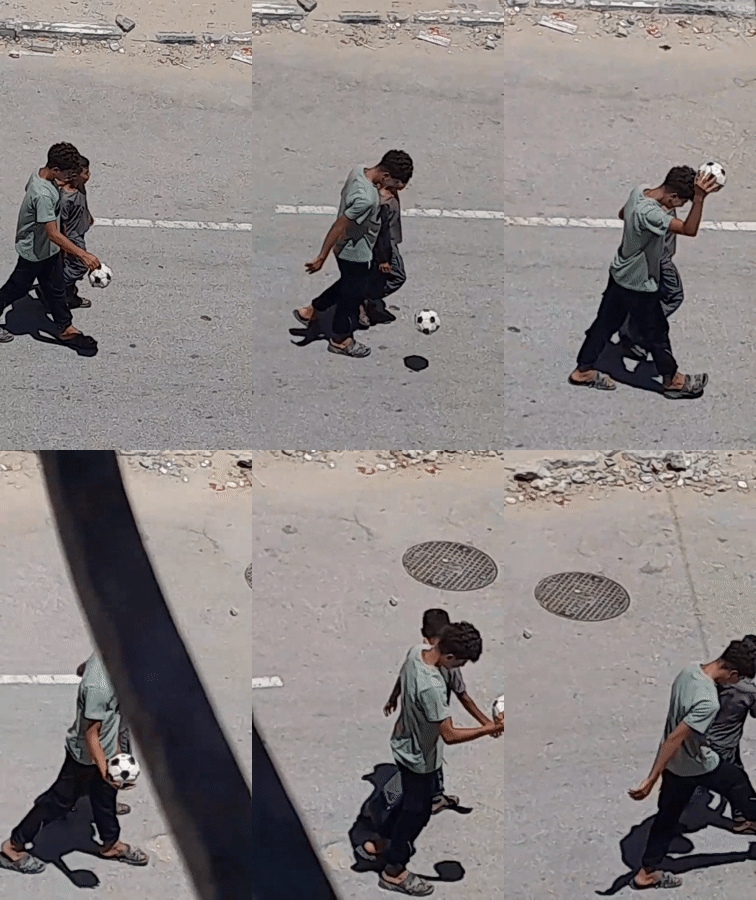
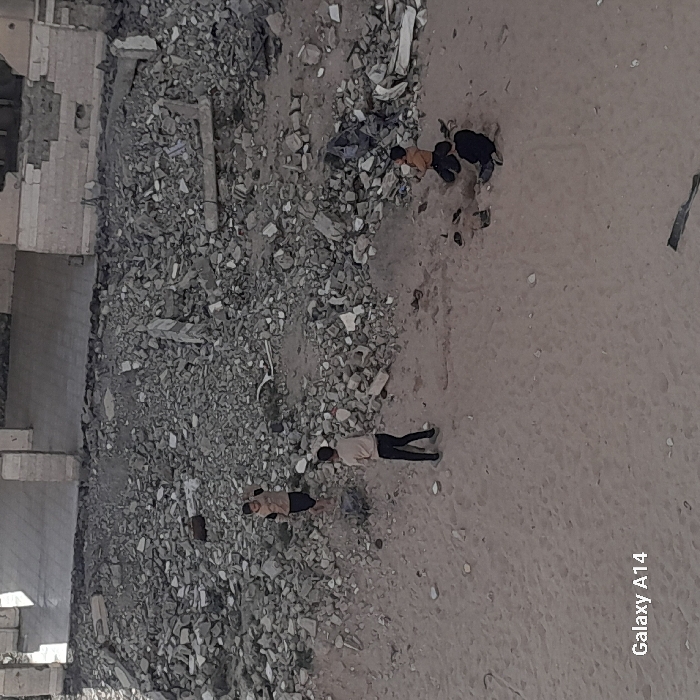
The video shows several children playing in an open area that is surrounded by heavily damaged buildings and debris. The ground is mostly sand, and scattered around are pieces of rubble, concrete, and various objects. The buildings are partially destroyed, with holes in the walls and missing sections. There is a white vehicle amidst the debris. The children are spread out, and appear to be throwing and kicking a ball. One child is digging or picking something up from the ground. The video is taken from an elevated position, likely from a balcony or a higher floor of one of the buildings. The overall scene suggests a post-conflict or disaster area where children are playing despite the destruction.
NERMEEN SALEH
Khan Yunis · Feb 22, 2026, 3:08 PM

Two figures walk on a sandy path alongside debris. The buildings are heavily damaged, possibly due to conflict or natural disaster. Rubble, broken materials, and dust cover the scene. Clothes are hung outside near a water tank. Overall, the setting is impoverished and demonstrates evidence of hardship.
NERMEEN SALEH
Khan Yunis, Palestinian Territory · Feb 22, 2026, 3:09 PM

The image captures a partial, angled view of a person seated or reclined indoors. The main focus is on the person's hands holding a small, dark-covered booklet or stack of documents with numerous fanned-out white pages. The pages appear to have faint green or light blue lines or printing, which is too blurry to be legible but suggests some form of structured text or data. The person is wearing dark, casual clothing. The visible left arm features a black sleeve with three prominent white stripes, characteristic of Adidas athletic wear. A small white detail or logo is also visible on the cuff area of the sleeve. The person's hands are visible, with a medium to dark skin tone, holding the item with thumbs on one side and fingers supporting the fanned pages on the other. To the left of the person, a blurry reddish-purple (possibly plum or burgundy) upholstered surface, likely a cushion or sofa arm, fills the background. To the right, behind the person's lower body, a glimpse of a red and grey/white patterned fabric with a diamond or checkered design is visible. The overall setting appears to be a comfortable indoor environment, such as a living room. The lighting is soft and ambient, providing no specific clues about the time of day. The person's activity seems to involve carefully looking through or reading the contents of the booklet.
NERMEEN SALEH
Khan Yunis, Palestinian Territory · Feb 22, 2026, 3:10 PM

The image portrays a severely damaged urban landscape. Buildings show signs of extensive destruction, with multiple floors collapsed and facades scarred. Debris and rubble are scattered across the ground. In the foreground, makeshift shelters or tents are visible, suggesting displaced people. A sandy area lies adjacent to the damaged buildings, possibly indicating a coastal location. Two individuals are walking in the distance. The overall impression is one of war or disaster.
NERMEEN SALEH
Khan Yunis, Palestinian Territory · Feb 22, 2026, 3:10 PM

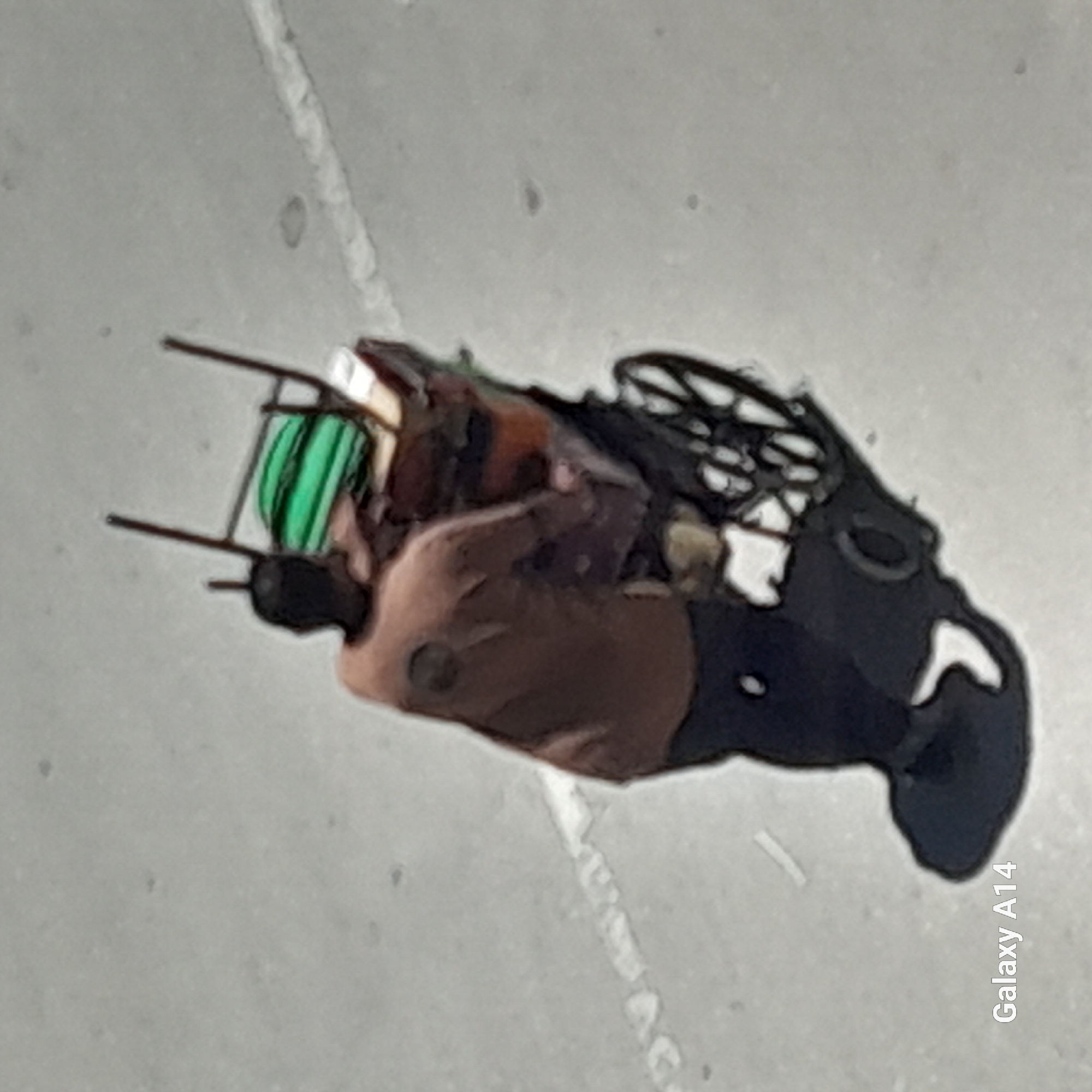
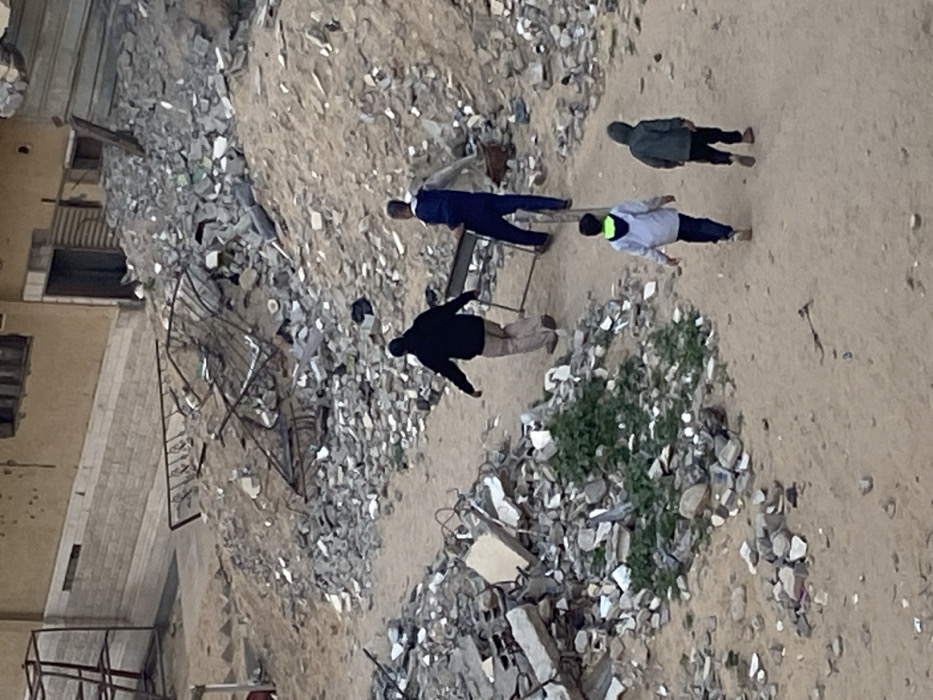
A high-angle shot reveals a scene of devastation with a landscape littered with debris. Amidst the rubble, two men are carrying a folding table across the sandy ground. Buildings stand damaged, with bullet holes visible on one facade. A large black tank sits atop a partially collapsed structure. Groups of people are also walking through the area.
NERMEEN SALEH
Khan Yunis, Palestinian Territory · Feb 22, 2026, 3:10 PM

From a high angle, the scene depicts four people walking through a debris-strewn landscape. The debris, consisting of gray and white rubble, suggests a destroyed building. A damaged building's facade is on the left. The people are dressed in casual attire. A patch of green vegetation grows amidst the destruction. The ground is sandy or dusty. The overall impression is one of devastation.
NERMEEN SALEH
Khan Yunis, Palestinian Territory · Feb 22, 2026, 3:10 PM

A damaged building exhibits signs of severe destruction, likely due to conflict or disaster. The facade displays missing walls, shattered windows, and rooms exposed. The ground is littered with rubble and debris. A destroyed car is also visible, emphasizing the extent of the devastation. The architectural style hints at a residential structure, now rendered uninhabitable. Clothes are hanging in the balcony of some rooms which are not destroyed. The overall scene evokes loss and destruction.
Khan Yunis, Palestinian Territory · Feb 22, 2026, 3:11 PM

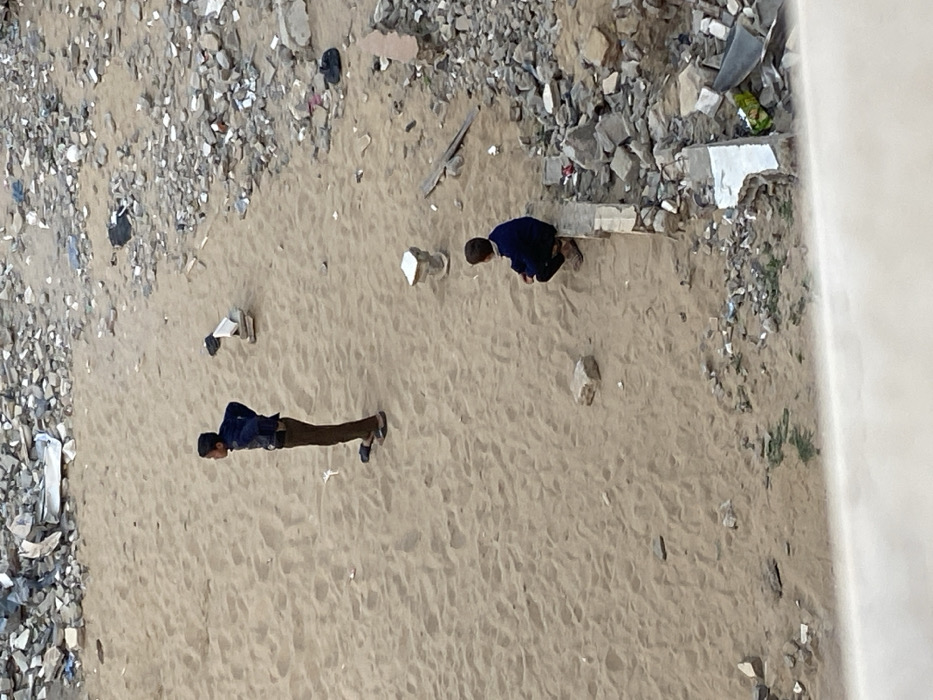
Two people are in a sandy, debris-strewn area. One person stands and faces left. He wears a blue shirt and brown pants. The other person is hunched over and faces right, wearing a blue shirt. Rocks and concrete fragments surround them. The sand shows many footprints. Debris borders the left and right edges. A white wall is slightly visible on the right.
NERMEEN SALEH
Khan Yunis, Palestinian Territory · Feb 22, 2026, 3:11 PM

An aerial view depicts a scene of devastation. A man in a white shirt and dark pants walks through debris. A wrecked white vehicle lies near a partially destroyed building on the left. Scattered rubble and concrete fragments cover the ground. The scene conveys a sense of destruction and potential conflict.
NERMEEN SALEH
Khan Yunis, Palestinian Territory · Feb 22, 2026, 3:11 PM

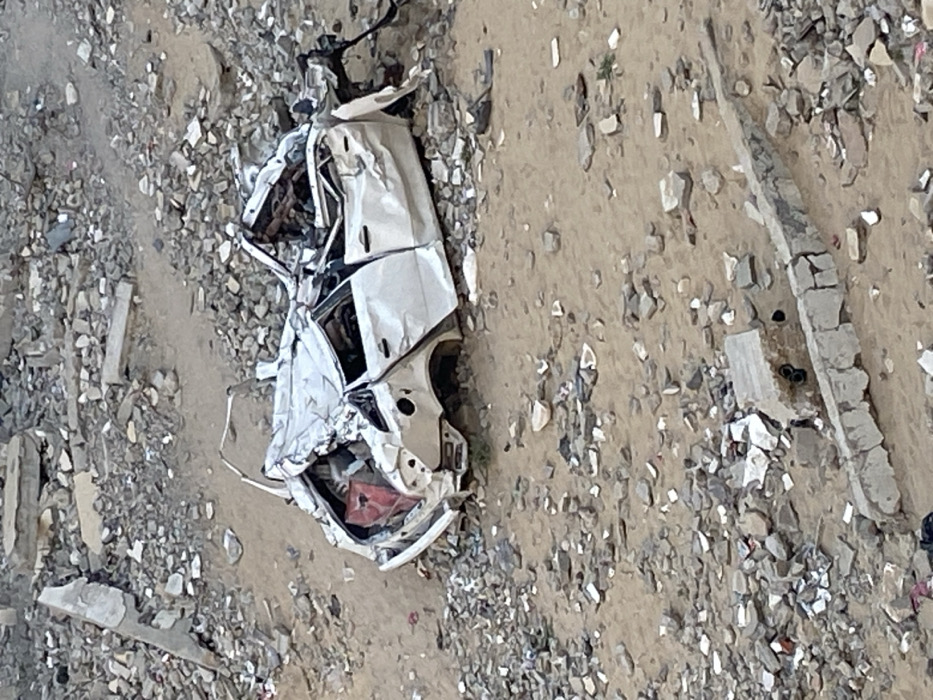
A severely damaged white car rests among rubble. The vehicle appears crumpled and twisted, with significant deformation to the front and side. The surrounding ground is covered with debris, ranging from small stones to larger chunks of what appear to be building materials. The car is angled and the photo is captured from above, providing a comprehensive view of the devastation.
NERMEEN SALEH
Khan Yunis, Palestinian Territory · Feb 22, 2026, 3:11 PM
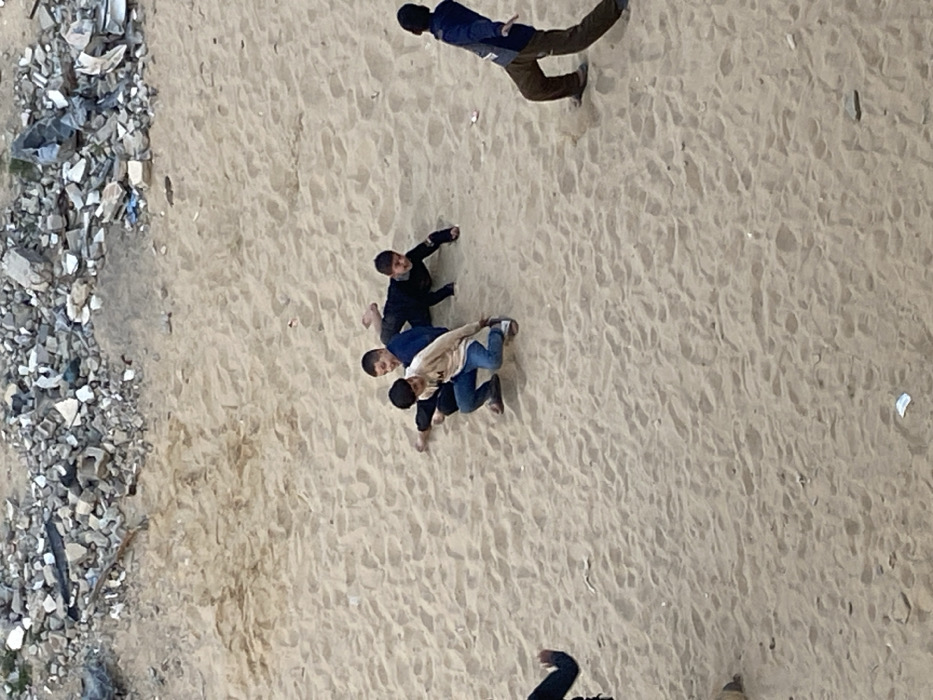
From an aerial perspective, a sandy area dominates, with a rocky strip on the left. Several children are present: a group of four clustered together, seemingly in a playful scuffle or group hug, and another child lying prone further away. The sandy expanse shows scattered footprints and minor debris, possibly litter. The overall scene suggests a playground or beach where children are actively engaged.
NERMEEN SALEH
Khan Yunis, Palestinian Territory · Feb 22, 2026, 3:11 PM


A dark pot on a stovetop contains vegetables simmering in liquid. Two bell peppers, one yellow and one orange, float near the top. Several light green, oblong objects are submerged. Steam rises slightly from the liquid. The surrounding stovetop and countertops appear dark.
NERMEEN SALEH
Khan Yunis, Palestinian Territory · Feb 22, 2026, 3:14 PM

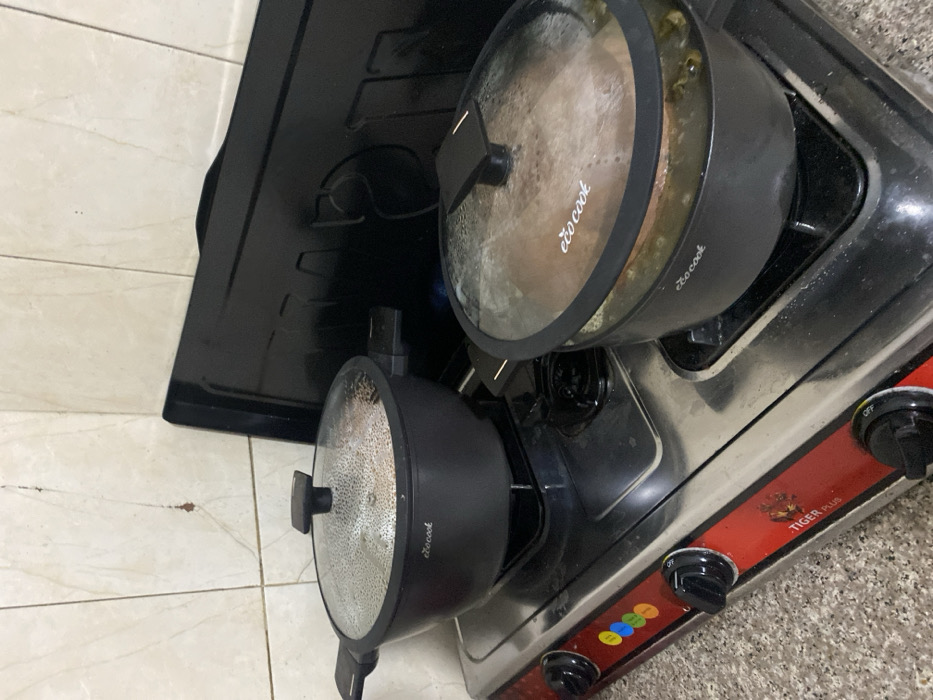
Two black pots labeled "eco cook" sit on a silver and red Tiger Plus gas stove. Both pots have clear lids. The larger pot is placed on the right burner, while the smaller one is on the left. A black stovetop cover sits to the left of the stove. The backdrop shows beige tiled walls.
NERMEEN SALEH
Khan Yunis, Palestinian Territory · Feb 22, 2026, 3:14 PM
Here's a description of the video: A person lifts the lid of a gray pot on a gas stovetop. Inside the pot, there is a broth-like liquid with zucchini and orange bell peppers simmering. Steam rises as the lid is removed. The person then places the lid back on the pot. The stovetop is stainless steel, with a red knob visible. The lid is clear, covered in condensation, and has a black handle. The person's hand is visible and has rings on the fingers.
NERMEEN SALEH
Khan Yunis · Feb 22, 2026, 3:14 PM
A person lifts the lid of a black Eco Cook pot on a gas stove to reveal a clay bowl inverted inside the pot, surrounded by a simmering liquid. The lid is then replaced. The stove is stainless steel and the surrounding kitchen area is visible in the background.
NERMEEN SALEH
Khan Yunis · Feb 22, 2026, 3:15 PM
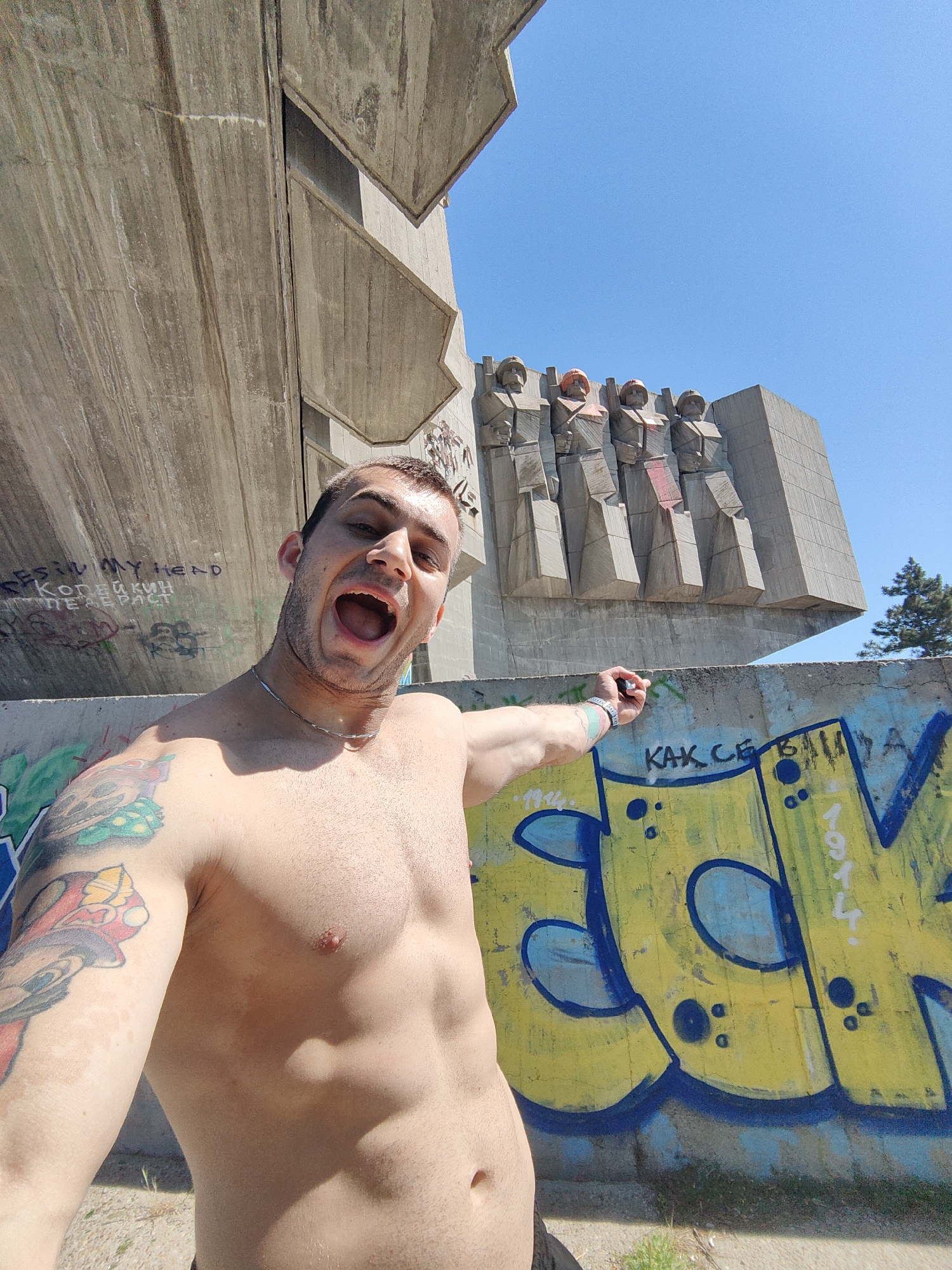
Man performs acrobatic stunts at Bulgarian war memorial