Monday, April 20, 2026 · Updated Monday, April 20, 2026
Subotica, Serbia
In the heart of Subotica, Serbia, a moment of pure joy and architectural splendor recently unfolded as a newlywed couple celebrated their union with a dance in a historic public square. This enchanting scene not only captured the romance of the occasion but also showcased the city's remarkable Art Nouveau heritage, making for a truly memorable cultural snapshot.
An outdoor, daytime shot in Subotica, Serbia, captures an ornate Art Nouveau building and a distinctive blue tiled fountain structure under an overcast sky. The multi-story building, positioned to the left, features a detailed facade with a blend of red and cream-colored sections, multiple arched windows and doorways on its lower levels, and a steeply pitched roof adorned with intricate patterned ceramic tiles and a decorative finial.
Lush green trees with fresh foliage, suggesting spring or early summer, partially obscure the building in the foreground and midground. To the right of a light-colored, paved pathway, a long, tiered fountain-like structure crafted from vibrant blue tiles stretches horizontally across the scene. Two small, spherical topiary plants are neatly placed alongside this structure on the pathway. Beyond the path, a strip of bright green grass extends to the right edge of the frame. In the far background, a few indistinct figures can be seen. Some small, illegible text is visible on shop signs integrated into the building's lower level, including what appears to be "euphonica" or similar lettering on one sign. The scene presents a peaceful view of the city's unique architectural landscape.
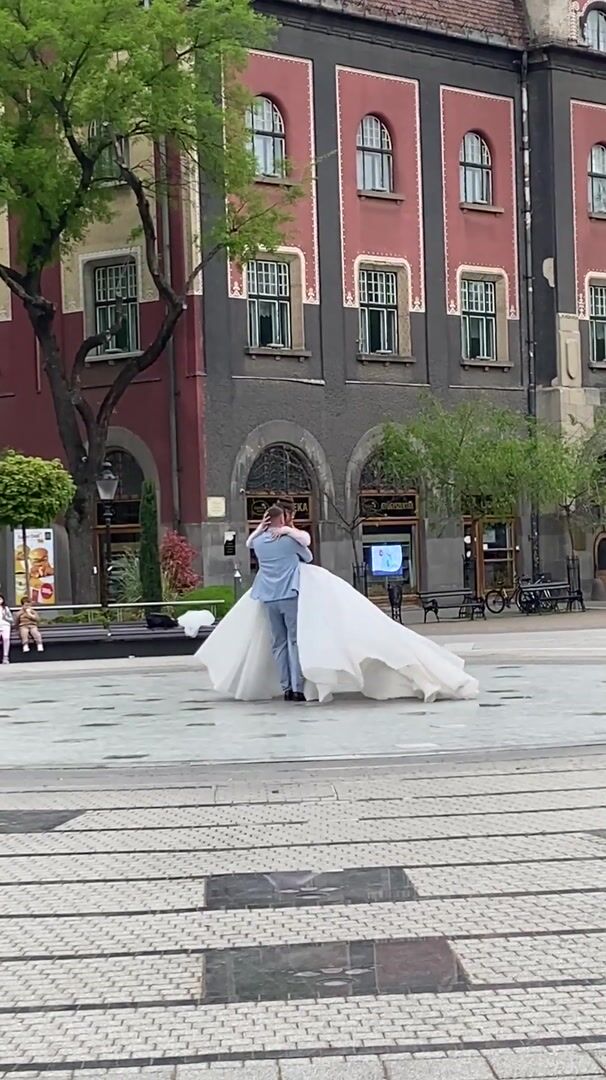
The couple, a bride in a voluminous white gown and a groom in a light blue suit, were pictured embracing and spinning, their happiness radiating against the ornate backdrop. Their dance took place in front of a grand, multi-story building, an architectural landmark that epitomizes the Art Nouveau style for which Subotica is renowned. Its distinctive red and dark grey facades, arched windows, and intricate decorative details, crowned by a prominent clock tower with a red and green roof, provided a magnificent stage for their celebration.
The image presents an upward-looking view of a distinctive building, partially framed by the vibrant green foliage and dark branches of trees. The building features a richly textured, reddish-pink (or mauve) facade, suggesting brickwork or stucco.
Architectural details point to an Art Nouveau or Secessionist style. Numerous windows are visible, varying in shape from rectangular and arched to oval and circular. Many are adorned with intricate stone carvings, including:
* Decorative columns and scrollwork around a large, multi-pane arched window.
* A section with highly detailed relief sculpture within an oval plaque, depicting figures, surrounded by ornate, swirling motifs on the window frame.
* A large circular window with an intricate metal grille.
The trees, with their dense, light green leaves, provide a natural foreground and contrast with the building's deep color. Patches of bright, uniform light gray sky are visible through the gaps in the foliage and above the building, indicating an overcast daytime. No people or specific activities are depicted. The scene highlights the elaborate craftsmanship of the architecture against a natural, leafy setting. This is a view of the Subotica City Hall in Subotica, Serbia, known for its Hungarian Secessionist design.
Subotica's commitment to preserving its unique architectural identity is evident throughout the city. Other views from the square reveal more of this rich design. One building, likely the City Hall, showcases a richly textured, reddish-pink facade adorned with elaborate stone carvings, including decorative columns, scrollwork, and relief sculptures within oval plaques. Variations in window shapes—rectangular, arched, oval, and circular—further highlight the Secessionist style.
The image displays a multi-story building, located in Subotica, Serbia, captured from a low-angle looking upwards against an overcast sky. The architecture features a distinctive curved central tower that tapers towards a green dome or spire at its apex. Adjacent facades extend from this central element.
The building exhibits an older architectural style, possibly Art Deco, characterized by a mix of geometric elements, such as diamond-shaped details between windows, and the prominent curved lines of the tower. The facade shows significant signs of age and wear, with plaster visibly peeling and cracking in many areas, revealing the underlying brickwork. Windows of various designs are present, some with white blinds, others with dark frames or protective grilles. Small, ornate iron balconies extend from some upper-floor windows. Electrical or communication cables are strung across parts of the building's exterior.
At street level, a commercial establishment is visible on the right side of the building, marked by a black sign displaying "TEATRO" vertically, reading from bottom to top. Above this, several street signs are affixed to the facade: a blue parking sign showing "P 30HA" and a circular "30" speed limit sign, a blue directional arrow pointing right, and another blue sign featuring a pedestrian symbol alongside "30HA". The scene depicts a static architectural view with no people or discernible activities.
The city's landscape is further embellished by features like a distinctive blue tiled fountain structure and lush green trees that frame these historic edifices. This blend of natural beauty and human craftsmanship creates an atmosphere where daily life and grand architecture harmoniously coexist. The image of the newlyweds dancing in this setting not only celebrates love but also invites appreciation for Subotica's unique cultural and artistic legacy, a testament to its enduring charm.
A newlywed couple, or a couple dressed as a bride and groom, is captured dancing and embracing in a public square. The bride wears a voluminous white wedding gown that flares out dramatically as she spins, while the groom is dressed in a light blue suit. They appear joyful and affectionate, holding each other close.
The setting is a large paved square, possibly in a city center. In the background stands a grand, ornate building, which is a significant architectural landmark. The building features multiple stories, with distinctive red and dark grey facades, arched windows, and intricate decorative details. A prominent clock tower with a red and green roof rises from the center of the building. Green trees are visible on the left side of the frame, and streetlights are also present.
A few other people are visible in the background, some sitting on benches. The scene takes place during the daytime, under what appears to be an overcast sky, providing soft, diffused lighting. Visible text on a sign on the background building reads "APOTEKA." The location is Subotica, Serbia.
An outdoor, daytime shot in Subotica, Serbia, captures an ornate Art Nouveau building and a distinctive blue tiled fountain structure under an overcast sky. The multi-story building, positioned to the left, features a detailed facade with a blend of red and cream-colored sections, multiple arched windows and doorways on its lower levels, and a steeply pitched roof adorned with intricate patterned ceramic tiles and a decorative finial.
Lush green trees with fresh foliage, suggesting spring or early summer, partially obscure the building in the foreground and midground. To the right of a light-colored, paved pathway, a long, tiered fountain-like structure crafted from vibrant blue tiles stretches horizontally across the scene. Two small, spherical topiary plants are neatly placed alongside this structure on the pathway. Beyond the path, a strip of bright green grass extends to the right edge of the frame. In the far background, a few indistinct figures can be seen. Some small, illegible text is visible on shop signs integrated into the building's lower level, including what appears to be "euphonica" or similar lettering on one sign. The scene presents a peaceful view of the city's unique architectural landscape.
The image presents an upward-looking view of a distinctive building, partially framed by the vibrant green foliage and dark branches of trees. The building features a richly textured, reddish-pink (or mauve) facade, suggesting brickwork or stucco.
Architectural details point to an Art Nouveau or Secessionist style. Numerous windows are visible, varying in shape from rectangular and arched to oval and circular. Many are adorned with intricate stone carvings, including:
* Decorative columns and scrollwork around a large, multi-pane arched window.
* A section with highly detailed relief sculpture within an oval plaque, depicting figures, surrounded by ornate, swirling motifs on the window frame.
* A large circular window with an intricate metal grille.
The trees, with their dense, light green leaves, provide a natural foreground and contrast with the building's deep color. Patches of bright, uniform light gray sky are visible through the gaps in the foliage and above the building, indicating an overcast daytime. No people or specific activities are depicted. The scene highlights the elaborate craftsmanship of the architecture against a natural, leafy setting. This is a view of the Subotica City Hall in Subotica, Serbia, known for its Hungarian Secessionist design.
The image displays a multi-story building, located in Subotica, Serbia, captured from a low-angle looking upwards against an overcast sky. The architecture features a distinctive curved central tower that tapers towards a green dome or spire at its apex. Adjacent facades extend from this central element.
The building exhibits an older architectural style, possibly Art Deco, characterized by a mix of geometric elements, such as diamond-shaped details between windows, and the prominent curved lines of the tower. The facade shows significant signs of age and wear, with plaster visibly peeling and cracking in many areas, revealing the underlying brickwork. Windows of various designs are present, some with white blinds, others with dark frames or protective grilles. Small, ornate iron balconies extend from some upper-floor windows. Electrical or communication cables are strung across parts of the building's exterior.
At street level, a commercial establishment is visible on the right side of the building, marked by a black sign displaying "TEATRO" vertically, reading from bottom to top. Above this, several street signs are affixed to the facade: a blue parking sign showing "P 30HA" and a circular "30" speed limit sign, a blue directional arrow pointing right, and another blue sign featuring a pedestrian symbol alongside "30HA". The scene depicts a static architectural view with no people or discernible activities.