Sunday, March 15, 2026 · Updated Sunday, March 15, 2026
London, United Kingdom
London, a global epicenter for art and culture, continually offers a rich tapestry of exhibitions and installations that challenge perceptions and inspire dialogue. A recent journey through some of the city's most prestigious cultural institutions revealed a dynamic landscape, showcasing everything from thought-provoking contemporary pieces to grand architectural marvels, firmly cementing London's reputation as a leader in the art world.
A high-angle, close-up view depicts a dark brown leather bench with a light wooden frame, located within a building in London, United Kingdom. The bench surface features five tufted sections. Centrally positioned on the leather is a small, black rectangular container holding approximately 15-20 assorted colored pencils, including yellow, green, red, pink, and light blue. Three additional colored pencils are observed outside the container on the bench surface: an orange pencil lies horizontally to the left of the container, a dark teal pencil lies diagonally to the immediate right, and a red pencil is positioned horizontally further up and to the right. The leather upholstery exhibits minor creases and wear. The bench rests on a light-colored wooden floor with a herringbone pattern. A segment of a dark wooden furniture leg is visible in the bottom left corner of the frame. No individuals are present in the scene.
London, United Kingdom · Mar 15, 2026, 1:01 PM · 134.3k attention
At the renowned Tate Modern, visitors encountered striking works that blur the lines between science and art. Among them, a preserved lamb suspended within a clear, liquid-filled tank stood as a powerful, if unsettling, commentary on life and preservation. This stark, iconic piece, framed by display cabinets filled with other specimens, exemplifies the museum's commitment to showcasing groundbreaking and often controversial contemporary art.
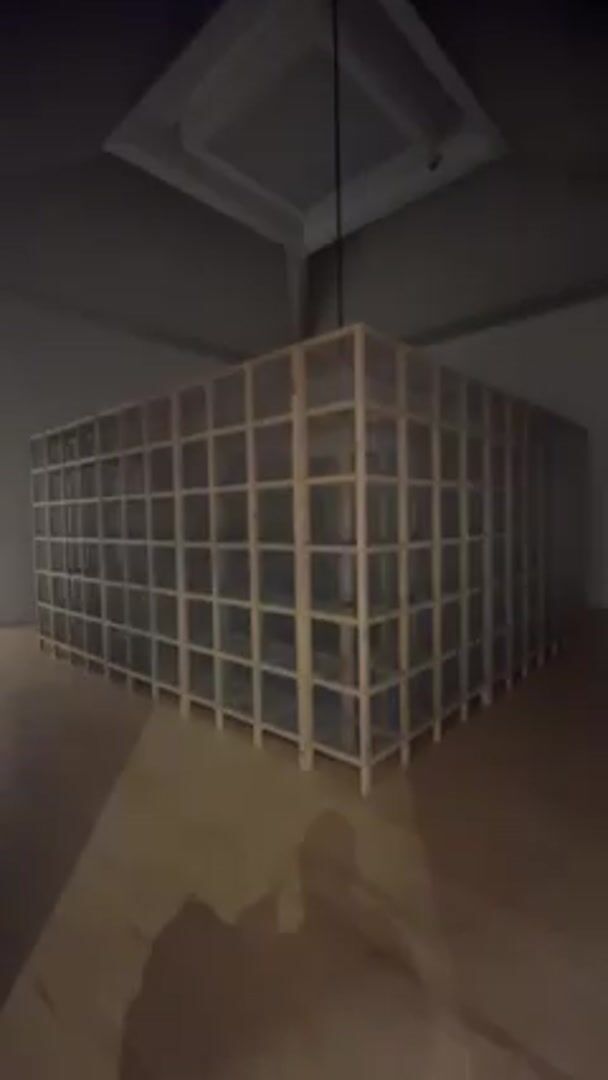
The video shows a cubic structure made of light wood frames, forming a grid with numerous square compartments. Each compartment contains a small light source, emitting a warm glow that creates a striking contrast to the structure’s stark geometry. The structure is situated on a polished wooden floor in a bright, white-walled room, topped with a square skylight. The lights within the structure flicker and dim, creating a dynamic visual effect. The camera remains static, capturing the play of light and shadow across the wooden frame and the floor.
London, United Kingdom · Mar 15, 2026, 12:59 PM · 16.0k attention
The exploration continued to The Serpentine Galleries in Kensington Gardens, a space celebrated for its innovative exhibitions. Here, the raw industrial aesthetic of the gallery harmonized with diverse installations: from dark, monumental metal objects grounded on the floor to a whimsical sculpture of pink spherical forms clustered on a pedestal. Abstract paintings in vibrant blues, greens, oranges, and reds adorned the walls, showcasing a breadth of modern artistic expression within Room 19.
A human left hand holds a small, rectangular piece of aged paper towards the viewer. The paper, approximately 10 cm x 6 cm, displays a handwritten message in dark ink, indicating it was placed on "fourth of June, 1897, Jubilee Year, by the Plasterers working on the job." The text expresses hope for the continued flourishing of the Plasterers Association and requests the finder to "Let us know in the Other World when You get this so as we can drink Your Health," signed by M. Gallop, F. Wilkins, H. Sainsbury, J. Chester, and A. Pickermell (Secretary). The background, out of focus, reveals a distinctive geometric floor pattern of interlocking black and off-white semi-circular shapes. Partially visible white architectural molding or a column base suggests an interior setting within a grand building. This historical note was discovered in the Old War Office Building (now The OWO Residences) located on Whitehall, City of Westminster, London, United Kingdom.
The image depicts the interior of a grand architectural structure, observed from a low angle looking upwards. The dominant feature is a multi-paned glass dome forming the ceiling, composed of numerous rectangular and square panels arranged in concentric rings, allowing natural light to illuminate the space. Below the dome, classical architectural elements are prominent, including a large, fluted, light-grey column in the foreground extending from the lower right towards the upper center. This column supports a complex entablature featuring decorative cornices and friezes. Further up, a series of smaller, similar columns with capitals are visible on an upper level, supporting another section of ornate stonework. Arches in a stark white finish are present at a lower level on the left, indicating a series of passageways or a vast open hall. The overall color palette is predominantly white and light grey, with subtle shadowing defining the architectural relief. No individuals, objects, or actions are depicted. This architectural style and specific dome structure are characteristic of the **Royal Exchange** building in the City of London, United Kingdom.
Beyond the specific gallery spaces, the city's architectural gems also stand as art in themselves. The majestic Royal Exchange, with its intricate glass dome ceiling and classical fluted columns, offered a moment of awe-inspiring beauty, demonstrating how London seamlessly integrates historical grandeur with contemporary cultural life. Even a seemingly simple leather bench with scattered colored pencils, observed in one of the city's many public spaces, hints at the quiet moments of creativity embedded within the urban fabric. This extensive tour underscored London's unwavering dedication to fostering and presenting art in its myriad forms, inviting both contemplation and wonder.
A large kinetic sculpture, specifically Alexander Calder's "Lobster Trap and Fish Tail" (1939), is suspended centrally from a high, white, coffered ceiling featuring multiple glass skylights and visible structural beams. The mobile consists of abstract metal shapes: a prominent, highly reflective, copper-toned disc (reflecting segments of the room and a faint human form), a smaller pale peach oval, a white elongated oval, a black oval, and a reddish-brown oval. These elements are interconnected by a system of thin black metal rods and fine suspension wires. The artwork is located within a spacious gallery hall at the Tate Britain, Millbank, London, United Kingdom. The room features smooth, light-colored walls. On the left, a cream-colored classical pilaster with an ornate Ionic capital and a decorative entablature defines an architectural opening. Through this opening, a brightly lit adjacent gallery space is visible in the background, displaying multiple framed artworks on its walls. No distinct individuals are clearly visible, but the reflective surface of the mobile implies human presence within the gallery.
The image displays the interior of an art gallery, specifically identified by signage as Room 19 of The Serpentine Galleries, located in Kensington Gardens, London, United Kingdom. The room is empty of people.
The scene features a light brown parquet floor and white walls. The high, vaulted ceiling is white with exposed structural elements and a long, cylindrical light fixture suspended centrally.
In the foreground, two large, dark blue-black industrial-style metal objects are positioned directly on the floor. One is a flat, rectangular form with visible rivets, and the other is an I-beam structure, with a horizontal bar extending from it. They appear to be sculptural installations.
In the midground, a black padded bench is centered on the floor. Behind it, a white cylindrical pedestal supports a sculpture composed of numerous pink spherical objects clustered into a rounded, irregular form. Along the walls, various contemporary artworks are displayed: on the left, a blue and green abstract painting; on the right, a large vertical green abstract painting with light geometric divisions, and an adjacent multi-panel abstract piece in orange, red, and green. To the left of the pink sculpture, a grid of six smaller framed artworks exhibits black and white geometric patterns.
Two large archways with classical pilasters and cornices are visible. The central archway is open, revealing a continuation of the gallery space, and is labeled "THE SERPENTINE GALLERIES" with the number "19" above it. Small, dark, low-profile stanchions are spaced throughout the midground. The room is brightly illuminated.
The image depicts an indoor scene within a modern art gallery, identified as The Weston Gallery in London, United Kingdom. The primary subject is a large, colorful sculpture positioned centrally in the foreground. This sculpture consists of a stack of multiple spherical components, primarily colored pink, arranged in a roughly pyramidal or cluster formation atop a white, cylindrical pedestal. The spheres at the base of the cluster feature a distinct white lower half. The entire sculpture is enclosed within transparent acrylic panels, forming a protective barrier.
The gallery space features light-colored, possibly off-white, walls and a polished wooden floor with a plank pattern. To the left of the frame, a grand doorway with decorative architectural elements, including pilasters and an ornate architrave, leads into another section of the gallery. The words "THE WESTON GALLERY" are inscribed above this doorway. The number "19" is visible on the wall adjacent to the doorway, indicating a room or section number. Through the open doorway, another artwork can be partially observed in the distant gallery, appearing as a multi-layered, abstract sculpture with a dark background. The floor in the foreground includes a rectangular metal grate. Thin, dark-colored stanchions with circular bases are placed on the floor, likely delineating visitor paths. No individuals are present in the scene.
The image displays an art installation located within Tate Modern, London, United Kingdom. A preserved, light-furred lamb is suspended within a clear rectangular tank filled with a pale turquoise liquid, positioned centrally in the foreground. The tank is enclosed by a substantial white frame. The lamb faces generally right, with its head slightly raised and angled towards the left. In the background, four tall, narrow display cabinets with white frames and wooden accents are mounted on a plain white wall. Each cabinet contains multiple shelves, densely populated with numerous clear glass jars and containers of various sizes, holding diverse preserved specimens. The floor is constructed from light-toned wooden planks. No individuals are present in the scene.
The image displays an interior view of an art gallery entrance, identified as "THE WOLFSON GALLERY," located within Tate Britain, Millbank, London, United Kingdom. A prominent, pale taupe-colored archway with classical architectural elements, including Ionic capitals, dentil molding, and a cornice, frames the entrance to the gallery space. "THE WOLFSON GALLERY" is inscribed in gold lettering on the architrave, and the number "24" is affixed in gold to the off-white wall on the left of the archway. A small utility panel is visible on the left pilaster. The floor in the immediate foreground is polished wooden parquet, transitioning to a lighter grey tiled threshold at the gallery entrance.
Beyond the archway, the interior of The Wolfson Gallery is visible. The gallery features walls painted in a deep, dark grey/blue hue, complemented by a high, white ceiling with intricate decorative plasterwork. The flooring inside the gallery continues the wooden parquet pattern. Several artworks are on display: a dark, patinated sculpture of a reclining or seated female figure, appearing to wear draped fabric, rests on a dark, multi-level plinth. Behind and to the left of this sculpture, a vertically oriented painting with a gold-toned frame hangs on the wall. Further into the gallery, on the right, a lighter-colored, stylized sculpture, possibly depicting a reclining animal, is presented on a dark, square plinth. The gallery is illuminated by overhead lighting and spotlights. No individuals are present in the scene.
London, United Kingdom · Mar 15, 2026, 12:54 PM
A high-angle, close-up view depicts a dark brown leather bench with a light wooden frame, located within a building in London, United Kingdom. The bench surface features five tufted sections. Centrally positioned on the leather is a small, black rectangular container holding approximately 15-20 assorted colored pencils, including yellow, green, red, pink, and light blue. Three additional colored pencils are observed outside the container on the bench surface: an orange pencil lies horizontally to the left of the container, a dark teal pencil lies diagonally to the immediate right, and a red pencil is positioned horizontally further up and to the right. The leather upholstery exhibits minor creases and wear. The bench rests on a light-colored wooden floor with a herringbone pattern. A segment of a dark wooden furniture leg is visible in the bottom left corner of the frame. No individuals are present in the scene.
A light-colored, taxidermied lamb or sheep is displayed in profile, facing left, behind a reflective glass barrier in the foreground. The animal exhibits light beige wool with darker brown coloration around its snout and eyes, which appear closed or glassy. The background reveals a brightly lit interior space with white walls and a light-toned wooden floor. On the far wall, three recessed display units are visible, each containing multiple shelves filled with numerous glass jars holding preserved biological specimens in liquid. This scene is consistent with an exhibit within an anatomical or medical museum in London, United Kingdom, such as The Hunterian Museum at the Royal College of Surgeons.
The video shows a cubic structure made of light wood frames, forming a grid with numerous square compartments. Each compartment contains a small light source, emitting a warm glow that creates a striking contrast to the structure’s stark geometry. The structure is situated on a polished wooden floor in a bright, white-walled room, topped with a square skylight. The lights within the structure flicker and dim, creating a dynamic visual effect. The camera remains static, capturing the play of light and shadow across the wooden frame and the floor.
This image depicts an interior view of a museum display, specifically within the Hunterian Museum at the Royal College of Surgeons of England, Lincoln's Inn Fields, London, United Kingdom. The scene features three white, horizontally-aligned shelves against a plain white wall, holding numerous anatomical or pathological specimens preserved in fluid within glass jars.
On the top shelf, two large, clear glass jars are prominently displayed. The left jar contains a large, convoluted, brownish-pink organic specimen, likely an internal organ or tissue mass, submerged in clear liquid. The right jar holds a flatter, elongated, dark brown organic form, also submerged.
The middle shelf features six smaller, clear glass jars with grey or black lids. These jars contain various smaller organic specimens and tissue samples, ranging in color from off-white and convoluted to greyish and fibrous, all suspended in clear preservative fluid.
The bottom shelf displays three additional clear glass jars. The leftmost jar contains a large, flattened, dark brown, leaf-like organic specimen. The central jar, sealed with a black lid, holds a dense, off-white, brain-like mass. The rightmost jar contains a white, convoluted organic specimen.
All jars are sealed, and the shelves are supported by visible white metal brackets. The overall impression is one of a preserved biological collection for study or exhibition.
A human left hand holds a small, rectangular piece of aged paper towards the viewer. The paper, approximately 10 cm x 6 cm, displays a handwritten message in dark ink, indicating it was placed on "fourth of June, 1897, Jubilee Year, by the Plasterers working on the job." The text expresses hope for the continued flourishing of the Plasterers Association and requests the finder to "Let us know in the Other World when You get this so as we can drink Your Health," signed by M. Gallop, F. Wilkins, H. Sainsbury, J. Chester, and A. Pickermell (Secretary). The background, out of focus, reveals a distinctive geometric floor pattern of interlocking black and off-white semi-circular shapes. Partially visible white architectural molding or a column base suggests an interior setting within a grand building. This historical note was discovered in the Old War Office Building (now The OWO Residences) located on Whitehall, City of Westminster, London, United Kingdom.
The image displays a multi-tiered collection of biological specimens preserved in fluid within glass jars, arranged on white shelves behind a transparent barrier. This setting is consistent with a pathology or anatomical museum, specifically resembling exhibits found at the Hunterian Museum, Royal College of Surgeons, in London, United Kingdom.
On the lowest visible shelf, three large clear glass jars are present, each sealed with an orange rubber gasket and a metal clamp mechanism. The leftmost jar contains a singular, irregularly shaped, light brown organic specimen submerged in a yellowish fluid. The middle and rightmost jars each hold an elongated, pale pinkish-brown specimen, exhibiting fibrous texture, positioned diagonally within clear to light yellowish preservation fluid. A small white object is partially visible within the middle jar, near the specimen's apex.
The middle and upper shelves contain numerous smaller glass jars, some with gold-colored screw-on lids and others with dark lids. These jars contain smaller, less defined biological tissue samples, varying in color from off-white to pale purple, also suspended in preservation fluid. The scene is devoid of human presence or active interaction, focusing entirely on the static display of preserved biological material.
The image depicts the interior of a grand architectural structure, observed from a low angle looking upwards. The dominant feature is a multi-paned glass dome forming the ceiling, composed of numerous rectangular and square panels arranged in concentric rings, allowing natural light to illuminate the space. Below the dome, classical architectural elements are prominent, including a large, fluted, light-grey column in the foreground extending from the lower right towards the upper center. This column supports a complex entablature featuring decorative cornices and friezes. Further up, a series of smaller, similar columns with capitals are visible on an upper level, supporting another section of ornate stonework. Arches in a stark white finish are present at a lower level on the left, indicating a series of passageways or a vast open hall. The overall color palette is predominantly white and light grey, with subtle shadowing defining the architectural relief. No individuals, objects, or actions are depicted. This architectural style and specific dome structure are characteristic of the **Royal Exchange** building in the City of London, United Kingdom.
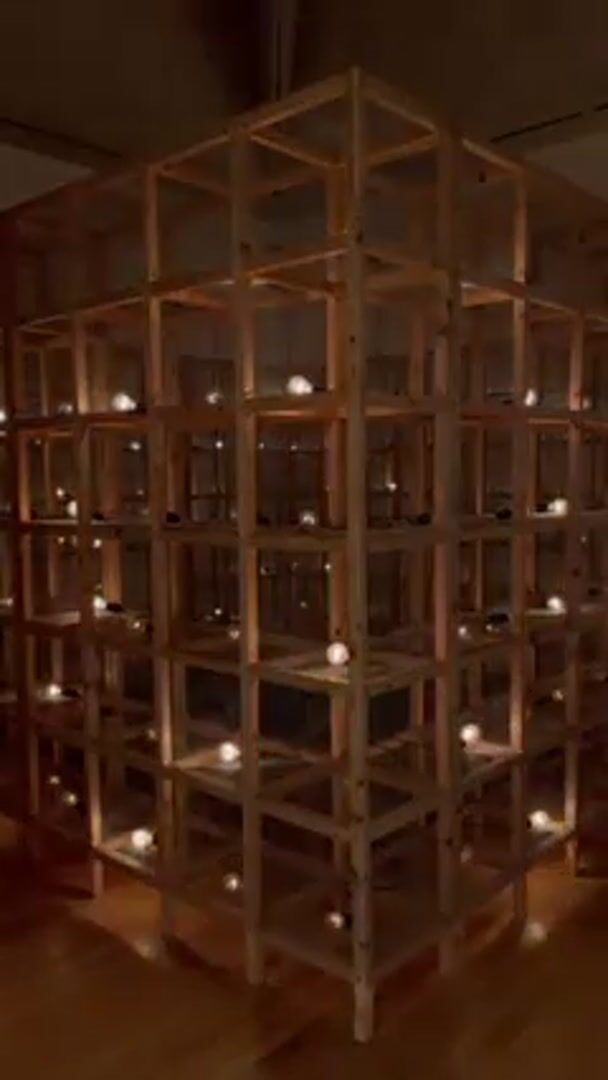
The video shows a large cubic structure made of wooden frames and wire mesh, divided into individual compartments. Each compartment contains a lit light bulb hanging from the ceiling. The lights inside create a warm glow that contrasts with the darkened environment around the structure. The structure is placed on a wooden floor in a room that appears to be an art gallery or exhibition space.
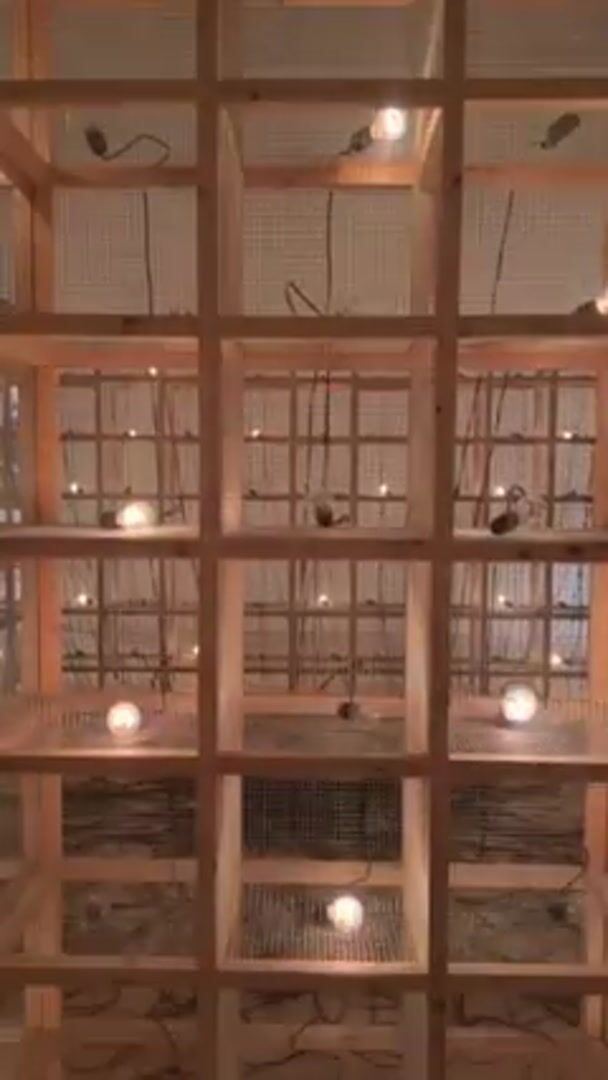
The video shows a wall composed of square compartments constructed from light wood. Each compartment contains a light bulb hanging by a wire. The lighting is dim, highlighting the bulbs. Some compartments have debris or loose materials on the bottom. The camera slowly pans upwards, showing the entire structure. There are no people visible in the video.
The scene is set within a gallery of the British Museum in London, United Kingdom. In the foreground, a light-colored wooden artist's easel stands, holding a brown clipboard. Attached to the clipboard by a metallic spring clip are multiple sheets of white paper. The visible papers display hand-drawn sketches in graphite or pencil; these include a stylized female face with wavy hair on the left, and a larger, more detailed stylized female face with prominent eyes, long eyelashes, and defined lips occupying the center. A small, simple sketch of a cat is visible to the right. The exposed brown surface of the clipboard is covered in extensive graffiti, including written names, symbols such as a circle-A anarchy symbol, and a partially obscured swastika. Through the frame of the easel and to its left, a gallery interior is visible, featuring a light brown, herringbone-patterned wooden floor and dark, possibly marble, architectural structures. In the midground, a large, reddish-brown marble sculpture depicting a muscular male figure (Hercules) holding a smaller figure (Telephus) is prominently displayed on a dark pedestal. The background further reveals a spacious museum hall with light-colored walls and additional architectural features.

 London, United Kingdom