Monday, March 9, 2026 · Updated Monday, March 9, 2026
Rome, Italy
Rome, a city steeped in history and spiritual grandeur, offers an unparalleled journey through centuries of art and architecture. An afternoon walking tour unfolds the city's profound legacy, guiding visitors through magnificent basilicas and their awe-inspiring interiors. Each stop reveals a new layer of Roman heritage, from ancient monuments to intricate Baroque masterpieces.
The image depicts a detailed section of a grand Baroque interior within the Basilica of Sant'Andrea della Valle in Rome, Italy, specifically focusing on the left-hand choir loft and its sculptural support.
In the upper portion, a large, ornate pipe organ is visible, featuring numerous vertical silver-colored metal pipes. The organ's dark wooden case is lavishly decorated with intricate gilded foliage and scrollwork. Below the organ, an elevated, curved balcony or choir loft extends, supported by a monumental marble sculptural ensemble. This balcony has a balustrade composed of grey balusters and a polished white marble top rail, accented with delicate carved details.
The primary sculptural support, located centrally, is carved from white marble and comprises three main elements. To the left, a winged, draped angelic figure is depicted in a seated or kneeling posture. This angel has flowing hair, a serene expression, and holds what appears to be a quill or stylus in her right hand, resting it against a large heraldic shield. Her left arm is bent, and large, detailed wings extend behind her.
At the center of the sculptural support is a prominent heraldic shield. At its apex, a papal tiara surmounts crossed keys, symbols of the papacy. Below these, the shield is quartered, displaying the coat of arms of the Chigi family, characterized by elements such as stylized mountains (often appearing as three conical peaks) surmounted by a star, and possibly other heraldic charges like oak branches in the alternating quarters.
To the right of the shield, a nude, corpulent infant figure (putto) is positioned, reaching upwards with both hands towards the underside of the balcony, amidst carved foliage elements. The entire sculptural group rests on a substantial marble architectural pier or column, featuring classical moldings, a decorative shell motif, and a patterned frieze at its base. An arched opening is visible to the right and below the sculpture.
The scene is primarily illuminated from the upper left, creating strong highlights on the white marble and gilded details, while the lower right and background areas are cast in deep shadow, enhancing the dramatic relief and depth of the intricate artwork.
The Basilica di Santa Maria sopra Minerva, a stunning example of Gothic architecture in Rome, houses breathtaking funerary monuments. Among them, the Monument to Cardinal Girolamo Bernerio commands attention with its dramatic skeletal figure draped in a shroud, enclosed by an ornate metal grate. Nearby, the Tomb of Maria Raggi showcases exquisite multi-colored marble, with winged putti supporting an oval medallion and a majestic lion statue at its base.
The image displays a carved memento mori emblem, consisting of a human skull positioned centrally above two crossed long bones, likely femurs. All bone elements are rendered in a light, yellowish-cream marble or alabaster, exhibiting numerous hairline cracks, particularly across the skull's cranium. This motif is mounted on a polished, dark green marble panel with mottled patterns. The green panel is framed by a narrow border composed of reddish-brown and yellowish-orange striated marble strips. Above and below this framed section, the image shows sections of a white marble architectural element with subtle gray veining and a classical molded profile. This decorative component is located within the Capuchin Crypt (Cimitero Cappuccino) beneath the Church of Santa Maria della Concezione dei Cappuccini on Via Vittorio Veneto, Rome, Italy.
Further along the tour, the Basilica of Sant'Andrea della Valle presents a lavish Baroque interior. Here, a grand pipe organ with gilded foliage is supported by a monumental marble sculptural ensemble. This includes a graceful angelic figure holding a quill and a prominent heraldic shield adorned with papal symbols and the Chigi family coat of arms, all illuminated to dramatic effect.
The image displays a white marble sculpture depicting the prophet Habakkuk and an angel, located within the Chigi Chapel of the Basilica of Santa Maria del Popolo in Rome, Italy. The sculpture features a winged, draped angel extending its left arm towards the head of a bearded, robed man identified as the prophet Habakkuk. Habakkuk is seated on a stack of objects, possibly books or a basket, and holds an open book or scroll in his left hand, gazing upwards towards the angel. The angel's right hand points forward, while its left hand appears to touch Habakkuk's head. The artwork is set within a deep, shell-domed niche, framed by white marble fluted pilasters. Above the niche, an ornate carved frieze features a central eagle with outstretched wings flanked by garlands. To the immediate right, a large reddish-brown marble panel of a funerary monument is partially visible, bearing a partial Latin inscription including "AUGUSTINO CHIGI SENENSI". To the left, a section of a framed oil painting, showing draped figures, is present.
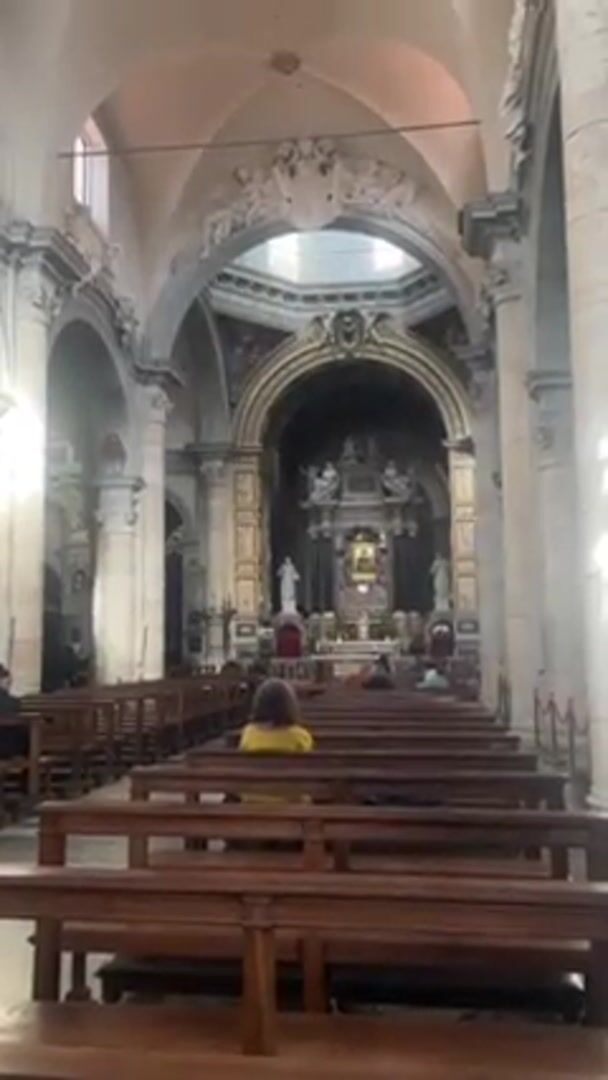
The image displays the interior of the Chiesa di Santa Maria dell'Anima, located in Rome, Italy, viewed from the nave looking towards the main altar.
The scene features a high, light-colored vaulted ceiling spanning the length of the nave. The nave is flanked by massive, light-toned stone columns with ornate Corinthian capitals, supporting a series of arches and upper architectural elements. Sculpted figures are visible on ledges above the arches. Further down the nave, a large archway frames the chancel, topped by an elaborate decorative crest. Beyond this arch, a dome featuring painted frescoes and an octagonal drum culminates in a skylight, allowing natural light to enter.
The focal point is the main altar, an elaborate multi-tiered structure situated at the far end of the chancel. It incorporates dark, possibly marble, columns, extensive golden decorative elements, and white marble statuary. A central altarpiece, a dark-toned icon of what appears to be a Madonna and Child, is prominently displayed within a gilded frame. White marble statues are positioned on pedestals flanking the altar structure.
In the foreground and midground, rows of dark wooden pews are arranged facing the altar. Approximately ten individuals are seated in these pews. They appear to be casually dressed and are facing forward towards the altar. No specific actions or interactions are discernible beyond their presence in the pews. Natural light illuminates the interior, streaming in from high windows on the left side of the nave and from the skylight within the dome, creating areas of brightness and shadow on the architectural elements.
Beyond the church walls, the journey extends to iconic public spaces. Piazza del Popolo, a bustling city square, offers glimpses of Roman daily life, even as its historic Chiesa di Santa Maria di Montesanto undergoes restoration. These diverse scenes, from the sacred to the civic, paint a vivid picture of Rome's enduring charm and its continuous dialogue between past and present.
A white marble statue of a female allegorical figure, identified as Abundance, stands prominently in Piazza Santa Maria Maggiore, Rome, Italy. The full-body statue depicts a draped woman holding a bundle of wheat stalks in her raised left hand and standing beside a basket filled with flowers at her right. A white bird is perched on her crowned head. The statue is elevated on a light-colored stone pedestal. Behind the statue to the left is a large, dense evergreen tree. To the right, a multi-story light tan building with multiple windows, each fitted with closed grey louvered shutters and ornate frames, rises into the frame. The sky above is blue with scattered white clouds and a visible aircraft contrail. A red and blue traffic sign is partially visible at the bottom right.
A young adult female takes a close-up selfie in an outdoor urban setting in Rome, Italy, specifically in the vicinity of Piazza di Spagna. The female, with dark hair pulled back and wearing a brown herringbone-patterned coat, looks directly at the camera with a neutral expression and slightly parted lips. Her face shows light makeup.
The background, under a bright blue sky with sparse white clouds, depicts a bustling public space. To the left, a prominent multi-story yellow building with arched ground-floor windows and rectangular windows on upper levels is visible. Behind and above this building, additional structures and bare deciduous trees indicate elevated terrain. In the mid-ground, below the yellow building, white canopy market stalls are set up with numerous pedestrians moving around. A dark-skinned male with a beard, wearing a light brown hooded sweatshirt, is partially visible to the left of the primary subject. To the right, bare trees with intricate branches extend upwards, and a black, ornate street light fixture is visible among them. A faint white vehicle is discernible in the far background.
The image displays an urban street scene in Rome, Italy, under an overcast sky. The location is consistent with a major thoroughfare, likely near Piazza della Repubblica or a boulevard leading from it, evidenced by the architectural style and a prominent Rome Metro "M" sign.
In the immediate foreground, bare tree branches partially obscure the upper left. A blonde-haired individual, seen from behind wearing a grey backpack, stands centrally in the lower frame, facing away from the camera.
The midground features a multi-lane street with vehicle traffic. A white tour bus and a red city bus are visible, both moving away from the viewer. To the left of the street, a modern, multi-story building with dark glass facades reflects the environment. To the right of the street, a long, multi-story historical building extends into the distance, characterized by a light peach-colored facade, white ornate trim, numerous windows with closed brown shutters, and decorative balconies. At street level, commercial establishments are present, including one with a white awning and a red square "M" logo, indicating an entrance to the Rome Metro. A multi-colored flag hangs from a balcony on this building.
Numerous pedestrians occupy the sidewalks and a wide pedestrian area to the right, moving in various directions. Their attire, including jackets and coats, suggests cool weather. Overhead power lines traverse the sky. In the background, against the grey clouds, multiple large construction cranes are visible above distant buildings, signifying ongoing development.
The experience is not just about observing but immersing oneself in the cultural richness. From the intricate carvings of religious art to the grand scale of historic architecture, Rome invites contemplation and wonder, cementing its place as an unforgettable destination for those seeking a true exploration of European heritage.
The image displays the exterior facade of the Porta del Popolo in Rome, Italy, under an overcast sky. The ancient gate, constructed primarily of weathered stone and brick, features a crenellated parapet along its top, adorned with regularly spaced decorative finials. Centered at the apex of the gate is a large circular emblem containing an eight-pointed star, positioned above an ornate coat of arms detailed with scrolls. Below this, two large rectangular panels containing Latin inscriptions are visible; the left panel includes "ANNO MDCCCXXIX," while the central one begins with "PIVS IIII PONT MAX." Two small, recessed windows are present between these inscription panels.
The gate's lower section includes a large central archway, its upper semi-circular portion filled with a decorative metal grid in a diamond pattern. To the left of the central arch, a smaller, unbarred archway is visible. A classical-style white marble statue of a draped male figure holding a scroll stands within a niche positioned between the central and left arches. Through the central archway, distant city buildings, a streetlight, and construction scaffolding are discernible. Through the left archway, a portion of a classical dome or rounded roof is visible.
At street level in the foreground, the top portions of several vehicles, including a dark-colored car, are present. To the right, a traffic light pole displays illuminated red lights for both vehicle traffic and pedestrian crossing. Two individuals are visible on the sidewalk in the lower right: one wearing a dark jacket and another in lighter clothing. The sky is covered by dense, grey clouds.
Rome, Italy · Mar 9, 2026, 12:12 PM
This image depicts the Monument to Cardinal Girolamo Bernerio, located within the Basilica di Santa Maria sopra Minerva in Rome, Italy.
The scene presents a funerary monument set into a marble wall. Centrally, a life-sized, bone-colored skeletal figure, draped in a flowing white shroud, is positioned within a recessed niche. The skeleton's hands are crossed over its chest. A dark, ornate metal grate with intersecting curvilinear bars encloses the niche, separating the skeleton from the viewer.
Above the niche, a white marble crest-like relief features a fruit-bearing tree supported by two lions rampant, with a fleur-de-lis motif at the upper corners. Flanking this central relief are two circular bronze medallions. The left medallion depicts a bare tree with an object in its branches, encircled by the Latin inscription "IN NIDULO MEO MORIAR." The right medallion shows a phoenix rising from flames, surrounded by the Latin inscription "UT PHOENIX MULTIPLICABOR DIES." The entire structure is composed of various types of marble, primarily light-colored and veined, providing a backdrop for the darker metal and bronze elements.
The image depicts the Porta Pia, a monumental gateway located in Rome, Italy, viewed from a street-level perspective on an overcast day. The gate is a robust stone structure, presenting a central larger archway flanked by two smaller, equally arched passages. These arches are framed by classical engaged columns and pilasters, supporting an entablature that features multiple rectangular stone plaques bearing Latin inscriptions, including "PIVS IIII PONT MAX" on the central plaque. Above the central inscription, a large, ornate coat of arms is integrated into the facade, crowned by a circular motif resembling a compass rose or star. The top edge of the gate is adorned with a series of decorative finials atop a crenellated parapet. A standing statue is visible within the leftmost archway.
In the foreground, an asphalt road with white striped crosswalk markings is present. On the left side of the road, a red hatchback car is parked next to a black metal barrier. Several bicycles are secured to this barrier on the sidewalk. On the right side of the frame, multiple black traffic light poles are visible, with red lights illuminated, indicating a stop. Approximately 10-15 individuals are gathered on the sidewalk and crosswalk area on the right, some walking across the street, others standing near the traffic lights. They are casually dressed. A silver or white car is visible among the pedestrians. Through the archways, further buildings with traditional Roman architecture can be seen, hinting at the urban environment beyond the gate. The sky above is entirely covered with dense, grey clouds, indicating overcast weather conditions.
The image depicts a detailed section of a grand Baroque interior within the Basilica of Sant'Andrea della Valle in Rome, Italy, specifically focusing on the left-hand choir loft and its sculptural support.
In the upper portion, a large, ornate pipe organ is visible, featuring numerous vertical silver-colored metal pipes. The organ's dark wooden case is lavishly decorated with intricate gilded foliage and scrollwork. Below the organ, an elevated, curved balcony or choir loft extends, supported by a monumental marble sculptural ensemble. This balcony has a balustrade composed of grey balusters and a polished white marble top rail, accented with delicate carved details.
The primary sculptural support, located centrally, is carved from white marble and comprises three main elements. To the left, a winged, draped angelic figure is depicted in a seated or kneeling posture. This angel has flowing hair, a serene expression, and holds what appears to be a quill or stylus in her right hand, resting it against a large heraldic shield. Her left arm is bent, and large, detailed wings extend behind her.
At the center of the sculptural support is a prominent heraldic shield. At its apex, a papal tiara surmounts crossed keys, symbols of the papacy. Below these, the shield is quartered, displaying the coat of arms of the Chigi family, characterized by elements such as stylized mountains (often appearing as three conical peaks) surmounted by a star, and possibly other heraldic charges like oak branches in the alternating quarters.
To the right of the shield, a nude, corpulent infant figure (putto) is positioned, reaching upwards with both hands towards the underside of the balcony, amidst carved foliage elements. The entire sculptural group rests on a substantial marble architectural pier or column, featuring classical moldings, a decorative shell motif, and a patterned frieze at its base. An arched opening is visible to the right and below the sculpture.
The scene is primarily illuminated from the upper left, creating strong highlights on the white marble and gilded details, while the lower right and background areas are cast in deep shadow, enhancing the dramatic relief and depth of the intricate artwork.
A female subject poses for a self-portrait, positioned in the foreground. She has light brown hair, parted centrally and styled loosely, light-colored eyes, and a subtle smile exhibiting dimples. Her lips are full. She is wearing a dark brown, double-breasted coat with wide lapels, featuring a visible herringbone weave. A light-colored strap, consistent with a shoulder bag, is visible over her right shoulder.
The background features the stone facade of the Santa Maria in Aracoeli church, located on Capitoline Hill in Rome, Italy. A wide, multi-tiered stone staircase leads up to the church entrance, partially obscured by the subject. The church facade is constructed from light-colored stone. Architectural details visible include a broken pediment with a sculpted relief, an inscribed rectangular stone plaque on the left, and a coat of arms mounted on the wall above the plaque. Further to the right, a grander entrance with a rectangular pediment and an ornate, possibly bronze, door is visible, along with a tall, arched window featuring vertical bars. The ground at the base of the steps is paved with cobblestones. The lighting is soft and diffused, indicating an overcast sky.
The image displays a carved memento mori emblem, consisting of a human skull positioned centrally above two crossed long bones, likely femurs. All bone elements are rendered in a light, yellowish-cream marble or alabaster, exhibiting numerous hairline cracks, particularly across the skull's cranium. This motif is mounted on a polished, dark green marble panel with mottled patterns. The green panel is framed by a narrow border composed of reddish-brown and yellowish-orange striated marble strips. Above and below this framed section, the image shows sections of a white marble architectural element with subtle gray veining and a classical molded profile. This decorative component is located within the Capuchin Crypt (Cimitero Cappuccino) beneath the Church of Santa Maria della Concezione dei Cappuccini on Via Vittorio Veneto, Rome, Italy.
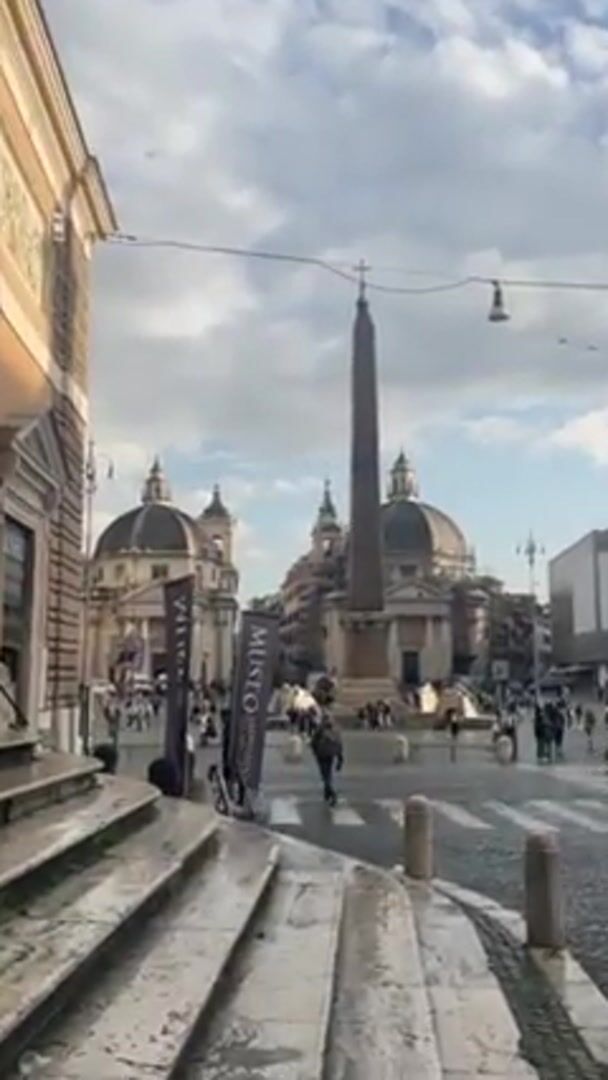
The image displays a street scene at Piazza del Popolo in Rome, Italy, viewed looking south towards Via del Corso. On the left, the facade and dome of Santa Maria dei Miracoli are visible, featuring classical columns, statuary in niches, and a prominent bell tower topped with a cross. A multi-lamp street light is positioned in the foreground on the left. On the right, Santa Maria in Montesanto is partially obscured by extensive scaffolding, indicating ongoing renovation or construction, though its dome and bell tower, also topped with a cross, are discernible. Via del Corso extends into the distance between the two churches, lined on both sides by multi-story buildings. Overhead wires and suspended streetlights traverse the street. The sky is dominated by a mixture of bright white cumulus clouds and darker grey clouds, with a patch of clearer, lighter sky in the center. A dark bird is visible in flight in the upper left quadrant, silhouetted against the sky.
The image displays a white marble sculpture depicting the prophet Habakkuk and an angel, located within the Chigi Chapel of the Basilica of Santa Maria del Popolo in Rome, Italy. The sculpture features a winged, draped angel extending its left arm towards the head of a bearded, robed man identified as the prophet Habakkuk. Habakkuk is seated on a stack of objects, possibly books or a basket, and holds an open book or scroll in his left hand, gazing upwards towards the angel. The angel's right hand points forward, while its left hand appears to touch Habakkuk's head. The artwork is set within a deep, shell-domed niche, framed by white marble fluted pilasters. Above the niche, an ornate carved frieze features a central eagle with outstretched wings flanked by garlands. To the immediate right, a large reddish-brown marble panel of a funerary monument is partially visible, bearing a partial Latin inscription including "AUGUSTINO CHIGI SENENSI". To the left, a section of a framed oil painting, showing draped figures, is present.
The image depicts an urban scene in Piazza del Popolo, Rome, Italy, centered on the facade of the Santa Maria dei Miracoli church. The church features a large, grey-tiled dome topped with a lantern and a cross finial. Its classical portico is supported by four fluted Corinthian columns beneath a triangular pediment. The inscription "HIER. S. R. E. PR. CARD. GASTALDVS" is visible above the columns. A dark double door serves as the entrance, accessible via several steps. Sculptures are positioned on the pediment and along the roofline. To the left, a multi-story building with light-colored walls and dark green louvered shutters lines a street. Scaffolding covers a section of the building's upper facade, and multiple flags, including the Italian flag, hang vertically. The street is populated by vehicles, including a white SUV and several white cars resembling taxis, receding into the distance. Approximately a dozen individuals are visible in the foreground and on the church steps; some are walking, others are standing or seated. One person in the immediate foreground holds a mobile phone. The sky is partly cloudy with diffused daylight. A black ornate lamppost with two lights is partially visible on the far right.
The image displays the interior of the Chiesa di Santa Maria dell'Anima, located in Rome, Italy, viewed from the nave looking towards the main altar.
The scene features a high, light-colored vaulted ceiling spanning the length of the nave. The nave is flanked by massive, light-toned stone columns with ornate Corinthian capitals, supporting a series of arches and upper architectural elements. Sculpted figures are visible on ledges above the arches. Further down the nave, a large archway frames the chancel, topped by an elaborate decorative crest. Beyond this arch, a dome featuring painted frescoes and an octagonal drum culminates in a skylight, allowing natural light to enter.
The focal point is the main altar, an elaborate multi-tiered structure situated at the far end of the chancel. It incorporates dark, possibly marble, columns, extensive golden decorative elements, and white marble statuary. A central altarpiece, a dark-toned icon of what appears to be a Madonna and Child, is prominently displayed within a gilded frame. White marble statues are positioned on pedestals flanking the altar structure.
In the foreground and midground, rows of dark wooden pews are arranged facing the altar. Approximately ten individuals are seated in these pews. They appear to be casually dressed and are facing forward towards the altar. No specific actions or interactions are discernible beyond their presence in the pews. Natural light illuminates the interior, streaming in from high windows on the left side of the nave and from the skylight within the dome, creating areas of brightness and shadow on the architectural elements.
The image depicts a monumental architectural complex at the base of the Monument to Victor Emmanuel II (Vittoriano) in Piazza Venezia, Rome, Italy, viewed looking upwards towards the monument's structures and the Capitoline Hill.
In the immediate foreground, a brick wall is partially visible, behind which several vehicles, including sedans, a light-colored van, and a white emergency or police vehicle with a blue stripe and "30" marking, are parked. Symmetrically positioned on this wall are two large, white stone sphinx statues, facing outwards.
The midground is dominated by a multi-tiered, white classical stone structure. Its lowest visible tier features a facade with three recessed arched niches, at least one of which contains a white classical statue. Above this tier, a balustrade supports at least four standing male statues in classical Roman attire, evenly spaced. A tall, ornate grey stone column emerges slightly right of center from behind this balustrade. This column features relief carvings, including what appear to be ship prows (rostra), and is topped by a large, winged figure holding multiple shields. Behind and above this structure, a wide set of stone stairs or terraced pathways with balustrades ascends, partially obscured by dense foliage.
The background is filled with a dense canopy of dark green trees, including distinctive flat-topped Italian stone pines (Pinus pinea) on the left, indicating a hillside. A glimpse of another white architectural element, possibly a balustrade or building facade, is visible crowning the hilltop on the upper right. The sky overhead is uniformly clear and light blue. No identifiable living individuals are present in the scene. The lighting suggests a clear day with natural sunlight from the left.
The image displays a wide-angle view of the Piazza del Popolo in Rome, Italy, dominated by the Porta del Popolo archway under an overcast sky.
The central feature is the Porta del Popolo, a monumental archway constructed from light-colored stone. It comprises a large central arch and a smaller arch to its left, both permitting passage. Above the central arch, an inscription reads "FELIC.FAVSTO.Q.INGRES / ANNO DOM.MDCLV". The upper section of the archway is adorned with baroque decorative elements, including carved reliefs and a prominent star emblem at its peak. Through the central arch, a street or plaza with additional buildings is visible.
To the left of the archway, a multi-story building with a light-colored facade is partially visible, featuring a sign that reads "PIAZZA GIACOMO ACQUA". To the right of the archway, a multi-story building with an ochre-toned facade, characterized by patterned brickwork and decorative carvings, is present. A vertical banner sign affixed to this building displays "MUSEO" at the top and "LEONARDO DA VINCI" below, indicating a museum. A dome is visible at the far right edge of the frame.
The foreground and midground of the paved square are populated by dozens of individuals. These pedestrians, appearing to be a mix of locals and tourists, are casually dressed and are engaged in walking, standing, and observing the surroundings. Some individuals are seen interacting or using mobile devices. A tall, black metal lamppost equipped with two streetlights stands centrally in the foreground, partially obscuring the upper section of the Porta del Popolo. A few parked vehicles are visible along the left side of the frame. The scene conveys a bustling urban environment.
The image captures a selfie of a female subject in Piazza del Popolo, Rome, Italy, under an overcast sky.
The primary subject, a young adult female, occupies the foreground and center, facing the camera. She has dark hair styled loosely upward and is wearing a dark brown, possibly herringbone-patterned, collared winter coat. Her expression is neutral with a slight smile.
In the background, to the subject's left, a multi-story building with a light-colored facade, ornate window details, and numerous rectangular windows fitted with light-colored closed shutters is visible. A circular window is present on a lower level. A decorative black lamppost protrudes from this building. A blue parking sign with a white 'P' is partially visible at the bottom left. The back of a person wearing a dark coat is partially visible near the building's base, below a dark awning.
To the subject's right, the prominent Baroque facade and dome of Santa Maria in Montesanto, one of the twin churches of Piazza del Popolo, are clearly visible. The church features classical columns and intricate architectural elements. Below the church facade, a line of white vehicles, consistent with taxis, is parked along a street.
The ground surface in the foreground appears to be paved with cobblestones.
The image displays a plain, solid teal-colored background. Centered horizontally and vertically on this background is the white text "#Superstitions". There are no other discernible subjects, objects, people, actions, or interactions present. The image does not depict any identifiable location within the city of Rome, Italy, or any other specific geographical environment.
A low-angle close-up depicts a young adult female looking directly at the camera, exhibiting a slight smile. Her light-colored hair is loosely styled. She is wearing a dark brown, herringbone-patterned wool coat with broad lapels. A light brown leather bag strap is visible over her right shoulder. The sky behind her is largely overcast, dominated by gray clouds. In the upper left quadrant, the corner of a light-colored building, exhibiting classical Roman architectural features such as a prominent cornice and a window with dark blue shutters, is visible. The scene is located in the city of Rome, Italy.
The image depicts a young woman taking a selfie in a city square, identified as Piazza del Popolo in Rome, Italy. The woman, positioned in the foreground, has brown hair tied back and blue eyes, and is wearing a dark brown, possibly wool, overcoat. Her expression is neutral with slightly parted lips.
Behind her, a queue of white taxi vehicles is parked on a cobblestone street marked with yellow lines. The first taxi is a white van with a "TAXI" sign on its roof. A person wearing a brown jacket is partially visible behind this vehicle. Further down the queue, other white taxis, including a Kia Niro, are visible. To the right, a concrete bollard with a rounded, weathered top stands on the cobblestones.
In the background, the prominent structure is the Chiesa di Santa Maria di Montesanto, a classical-style church with a large dome currently undergoing restoration, indicated by extensive scaffolding covering its dome and parts of its facade. Another classical building with columns is partially visible to the left of the church. Multi-story buildings with numerous windows line the background to the right. The sky is overcast.
Rome, Italy · Mar 9, 2026, 12:23 PM
The image displays the Obelisco Agonale (Obelisco di Domiziano) in Piazza Navona, Rome, Italy, under an overcast sky with significant cloud cover.
The central and dominant feature is a tall, slender, greyish-brown granite obelisk, extensively carved with Egyptian hieroglyphs. It tapers towards its apex, which is adorned with a bronze finial culminating in a starburst or sunburst-shaped ornament. The obelisk rests on a robust base of lighter-colored stone, showing some signs of weathering and minor cracking.
To the left of the obelisk, a large, multi-story building, identified as the Palazzo Pamphili, occupies the background. It features a light beige facade, a brown tiled roof, and numerous rectangular windows with light-colored shutters, some open, some closed. The ground floor presents a series of arched windows or alcoves. A portion of a construction crane or scaffolding is visible above the building's roofline on the far left.
To the right of the obelisk, a lower building with a beige facade and a prominent dark dome, topped by a smaller cupola and a cross, is visible. This structure is part of the Sant'Agnese in Agone complex. A blue flag is visible near the base of the obelisk, against this building.
In the mid-ground, several black, ornate streetlamps with multiple arms and white, bell-shaped fixtures are positioned, one prominently to the right of the obelisk and another smaller one to its left. At the bottom edge of the frame, partially visible white marble sculptures, consistent with elements of a public fountain (likely the Fontana del Nettuno), include what appears to be a large animal figure (possibly a lion) and part of a human statue. No clearly identifiable people or specific actions are discernible within the visible scene.
The image depicts an urban street scene in Rome, Italy, specifically at the intersection near the Roman Forum and Piazza Venezia, featuring the churches of Santi Luca e Martina and Santa Maria di Loreto.
On the left, the facade of Santi Luca e Martina is visible, constructed from light-colored stone with large engaged columns featuring ornate Corinthian capitals. A curved entablature supports a balustrade topped with at least two sculpted figures. Partial Latin text "...TALDVS..." is inscribed on the frieze. A coat of arms or plaque is affixed to the lower section of the church wall. Approximately seven individuals, predominantly young adults in casual attire, are seated on the stone steps at the church's base.
In the midground, a multi-story building with a light pink facade and numerous windows with dark shutters stands behind the street. To the right, the church of Santa Maria di Loreto is heavily covered in a multi-level metal scaffolding structure, indicating ongoing renovation or construction. The upper portion of its ornate Baroque bell tower, featuring a cupola and a cross finial, is visible above the scaffolding.
The foreground shows a paved street with a clearly marked pedestrian zebra crossing. A dark bollard and a lamppost are present. A white object, possibly a discarded cup, lies on the street near the crossing. A group of approximately fifteen to twenty pedestrians, casually dressed, is gathered on the right side of the street near the crossing and the scaffolded church. Some appear to be standing, others walking, with one individual prominent in a bright yellow top. The sky is uniformly overcast with grey clouds. No explicit interactions are clearly discernible between the groups of people.
An outdoor urban scene in Piazza del Popolo, Rome, Italy, is depicted under an overcast sky. The image centers on a young adult female in the foreground, captured in a self-portrait.
The female subject, visible from the chest up, has light skin and dark brown hair loosely pulled back. She wears a dark brown herringbone-patterned wool coat and displays a faint smile while looking directly at the camera.
In the background, two Baroque churches flank the central perspective. To the left, Santa Maria in Montesanto is visible with its classical facade featuring prominent Corinthian columns, a pediment, and sculptural details. Part of an inscription, "ALDVS," is legible on its entablature. Several indistinct individuals are seated on the stone steps leading to this church. To the right, Santa Maria dei Miracoli features a large dome entirely enveloped by extensive metal scaffolding, indicating ongoing restoration work. A bell tower adjacent to this dome is also partially scaffolded.
Between the churches and behind the primary subject, a paved public square contains multiple indistinct pedestrians walking across it. Further to the right in the mid-ground, white and yellow construction barriers are visible, displaying partial text such as "CAPITOL" and "MUN." The ground in the immediate foreground is paved with light-colored cobblestones.
The image displays the Baroque facade of the Basilica of Santa Maria in Via Lata, located on Via del Corso in Rome, Italy. The grand, light-colored stone facade is dominated by a portico featuring six large, unfluted columns with Corinthian capitals, supporting an entablature. The inscription "HIER. S. R. E. PR. CARD. GASTALDVS" is prominently displayed on the entablature. Above this, a triangular pediment is topped with a small finial and two stone statues, one on each corner. Additional statues adorn the roofline to the left and right of the pediment.
At the center of the facade's lower level is a dark, double-leaf wooden door set within an arched stone frame, above which "ANNO DOMINI MDCXX" is partially visible. A colorful crest or emblem is affixed to the wall to the right of the entrance, between two columns. The building material appears to be light-colored stone, exhibiting some signs of age. The sky above is overcast with a blanket of grey and white clouds.
In the foreground, at the base of the church's facade, approximately ten individuals are seated or resting on a low stone ledge or steps. They are dressed in casual clothing, including jackets, hoodies, and jeans, characteristic of cooler weather. Their postures suggest a relaxed state, with some looking down and others observing their surroundings. The image is captured from a low-angle perspective, emphasizing the imposing height of the basilica.
The image captures a view looking down a narrow street in the city of Rome, Italy. Multi-story buildings line both sides of the street, featuring pale facades, prominent cornices, and numerous tall windows equipped with dark, closed wooden shutters. The building on the left displays a rooftop garden with visible greenery. Similarly, the building on the right shows some foliage on its upper levels. The sky overhead is overcast, with dense, light-grey clouds showing brighter patches of indirect sunlight. Multiple black wires are strung across the street between the buildings, with two dark, bell-shaped streetlights suspended from them in the upper mid-ground. Further down the street on the left, several red flags are visible hanging from balconies. On the right side of the street, a green cross sign and blue circular traffic signs are discernible. The top of at least one human head is visible at the very bottom edge of the frame. In the far distance, a large, light-colored architectural structure with columnar features is faintly visible.
An electric bicycle is parked on a dark grey tiled sidewalk next to a large, weathered stone building in Rome, Italy. The bicycle is dark grey with fat tires, a brown leather-like seat, and features a visible battery pack on the downtube. A blue U-lock secures the bicycle to a metal fixture or part of the building. A black circular headlight is mounted at the front, and a red taillight is present at the rear. A small black bag is attached near the handlebars. The building displays multiple classical columns with heavily weathered, light-colored stone, and dark, recessed windows are visible between the columns. Asphalt pavement and a curb are visible to the left of the sidewalk. No individuals are present in the scene.
The image displays an urban street scene in Rome, Italy, specifically in the vicinity of Via del Corso. The perspective looks down a narrow street flanked by multi-story buildings under an overcast, cloudy sky.
On the left, a multi-story building features a peach-orange facade with white trim, multiple windows fitted with closed light-colored shutters, and wrought iron balconies. Greenery is visible on its rooftop. On the right, another multi-story building exhibits a facade with sections of grey-blue and peach-orange, also featuring white trim, windows, and wrought iron balconies. Two vertical red banners, each displaying the white text "POP MART," hang prominently from this building. Further down the street on the right, a building appears partially covered by scaffolding and white tarps. Multiple dark-colored, bell-shaped street lamps are suspended across the street by overhead wires. No individuals, vehicles, or explicit actions are visible within the frame.
A young woman with light skin, blue eyes, and dark hair pulled into an updo occupies the foreground, centered in a selfie-style photograph. She wears a dark brown herringbone-patterned overcoat with wide lapels and a deep V-neck, looking directly at the camera with a neutral expression. The scene is an urban street in Rome, Italy, under an overcast sky. To the left of the woman, a large dark green wooden door with multiple panels, a brass kickplate, and a brass letterbox is visible, set within an aged ochre-colored building. A white sign with dark text and a logo, including the word "AGROUP," is affixed to the wall next to the door. To the woman's right, a narrow street extends into the background, lined with multi-story buildings characteristic of Roman architecture, featuring facades in shades of reddish-orange and pale yellow, with numerous windows and balconies. Several pedestrians are walking away from the camera in the distance; discernible figures include a woman in a denim jacket and gray shorts, a woman in a white top and dark pants carrying a bag, and a man in a dark t-shirt and light pants.
A young woman wearing a brown coat walks on a street. The street is lined with buildings. People can be seen in the background. The woman appears to be filming herself with a phone or camera.
An ornate funerary monument crafted from multi-colored marble stands within a grand architectural interior, likely a church, characterized by light-colored fluted columns and classical architectural elements. The monument is the Tomb of Maria Raggi, located in Santa Maria sopra Minerva, Rome, Italy.
At the top, two white marble winged putti support a large, gold-framed oval medallion. Inside the medallion, a white marble relief depicts a woman's profile bust, facing right, with an elaborate hairstyle. Above the putti, a partial view of a white marble bird (possibly a dove or eagle) is visible.
Below, a large drapery, carved from deep red polished marble with extensive gold trim and fringe detailing, descends vertically. This drapery is inscribed with Latin text. Dark, stylized tree branches and foliage, possibly of bronze or dark marble, emerge from behind and around the red drapery.
At the base of the monument, a white marble lion statue is depicted rearing on its hind legs, with its front paws resting on a naturalistic, rocky white marble base. The lion has an open mouth, appearing to roar or vocalize, and a collar around its neck. Dark, vine-like foliage with leaves wraps around the rocky base and extends upwards. The entire monument is set against a dark grey or black polished marble slab that forms a significant portion of its background.
Rome, Italy · Mar 9, 2026, 3:02 PM
An image taken indoors depicts a young adult female from the chest up, positioned slightly off-center and facing the camera directly with a neutral expression. She has brown hair and light eyes, with a reddish tint on her lips. She is wearing a dark brown, possibly wool, overcoat featuring a wide collar and lapels, over a darker garment. The background indicates a historic building interior, specifically a church, located in Rome, Italy. To her left, a large, dark wooden architectural element or furniture piece, possibly a sacristy cabinet or choir stall, occupies the left half of the frame. This piece exhibits recessed rectangular panels and intricate carving along its upper edge, with a small metallic decorative fixture visible on its upper left. To her right, a light-colored wall features a Baroque-style bas-relief sculpture of at least two winged putti. Above the putti, a rectangular plaque, potentially an inscription, and a small cross are visible. Lighting appears to be natural, entering from an unseen source high and to the left, casting shadows and highlights across the scene.
The image displays the interior of St. Peter's Basilica, located in Vatican City, Rome, Italy. The scene shows a grand, elongated hall or nave with high vaulted ceilings and a series of monumental arches supported by colossal fluted columns with ornate capitals, extending into the background.
On the left side of the foreground, a large, multi-component funerary monument, identified as the Tomb of Urban VIII, is prominently featured. This monument is predominantly red and gold, with a large white marble eagle sculpture at its upper left. Below the eagle, two white marble cherubs are depicted holding a golden oval medallion that contains a white marble bust of a robed figure. Further down the monument, golden inscriptions are visible on a red background, and a white marble lion sculpture is visible at the very bottom left, facing right.
Further into the mid-ground on the left, beyond the large tomb, a tall white marble statue of a robed figure stands on a patterned marble pedestal. The floor throughout the visible area is composed of polished marble tiles with geometric patterns.
Two adult males are present in the mid-ground, walking away from the viewer down the central aisle. The individual on the left wears dark trousers and a dark long-sleeved shirt. The individual on the right wears dark trousers and a dark jacket or coat. The basilica is brightly lit, with light illuminating the architectural and sculptural details from above and to the right, casting soft shadows.
The image displays the interior of the Basilica di Santa Maria Maggiore, located in Rome, Italy. The scene shows a grand church nave characterized by elaborate Baroque architecture.
Massive, light-colored fluted stone columns with ornate Corinthian capitals line the left and right sides of the nave, supporting a series of high, light-colored arches that lead to a vaulted ceiling. Above the arches, intricate decorative friezes are visible, featuring sculpted figures, including angels, and architectural details. Bright natural light streams in through high, rectangular windows positioned above the arches on the right side.
In the mid-ground, multiple rows of dark brown wooden church pews, equipped with black padded kneelers, are arranged facing away from the viewer. A red velvet rope barrier, supported by two brass stanchions, defines a section in the immediate foreground, running diagonally from the bottom right towards the left.
One individual, wearing a dark coat or jacket, stands in the aisle between the pews in the middle ground, viewed from behind. Other indistinct figures are visible further in the background, near various altars or chapels within the extensive, dimly lit areas of the basilica. The floor consists of light-colored, possibly marble or stone, tiles.
A detailed image captures the Funerary Monument to Maria Flaminia Chigi Odescalchi, located within the Basilica di Santa Maria Maggiore in Rome, Italy.
The monument is a large, ornate Baroque structure affixed to a church wall, extending vertically. A central oval medallion, framed in gold with an internal black field, displays a white marble bust of a woman in profile, facing right, with an elaborate hairstyle. Two white marble winged putti suspend this medallion with golden chains, positioned to its upper left and right. Above these figures, the wings of a large white marble eagle are partially visible. Below the medallion, a voluminous red marble drapery, edged with gold fringe and tassels, flows downwards. This drapery bears a multi-line inscription in Latin, rendered in gold lettering, starting with "MARIAE FLAMINIAE ODESCALCHAE CONJUGI CARISSIMAE".
At the base of the monument, on the left, a white marble lion statue stands on sculpted white rocks, depicted mid-roar with its mouth open. Dark, stylized tree branches and foliage intertwine around the base and beneath the red drapery. On the right side of the base, a white marble urn or vase emits sculpted, cloud-like forms. The monument is set against a dark, polished stone or marble background. To the right, a large, fluted marble column with a visible Corinthian capital rises, indicating a grand interior. The background to the left shows blurred architectural details and faint framed artworks. Ambient light enters from an unseen high window on the right.
The image depicts the interior of the Contarelli Chapel within the Church of San Luigi dei Francesi (Saint Louis of the French) in Rome, Italy. The view is centered on the chapel's altar and dome.
A high, coffered dome is visible at the top, featuring several square windows through which bright light enters, creating distinct rays of light in the dusty air. The dome's interior is decorated with frescoes depicting figures. Below the dome, a circular frieze with Latin text runs along the base. The chapel walls are structured with fluted pilasters and cornices in reddish-brown and white marble.
The central feature is a large altarpiece, an oil painting depicting "The Martyrdom of Saint Matthew" by Caravaggio. This dark-toned artwork shows a dynamic scene with multiple figures, including a partially nude executioner, Saint Matthew, and observers, amidst a dramatic composition. Below the painting, a rectangular, dark bronze relief sculpture is mounted on a white marble base.
Flanking the altarpiece are two tall, ornate dark metal candlesticks, each holding a long, unlit yellow candle marked with a Chi-Rho symbol. To the left and right of the main painting, within recessed niches, are white marble sculptures. The sculpture on the left depicts a standing male figure. The sculpture on the right shows a group of figures in a more active, intertwined pose.
The lower foreground reveals the top of a dark wooden structure and a section of a veined marble surface, suggesting an altar rail or furniture. The lighting from the dome windows strongly illuminates the upper sections of the chapel, contrasting with the darker tones of the altarpiece and lower areas.
A single female subject is positioned in the foreground, looking directly at the camera. She has light skin, light-colored eyes, and dark brown hair loosely gathered atop her head. Her lips are tinted red. She wears a dark brown, textured overcoat with a prominent collar, covering a darker garment visible at the neckline.
The background reveals the ornate interior of a Baroque chapel. This is the Chigi Chapel within the Basilica di Santa Maria del Popolo, located in Rome, Italy. The chapel features a highly decorative domed ceiling adorned with frescoes depicting figures and elaborate stucco work, including a central shell motif. On either side of the subject, two multi-paned windows allow natural light into the space. Below the windows, two significant funerary monuments are visible. On the viewer's left, a large sarcophagus or tomb structure supports a reclining or seated marble figure, with a bust below. On the viewer's right, a similarly grand monument features a dynamic, allegorical marble figure draped in fabric, emerging above a pedestal or sarcophagus, also accompanied by a bust. These are identifiable as the tombs of Agostino Chigi and Cardinal Sigismondo Chigi, respectively, designed by Gian Lorenzo Bernini. A white marble balustrade with numerous balusters extends across the mid-ground, separating the immediate foreground from the main chapel space. The floor appears to be a light-colored, possibly marble, surface. The overall scene is well-lit by natural light entering through the windows, highlighting the intricate architectural and sculptural details.
The image depicts the interior of the Basilica di Santa Pudenziana in Rome, Italy. The scene presents a wide view of a large, historically significant church characterized by high vaulted ceilings and massive, light-colored fluted stone columns supporting arched openings.
At the far end, a grand altar area is centered with a large, dark-framed altarpiece painting depicting a religious scene with multiple figures. Dark columns with gold accents flank this altar. Side altars or chapels containing additional religious artworks are visible to the left and right. Above the main arches, decorative cornices feature reclining sculptural figures. Two rectangular windows high on the walls admit bright natural light, causing prominent lens flares in the upper portion of the image. Latin inscriptions, including "SPUDENTIA" and "CATHARINA," are visible on the columns. The floor is patterned marble in dark gray and white tones.
Approximately 10-15 individuals are present, primarily in the midground and background, near the central altar. One individual in a black top and light pants stands to the right, near rows of dark wooden pews. The pews are arranged facing the altar and are separated by red velvet ropes on golden stanchions. The lighting transitions from bright natural light entering from above to subdued ambient light at ground level.
This image captures a detail of the Monument to Agostino Chigi, sculpted by Giovanni Battista Maini, located in the Basilica of Santa Maria del Popolo in Rome, Italy. The scene depicts a large, white marble funerary monument positioned against a fluted marble wall.
The primary subject is a standing allegorical figure, possibly an angel or spirit, carved from white marble, positioned on the left side of the monument. This figure is depicted with large, elaborately feathered wings extending behind its left side. It wears flowing, pleated robes that extend to its bare feet, visible at the base. Its head is slightly tilted upwards and to the right, with a serene expression. Its right arm is raised, holding a spherical object, possibly a globe or urn, with both hands.
To the right of this main figure, a rectangular marble plaque forms the central element of the monument, bearing a multi-line inscription in Latin, partially legible and referring to "AUGUSTINI I. PRINC. CHISII" and dates including "AN MDCCLXXV." Below and to the right of the inscription, a second allegorical figure, a draped female, is partially visible. Her head rests on her right arm, and she appears to be looking towards the viewer, with her left arm extending towards the inscription.
The monument is crafted from white marble, with a visible reddish-brown marble base. The background features vertically fluted marble pilasters or columns on the left, transitioning to darker, less detailed architectural elements towards the top and right, suggesting a deeply recessed or dimly lit section of the interior. Illumination from the left casts distinct shadows, enhancing the sculptural depth and textural detail of the drapery and feathers.
This image depicts the ornate Baroque interior of the Paluzzi Albertoni Chapel within the Church of San Francesco a Ripa Grande, located in the Trastevere district of Rome, Italy.
The scene features a large, framed oil painting, "The Adoration of the Shepherds" by Giovan Battista Gaulli (Baciccio), as its central altarpiece. The painting, rendered in dark tones, shows multiple figures clustered around a brightly lit central group, with a distinct reflective glare spot visible on its lower right quadrant. Below the painting, a dark marble altar base supports a central rectangular bronze bas-relief plaque, depicting a dense group of figures, flanked by two inscribed white marble plaques.
The walls are extensively adorned with intricate stucco or carved stone pilasters and panels, featuring classical and foliate motifs. Two tall, rectangular windows, each with multiple small panes, are positioned on the opposing side walls, admitting diffused natural light into the chapel. Below each window, on an ornate pedestal, rests a white marble portrait bust: the left bust portrays a bearded male figure, identified as Giacomo Paluzzi Albertoni, while the right bust depicts a male figure with draped headwear, identified as Cardinal Ludovico Altieri. The vaulted ceiling is covered with painted frescoes set within decorative panels, separated by elaborate stucco ornamentation that includes winged putti figures and shell motifs. The overall aesthetic is one of rich, classical Baroque design with a muted color palette, highlighted by the white marble and bronze elements.
The image displays a dark wooden statue of the Mater Dolorosa (Our Lady of Sorrows) positioned within the Chapel of Saint Philip Neri in the Chiesa Nuova (Santa Maria in Vallicella), Rome, Italy. The full-height statue stands on a dark, tiered pedestal. The female figure is draped in dark, heavy fabric, with a hood covering her head and a light brown or golden-colored fabric visible at her neck and chest. A reddish-brown fabric appears around her feet. Her hands are clasped together at chest level, and her face, with dark features and a reddish-brown complexion, conveys an expression of profound sorrow. The background consists of a light-colored wall with architectural details: a multi-paned window in the upper left, an oval-framed portrait of a person in profile to the left, and decorative pilasters and carved friezes across the wall surface. Light illuminates the statue from the left, casting a soft shadow to its right on the wall.
Rome, Italy · Mar 9, 2026, 3:09 PM
The image depicts the interior of the Ginnetti Chapel, located within the Basilica di Sant'Andrea della Valle in Rome, Italy.
A large wooden crucifix, featuring the dark, anatomically detailed figure of Jesus Christ wearing a white loincloth, is centrally mounted against a vibrant red panel. This panel is framed by an ornate, gilded architectural structure comprising two fluted Corinthian columns supporting a decorated entablature. Below the crucifix, a marble altar is present. Its front panel is crafted from yellow-orange marble with a central green and white circular inlay, displaying significant surface wear, flaking, and discoloration. On the altar's surface, directly beneath the crucifix, a small, dark bronze sculptural grouping of indeterminate figures is positioned.
The chapel walls are light-toned, adorned with decorative pilasters, stucco work, and relief carvings. On the lower left wall, a circular portrait in an oval frame depicts a dark-haired man in profile, facing right. Two tall, multi-paned windows, one on each side of the central altar structure, admit bright, diffused light into the space. The vaulted ceiling features stucco ornamentation and faded frescoes depicting religious scenes. The floor is constructed of dark, large-format stone tiles. No individuals are present in the scene.
This detailed image captures a section of an elaborate Baroque funeral monument within the Basilica of Sant'Andrea della Valle in Rome, Italy.
The central focus is a large, ornately carved marble or stone sculpture group. On the right, a draped, winged female figure (an angel) with flowing garments is depicted in a dynamic posture, supporting a prominent, scrolled shield or cartouche with both hands. To the left, a nude putto (child-like figure) with curly hair also assists in supporting the shield, while clutching decorative foliage. The shield itself displays a complex coat of arms, featuring three bees in the upper section, a tree on the left, and a star on the right, indicative of the Barberini family crest.
Above this sculpture group, a curved architectural element is visible, featuring a gray marble balustrade with dark balusters, topped by a dark wooden railing adorned with gilded acanthus scrollwork. Behind this, dark, vertical elements, consistent with organ pipes, are discernible, indicating an organ loft or tribune.
Below the main sculpture, a marble pedestal or architectural base features a central niche. Within this niche stands a classical marble bust of a man, flanked by two smaller, standing, draped figures, possibly putti or allegorical representations. Above this niche, a smaller, crowned coat of arms is carved into the stone.
To the lower-left, a segment of an archway with elaborate carved relief is present. Beyond this, a secondary archway reveals a glimpse of a frescoed ceiling with warm, reddish tones. To the lower-right, partially obscured by shadow, a stained-glass window with distinct heraldic elements is visible.
The entire scene is rendered in predominantly light-colored marble or stone, showcasing intricate carving and detail characteristic of the Baroque period, illuminated by natural light that creates distinct shadows and highlights.
This image captures the main altar of the Chapel of the Adoration of the Shepherds within the Basilica of San Paolo fuori le Mura (St. Paul Outside the Walls) in Rome, Italy.
The central subject is a large rectangular oil painting titled "The Adoration of the Shepherds" by Giovanni Lanfranco, set within an ornate dark, veined marble frame. The painting depicts multiple figures: the Virgin Mary in a blue robe, Saint Joseph, several shepherds, and the Christ Child in the lower section, while numerous putti and angels are visible in a radiant light within the clouds above.
Flanking the painting are two monumental white marble sculptures of winged angels. The angel on the left stands with its left hand positioned against the painting's frame, looking towards the right. The angel on the right stands with its right arm raised, its hand near the frame and appearing to shield its eyes or support the structure, looking towards the left and downwards. Both angels are draped in flowing classical garments.
Below the painting, the altar is constructed from polished, variegated marble, predominantly reddish-brown with white veining. A small, ornate, gilded object, possibly a reliquary or tabernacle, is centrally positioned on the altar table. The front of the altar features a large circular inlay composed of different colored marbles, centered with a starburst design in black and gold. This lower section is bordered by carved white marble elements, including a coat of arms on the left side. The entire altar monument is surmounted by a classical cornice structure and is set against plain, light-colored walls.
The image displays a full-length, light-colored marble sculpture of the "Angel with the Superscription" by Gian Lorenzo Bernini, located within the Church of Sant'Andrea delle Fratte in Rome, Italy. The angel stands with its weight primarily on its right leg, its left leg slightly bent, and bare feet visible on a sculpted base. Its head is tilted slightly upward, with an unsmiling expression and curly hair framing the face. A large, detailed feathered wing extends from its left side (viewer's right). Flowing, deeply carved drapery covers the figure, revealing portions of its legs. The angel's right arm (viewer's left) extends horizontally, with its hand resting against a dark, vertically fluted marble column or pilaster. The background is a plain, light-colored wall. To the lower left, a dark gray architectural element with carved details and a partial inscription reading "VS" is visible. Dramatic lighting from the upper left casts significant shadows, enhancing the sculpture's three-dimensional forms.
A close-up photograph captures a monumental white marble sculpture of a winged, classically draped figure, identified as an angel, within an indoor architectural setting. The angel stands in a dynamic, contrapposto pose, with its proper left arm raised to forehead level, shading or obscuring the upper facial features. Its proper right wing, detailed with individual feathers, is prominently displayed, extending outward from the torso. Voluminous drapery envelops the lower body and legs, creating deep folds and a sense of motion; the proper left leg is visible beneath the fabric.
The sculpture is installed against a light-colored, plain wall. To its immediate left is a polished, dark marble fluted column exhibiting reddish-brown veining, forming part of a larger architectural framework. A partial view of a darker, possibly painted, area with a red hue is visible to the far left. In the upper right corner, a dark, rectangular window opening, possibly with a grille, is present. A dark, molded architectural base is visible at the lower right. Strong, localized illumination casts distinct shadows across the angel's face, chest, and the deep recesses of the drapery, emphasizing its three-dimensional form.
This sculpture is one of the angels flanking the tabernacle on the Altar of the Blessed Sacrament inside the Basilica di San Giovanni in Laterano (St. John Lateran Basilica), Rome, Italy.
A young adult female is depicted in a close-up selfie within the Basilica di Santa Maria del Popolo in Rome, Italy. The subject, centrally framed, has light skin, blue eyes, dark hair styled up with loose strands, and wears a dark brown, herringbone-patterned double-breasted coat over a dark garment. Her lips are a light pink-gloss hue. She gazes directly into the camera. The background reveals the ornate interior of the basilica. To the left, a marble-paneled corner features two sculptural reliefs: an upper rectangular panel depicting multiple figures, and a lower circular medallion with a male bust in profile. A dark wooden door is partially visible on the far left. To the right, a grand archway opens into a chapel, adorned with frescoes and intricate patterns on its vault. Within this chapel, a white marble statue of a standing male figure, specifically identifiable as Prophet Jonah by Lorenzetto (Chigi Chapel), is visible in a niche. The ambient lighting is diffused, illuminating the historical art and architecture.
The image displays the richly adorned interior of the Borghese Chapel (Cappella Paolina) within the Basilica di Santa Maria Maggiore, located in Rome, Italy. The perspective is upward-looking, showcasing the chapel's vaulted ceiling and altar area.
The ceiling is extensively covered with frescoes and gilded stucco work. A central circular medallion depicts a grey dove, representing the Holy Spirit, against a golden background. Surrounding the medallion, multiple rectangular and curved fresco panels portray figures in various poses, including saints and angels. These figures are rendered in a palette of blues, greens, reds, and flesh tones, often depicted on clouds or engaged in contemplative actions like reading books. The painted scenes are framed by elaborate gilded stucco ornamentation featuring intricate scrollwork, floral motifs, and small gold putti figures.
Below the vaulted ceiling, the architectural elements consist of pilasters and arches. These surfaces are covered in continuous, dense patterns of gilded stucco decoration, incorporating further small golden cherubic sculptures and white relief figures within arched frames.
The central focal point is the main altar. It features a large, rectangular altar painting depicting a female figure, likely the Virgin Mary, ascending with outstretched arms, surrounded by numerous figures and cherubs below looking upwards. The painting is framed by dark, fluted marble columns with white Ionic capitals, supporting an ornate pediment. Directly above the altar painting, an arched stained glass window is visible. This window contains geometric patterns and a prominent central escutcheon displaying the Borghese family coat of arms, which includes a crowned eagle and a dragon on a blue field.
To the right, a section of an adjacent wall is visible, exhibiting another large, dark-toned religious painting. This wall continues the chapel's pervasive gilded stucco decorative scheme. The overall environment is highly ornate, indicative of Baroque ecclesiastical architecture, illuminated by ambient light.
This image depicts the Cerasoli Chapel, located within the Basilica di Santa Maria del Popolo in Rome, Italy. The central focus is a large altarpiece painting, *The Assumption of the Virgin* by Annibale Carracci.
The painting features the Virgin Mary in the upper section, dressed in red and blue drapery, with arms outstretched and gaze directed upwards, ascending on clouds accompanied by several cherubic figures. Below, in the lower section of the painting, a group of apostles and other figures are gathered around what appears to be an empty tomb or sarcophagus, visible at the bottom center, expressing various reactions of awe and wonder, with several individuals looking upwards and gesturing towards the ascending Virgin.
The altarpiece is set within a highly ornate architectural frame constructed primarily of marble. Two tall, fluted columns of dark green (verde antico or similar) marble, topped with white Corinthian capitals, flank the painting. Above the painting, an elaborate entablature features intricate relief carvings and decorative friezes. Surmounting the entablature is an arched stained-glass lunette, divided into geometric panes. The central panel of the stained glass displays a coat of arms, featuring two lions rampant supporting a crown-like element, and below it, the inscription "CERASI". The lower part of the altar structure below the painting consists of decorative marble panels, including a central aedicule housing a small, stylized sunburst or floral motif, flanked by further carved reliefs. The overall environment is a richly decorated church interior, typical of a Baroque chapel.
An altarpiece depicting the Assumption of the Virgin Mary is centered within the Cerasi Chapel of the Basilica of Santa Maria del Popolo in Rome, Italy. The painting features the Virgin Mary in red and blue robes, with arms outstretched, ascending amidst clouds and surrounded by putti and angels in the upper section. Below, a group of male figures, likely apostles, are gathered around an empty sarcophagus, gazing upwards with expressions of astonishment and hands raised in wonder. The painting is framed by a rectangular marble surround and flanked by two fluted columns of dark green marble with ornate white Corinthian capitals. Below the painting is an elaborate altar structure composed of various polished marbles, including patterned white and yellow, deep red, and dark grey. This altar features a central pedestal with a small, arched niche containing a gold-colored, sunburst-like sacred object. A simple dark metal barrier is visible in the foreground, restricting access. The surrounding chapel walls are richly decorated with ornate pilasters and intricate gilded relief patterns against darker backgrounds.
A large marble sculpture, part of the Tomb of Pope Urban VIII, is depicted within St. Peter's Basilica in Vatican City, Rome, Italy. The central subject is a winged allegorical figure, representing Charity, positioned on the right side of the frame. This figure, carved in light-toned stone, is shown in profile, leaning forward and to the left, with flowing drapery and large, detailed wings. Her hands rest upon a prominent, ornate heraldic shield, appearing to support or present it. Below and to the left, a plump putto also supports the lower left corner of the shield. The shield displays the coat of arms of Pope Urban VIII, featuring a papal tiara and crossed keys at the top, along with other symbols including a cross with multiple bars, a star, and foliage. The sculpture is set against a dark architectural cornice with layered moldings, indicative of a grand monument, and a light-colored, curved vaulted ceiling is visible in the background, suggesting a vast interior space.
Rome, Italy · Mar 9, 2026, 3:15 PM
The image displays the ornate interior of the Basilica di Santa Maria Maggiore in Rome, Italy. The view focuses on a section of the nave featuring a large pipe organ and elaborate architectural decoration.
A prominent pipe organ, characterized by its grey-silver pipes interspersed with gold, tree-like foliage ornamentation, is positioned on a high balcony in the upper right. The balcony features a white marble balustrade and a dark wooden top section with gold decorative elements. This structure is supported by a large, white marble sculptural ensemble, including a winged angel with flowing drapery, appearing to hold an object.
To the left, a substantial column with a Corinthian capital rises, adorned with gold and white marble. The wall section to the left of this column is covered in vertical gilded panels containing white bas-relief figures. A vaulted ceiling above displays remnants of frescoed art. Natural light enters from an unseen source, illuminating the upper sections and creating areas of shadow within the architectural recesses.
In the lower left, a portion of an altar or table, draped with a white cloth, is visible, featuring a single white candle and a small cluster of white flowers. Below and to the right, a white marble statue of a Madonna and Child is recessed into a column base. Dark wooden pews or chairs are arranged in the foreground and midground. On the far right, a partially visible individual in dark clothing and a red knitted hat is present, seated or standing behind a dark wooden lectern.
The image displays the interior of the Basilica di Sant'Agnese fuori le mura (Basilica of Saint Agnes Outside the Walls) in Rome, Italy. The scene is dominated by large, light-colored stone columns with ornate capitals supporting a series of rounded arches and a vaulted ceiling. Above the central arch, a classical entablature features two reclining white marble statues of draped figures, positioned on either side of a large, rectangular window that emits strong natural light, causing significant lens flare. Inscriptions visible above the arches include "S. AGNES" on the left, and "S. MARTINA" and "S. CECILIA" on the right. The area beneath the central arch is dark, revealing a distant chapel or altar space with architectural details and a grid-patterned window. In the foreground, dark wooden church pews are arranged, with red velvet ropes delineating a path. A tall, dark wooden confession booth stands on the right. Several individuals are present in the mid-ground: a male in a dark jacket walks left to right, two males stand near the dark background, and a female in a light blue jacket approaches a lit candle stand on the right. The floor features patterned stone tiling.
The scene is set within the interior of the Basilica di Santa Maria degli Angeli e dei Martiri in Rome, Italy. A young adult female, light-skinned with light brown hair, occupies the foreground, positioned slightly right of center. She wears a dark brown, collared, textured coat, and her right hand touches a zipper closure on her coat's lapel. Her head is turned to her left, with her eyes directed off-camera.
In the mid-ground to the left, a second individual, a blonde-haired person wearing a bright blue jacket and blue jeans, is visible from behind. This person carries a dark red backpack and faces an arched window composed of multiple panes.
The architectural environment features large, fluted grey marble columns with white veining and ornate Corinthian capitals, supporting a vaulted ceiling adorned with classical frescoes depicting figures in muted earth tones. Marble pilasters and wall sections display relief carvings, including a cross, and several framed commemorative plaques. One prominent plaque, situated above a framed portrait bust, contains the inscription "D.O.M." The flooring consists of light-colored, possibly patterned, stone tiles. Natural light enters through the background window, complementing the internal illumination.
This image captures the interior architecture of the Basilica di Santa Maria del Popolo in Rome, Italy. The scene shows a high-ceilinged space characterized by monumental classical elements. Light-colored, vaulted and ribbed ceilings converge towards decorative accents.
Structurally, the area is defined by massive grey, veined marble arches and large columns topped with ornate white Corinthian capitals. Natural light permeates the space through various windows: a prominent oval oculus window is positioned high on the left, and a smaller rectangular window with a grid pattern is visible on the upper right wall.
The walls feature significant decorative elements. On the left, a large rectangular marble plaque contains a Latin inscription, prominently displaying "ALEXANDER VII P. M." and the date "MDCLX" (1660). Below the oval window on the left, a white marble sculpture of a draped, standing figure is affixed to the wall. Above a large arch on the right, two additional white marble sculptures depict draped, seated figures on a decorative ledge. One figure appears to hold a book or tablet, while the other holds an elongated object.
In the lower left foreground, a tall, dark wooden cabinet or confessional-like structure is partially visible, featuring multiple panels with grid-patterned translucent panes. Below the main central arch, a glimpse of another dark wooden object, possibly a piece of furniture or altar, is present. The general environment is one of historical grandeur and ecclesiastical significance. No individuals are clearly discernible within the frame.
The image depicts the interior of a richly decorated Baroque chapel within Sant'Andrea al Quirinale in Rome, Italy. The scene focuses on a side altar, framed by an arched recess and flanked by towering, fluted columns composed of variegated reddish-brown and white marble (likely scagliola) with ornate Corinthian capitals. The walls are extensively clad in polished marble, featuring contrasting dark green speckled sections, white trim, and further reddish-brown elements.
At the center, a large rectangular altarpiece painting is set within a dark green marble frame. The artwork depicts a religious scene, likely "The Assumption of the Virgin" by Giovanni Battista Gaulli, showing the Virgin Mary ascending to heaven on clouds, surrounded by light and cherubic figures. Below her, a group of male figures, identified as apostles or saints, are depicted gazing upwards, one in a prominent red robe gesturing towards the ascent.
Below the altarpiece, a simple altar table is covered with a white cloth. On its left side, a tall, white ceremonial candle adorned with floral patterns stands. To the right, a silver-colored liturgical vessel or chalice on a slender stand is visible. Behind the altar, a small, dark wooden cabinet is placed against the wall.
Above the altar and altarpiece, a segment of a frescoed vaulted ceiling or dome is visible, displaying further religious figures amidst clouds, characteristic of Baroque celestial depictions. The floor in the foreground consists of light-colored stone or marble with darker, geometric inlaid patterns.
In the foreground, several rows of unoccupied light-colored wooden chairs with small attached kneelers are arranged, facing the altar. No individuals are present in the scene.
This image depicts a funerary monument located within the Basilica di Santa Maria in Via Lata, Rome, Italy. The central feature is a rectangular white marble plaque inscribed with Latin text dedicated to Gasparo Coelio. The inscription details his name, parentage, an association with the Catholic King of Spain, his profession (military engineer/architect), and his death date: November 29, 1612, at age 59. The plaque is framed by a decorative border of mottled brown and green marble, which is further integrated into a larger architectural structure of dark gray and white veined marble columns or pilasters on either side. Centered at the base of the inscribed plaque, resting on a plinth of reddish-brown and gray marble, is a carved, realistic human skull in a light cream-colored stone. Two stylized, light brown or cream-colored wings extend horizontally from behind the skull's temporal regions, one on each side. The monument exhibits signs of age, including some discoloration and minor surface imperfections on the marble.
The image captures the interior of the Carafa Chapel within the Basilica of Santa Maria sopra Minerva, located in Rome, Italy. The central focus is a multi-layered altarpiece and fresco cycle.
Dominating the central wall is a large rectangular painting framed by ornate white and gold pilasters topped with Corinthian capitals. The main panel of this painting depicts the Madonna and Child. The Virgin Mary, dressed in a dark blue mantle over a red garment, is seated, holding the infant Jesus, who is nude and reaching towards a figure on the left. To the left, a male figure, identifiable as Cardinal Oliviero Carafa representing Saint Thomas Aquinas, stands in a red cope, white alb, and bishop's miter, holding an open book towards the Child. To the right, several male figures in brown monastic habits, likely Franciscan friars, observe the scene. A landscape with trees and hills is visible in the background.
Directly above this main altarpiece, within an arched lunette, is a fresco portraying God the Father as an elderly, bearded figure, surrounded by several smaller angelic figures or putti.
The walls and vaulted ceilings of the chapel are extensively covered with additional frescoes, also by Filippino Lippi, depicting various religious narratives. On the upper left and right vaulted sections, multiple figures in period attire are engaged in different actions within architectural settings.
Architecturally, the chapel features highly decorative elements. The pilasters framing the central artwork are adorned with intricate white floral and scroll motifs. Arched windows with gridded, circular panes are visible on the left and right walls, admitting ambient light. Below the central altarpiece, a marble mantlepiece is present, featuring two carved winged cherubs (putti) holding a wreath. The lower sections of the walls display additional marble panels and sculpted details, including low-relief figures.
The image captures the interior of the Buoncompagni Chapel, also known as the Chapel of the Assumption, located within the Church of Sant'Andrea della Valle in Rome, Italy. The view centers on the chapel's main altar wall and the dome above it.
A large altarpiece painting dominates the central wall, depicting the Assumption of the Virgin Mary. In the upper portion of the painting, a female figure in a blue robe ascends on clouds, enveloped in a radiant light, while looking upwards. Below her, a group of figures, likely apostles, are gathered; one prominent figure in a red robe gestures towards the ascending Virgin, and another kneels in the lower left foreground.
Above the altarpiece, a richly frescoed dome covers the ceiling. This fresco portrays numerous celestial figures, including angels and cherubs, swirling within clouds, with a central dynamic figure in red robes.
The chapel's architecture is lavishly adorned with marble. Tall Corinthian columns, crafted from mottled reddish-brown marble, frame the altarpiece and other sections of the chapel. Walls and structural elements are faced with polished dark green marble panels and lighter veined marble. Intricate white marble capitals and moldings are visible throughout. Below the altarpiece, a white-draped altar table holds a silver chalice or bowl. A single tall, white candle stands to the left of the altar. Natural light illuminates the scene, filtering through windows visible on the upper left side of the chapel. No living individuals are present in the foreground or mid-ground.
This image depicts the interior of the Basilica di Santa Maria del Popolo in Rome, Italy, specifically focusing on the tomb of Cardinal Jorge da Costa.
The scene presents a chapel-like space with high, vaulted, frescoed ceilings and walls, many frescoes showing signs of age and fading. Dominating the lower center is a dark, recumbent effigy of a male figure, likely made of bronze or patinated stone, dressed in ecclesiastical robes and lying supine on an ornate white marble sarcophagus. The sarcophagus features carved garlands, ribbons, and winged cherub heads, with a sculpted drapery along its upper edge, and rests on a dark, simple stand.
Behind this effigy stands a large, multi-tiered white marble wall tomb, identified as the monument to Cardinal Jorge da Costa. Its lower section contains a Latin inscription. The central portion features three standing male figures sculpted in high relief within individual arched niches, separated by classical pilasters. Above these figures are three circular medallions containing additional relief sculptures. The upper tier of this monument includes classical architectural elements and, at its apex, a relief of God the Father emerging from clouds.
To the left of the main tomb is another, smaller white marble wall monument with a sculpted bust of a man (Vincenzo Canziani) above a large inscribed tablet. To the right, an arched window composed of numerous small, circular or hexagonal translucent panes admits diffuse light. The floor consists of large, light-colored square tiles. No individuals are present in the scene.
The image displays a religious scene within the Chapel of Santa Rita in the Basilica di Santa Maria in Aracoeli, Rome, Italy. In the foreground, a life-sized polychrome statue of a female saint, identified as Santa Rita of Cascia, stands. She is depicted wearing a brown habit, a white coif, and a black veil. A red mark is present on her forehead. Her hands are positioned to hold a wooden crucifix horizontally in her right hand, while her left hand supports the crucifix and holds a single red rose with green leaves.
Behind the statue, a large, ornate gilded frame encloses an oil painting. The painting features a seated female religious figure with a halo and a crown of thorns, depicted against a backdrop of arched architecture, distant mountains, and rose bushes.
Below the painting and partially to the left of the main statue, an altar is visible. On the altar, a smaller, carved stone crucifix stands between two tall white candles in brass candlesticks. To the far left, a partial view of another light-colored stone statue, depicting an angelic figure, is present. The altar base is constructed from dark green marble with white veining.
Rome, Italy · Mar 9, 2026, 3:22 PM
The image depicts the interior of the Pauline Chapel (Cappella Paolina or Borghese Chapel) within the Basilica di Santa Maria Maggiore, located in Rome, Italy.
The scene focuses on the chapel's monumental dome and its supporting structure, rendered in a Baroque style. A large, octagonal dome rises centrally, featuring multiple rectangular windows that emit strong, directional sunlight. The interior of the dome is adorned with a vast fresco depicting numerous figures amidst clouds. Below the dome, grand arches are supported by massive pilasters.
On the left, a portion of an adjacent nave or aisle is visible through a wide archway, with a dark, ornate balcony section positioned higher. A fresco in a pendentive depicts a draped figure, likely a Madonna, with a child.
On the right, a highly ornate, gilded arch frames a deeper section of the chapel. This arch is lavishly decorated with gold relief work and sculptural elements, including figures of putti and decorative crests. Below this arch, a large, rectangular gilded relief panel is prominently displayed, depicting a complex scene with multiple figures. Adjacent to this, on the far right foreground, a white marble statue of a robed male figure stands. Behind it, a richly decorated altar or tomb monument features additional white marble sculptures, architectural framing, and a smaller, venerated iconic painting set within a gilded frame at its base. Stained glass windows with vibrant colors are visible in the background of this chapel section.
The architectural elements are constructed from marble and stone, featuring extensive gilding, frescoes, and white marble statuary. Natural light from the dome's windows illuminates the upper sections, casting distinct light and shadow patterns across the interior. No living individuals are present in the frame.
A young adult female with dark hair and a neutral expression, wearing a dark brown textured overcoat, is depicted in a selfie. The background is the highly ornate interior of the Basilica di Santa Maria sopra Minerva, located in Rome, Italy. To the subject's left, a large marble funerary monument is visible, bearing carved Latin inscriptions, including "S. M. L. AVICINO" and "APOLLINARIS," with gilded baroque ceiling artwork visible above. To her right, a grand pipe organ with extensive gilded woodwork and pipes is mounted high on the wall, situated above an ornate balcony supported by carved white marble angels and other figures. Further right and lower, an oil painting depicting a multi-figure religious scene in a gold frame hangs within an arched alcove. The architectural style is baroque, featuring vaulted ceilings and intricate decorative elements.
The image depicts a low-angle selfie of a young adult female inside the Basilica di Sant'Andrea della Valle in Rome, Italy.
The primary subject, a Caucasian female with light brown hair, occupies the majority of the foreground. She is wearing a dark brown, possibly wool, coat over a darker garment, cinched at the waist by a black belt with a silver rectangular buckle. Her face is centered, looking directly at the camera with a slight smile and lightly pursed, glossy lips.
In the background, the ornate interior of the basilica is visible. To the upper right of the primary subject, a large, elaborate pipe organ is prominently displayed. It features numerous silver-toned pipes, a white balustraded lower section, and extensive gilded rococo-style ornamentation. The ceiling above is characterized by vaulted architecture adorned with elaborate gold stucco decorations, including what appear to be cherubic figures and intricate mouldings. Portions of a decorative archway and further gilded elements are visible on the left side of the frame. Faintly discernible in the far left background are segments of stained glass windows.
A secondary individual is partially visible on the far right side of the frame, out of focus. This person, from the chest up, appears to be looking upwards and to the right, away from the camera. The overall scene is illuminated by ambient light, highlighting the gilded architectural details.
A young woman stands in what appears to be a historical building or church, taking a selfie video. She wears a brown, wool-like coat with a high collar, and her hair is pulled back loosely. She has light skin, pink lips, and a natural makeup look. The camera angle is from slightly below, looking up at her face. Behind her, the environment is rich in architectural detail, with vaulted ceilings, ornate marble pillars, and decorative elements. Other people can be seen in the background, suggesting a public space. The lighting is subdued, highlighting the textures and patterns in the building.
The video captures the interior of a grand church, with pews occupying much of the foreground. People are seated in some of the pews, some facing forward, others turned to the side. At the end of the pews is the church's altar, adorned with sculptures and ornate architectural details. Sunlight streams in from above, illuminating the interior and accentuating the details of the church's architecture. The camera slowly pans upward, emphasizing the church's tall columns, arched ceilings, and the artwork adorning the dome above the altar.
A young woman is featured in a selfie-style video, appearing to be inside a large, ornate building, likely a church or cathedral, given the architectural details. She has light brown hair, partially pulled back, and is wearing a dark brown, possibly wool or felt, overcoat with a wide collar over a darker top. Her lips have a reddish tint.
Throughout the short clip, she looks directly at the camera. Initially, her expression is neutral, almost contemplative. Around the 0:02 mark, her lips slightly part, and she appears to be on the verge of a smile or speaking. By the end of the video, she offers a slight, gentle smile. Her head shifts subtly from side to side as she records.
The background reveals grand architecture: high, vaulted ceilings in light tones, large stone or plaster columns, and arched doorways. Ornate details are visible on the walls, including what appears to be a framed painting or fresco around the 0:03 mark. Other people can be seen moving in the background, out of focus, indicating a public space. The lighting in the building is bright and even.
A woman in a brown coat is taking a selfie video inside a church. She is facing the camera and smiling slightly. Behind her are rows of pews and a decorated altar. The church has high vaulted ceilings and architectural details. Another person is visible in the background.
A funerary monument is depicted within the Basilica di Santa Maria Maggiore, Rome, Italy. The central element is a large, deep red marble drapery, featuring a gilded oval medallion enclosing a white marble bust of a woman in profile, facing right. An inscribed Latin text below the bust identifies her as "MARIAE FLAMINIAE ODESCALCHI". Above the medallion, two white marble putti with wings are present; one is seated on the left, the other seemingly in motion on the right, both holding golden garlands that drape across the monument. Behind and above these figures, a prominent white marble eagle with outstretched wings is sculpted. Dark, stylized foliage, likely bronze or dark marble, flanks the red drapery on both sides. The base of the red drapery includes gold fringe and decorative accents. The monument is integrated into a larger architectural setting with classical grey and white marble columns and pilasters. Strong, directional light illuminates the upper and central portions of the monument, creating stark contrasts with shadowed areas.
The image displays a detailed, light-colored marble sculpture of a roaring lion, depicted with its mouth agape, exposing teeth, and its head angled upwards. Its elaborately carved mane cascades down its neck, and its front paws rest upon rough-hewn marble rocks. Dark, slender, leafy vines, possibly metal, twine around the base of the rock formation.
Immediately behind and above the lion, the scene transitions to a larger, complex monument. A dark, polished marble slab forms the background. Above this, a section of red, gold-fringed drapery or fabric is visible, adorned with golden heraldic emblems: a papal tiara and the six-pointed Chigi star (Monti cum Stella). Dark, decorative foliage, possibly bronze or patinated metal, extends from behind this drapery.
To the left of the lion, in the background, further architectural elements of the interior space are visible. These include a lighter, textured stone column or pilaster and sections of polished white and gray marble with intricate relief carvings, one featuring an oval motif. A dark, recessed opening is also present, with a small, rectangular object resting on a lower ledge.
This sculpture is part of the **Tomb of Pope Alexander VII**, located within **St. Peter's Basilica** in **Vatican City, Rome, Italy**.
The image displays a highly ornate pipe organ and its supporting structure, located within the Basilica di Santa Maria degli Angeli e dei Martiri in Rome, Italy. The upper section of the image features the organ's multiple gray metallic pipes, partially obscured by dark, sculptural bronze foliage resembling intertwined trees or branches. Below the pipes, a balustraded choir loft or console area is visible, constructed from white marble with a curved front, incorporating dark wood panels adorned with intricate gold patterns. This entire structure is supported by a large, intricately carved marble corbel. The most prominent feature of the support is a large, winged angelic figure sculpted in light-colored stone, depicted in a draped posture, holding an object that appears to be a scroll or a musical instrument. A smaller angelic figure is also discernible on the corbel. The organ and its supports are integrated into the basilica's interior architecture, which includes large fluted columns with Corinthian capitals, curved marble arches, and a vaulted ceiling. Lighting originates from the upper left, creating deep shadows on the underside of the organ and highlights on the gilded and marble surfaces. No individuals are present in the scene.
Rome, Italy · Mar 9, 2026, 3:36 PM
This image depicts the interior of the dome and upper drum of the Basilica di Sant'Andrea della Valle, located in Rome, Italy. The perspective is an upward-looking shot, capturing the monumental architecture and dramatic lighting within the sacred space.
The uppermost section of the dome features dimly lit, expansive frescoes, likely portions of Giovanni Lanfranco's 'Glory of Paradise'. Below the dome, an octagonal drum structure houses eight tall, arched windows with a grid-like pane configuration. Several of these windows, particularly on the right, display a distinct orange-yellow triangular pane near the top center of their grid. Strong, natural sunlight penetrates these windows, casting bright, patterned light onto the opposing pilastered walls of the drum.
The walls are constructed of a grey, possibly marble or painted stone material, featuring architectural pilasters and ornate cornices with classical moldings. Below the windows, intricate gilded and white stucco decorations are visible, including a prominent central escutcheon (shield) flanked symmetrically by two winged figures, identified as putti or angels, positioned above a dark archway. A large, fluted column or pilaster is partially visible on the far left side of the frame. The scene is devoid of people or discernible actions.
A young woman wearing a brown coat is standing inside what appears to be a large church or cathedral. The interior is richly decorated with sculptures, busts, and ornate architectural details. She has her hair pulled back and is looking directly at the camera. Other people are visible in the background, some taking photos. She briefly touches her hair near her ear.
This image captures the interior of the Cappella Sacchetti (Sacchetti Chapel) in the Church of San Giovanni Battista dei Fiorentini, located in Rome, Italy. The central element is a large, dark wooden crucifix depicting Jesus Christ on the cross, set against a vibrant red backdrop. This crucifix is framed by a gilded architectural structure featuring two golden, fluted Corinthian columns and a matching entablature. Below the crucifix, on the altar, sits a small, dark bronze or wooden sculpture of a clustered group of figures, likely a Pietà. The altar front below this features a distressed, multicolored marble-like pattern with a central circular motif.
The vaulted ceiling is extensively frescoed with numerous figures, including angels, cherubs, and draped individuals, painted in dynamic poses against cloudy skies, with ornamental architectural elements delineating the separate panels.
To the right of the altar, a tall, dark-colored statue of a sorrowful female figure, likely the Virgin Mary or Mary Magdalene, stands facing the altar. She wears dark, flowing robes with a hint of red fabric visible near the base, and her hands are clasped. Behind this statue, a tall, rectangular window composed of multiple small panes is visible, set within an ornately carved stone frame that features classical motifs and what appear to be military trophies or insignia. Below this window, an oval-framed portrait of a man is mounted on the wall. The chapel walls are light-colored, adorned with pilasters, cornices, and decorative moldings. A similar window is partially visible on the left side of the altar.
The image displays a detailed, downward-angled view of an ancient marble floor within the Pantheon in Rome, Italy. The central feature is an octagram, an eight-pointed star, composed of dark grey stone segments set into a lighter, off-white circular marble field. Visible cracks spiderweb across the star's points and along the segmented lines. Two small, dark, circular metallic or stone inlays are embedded in the lighter marble field, one positioned upper-right and one lower-left relative to the star. The circular star motif is bordered by a roughly hewn edge, transitioning to larger, irregularly cut dark grey marble slabs. In the upper-left quadrant, a partial, intricate inlay of lighter-colored stone is visible within these dark slabs, featuring swirling patterns and a distinct, stylized motif resembling a winged skull or similar symbolic design. The entire floor exhibits significant signs of age, wear, and natural discoloration. There are no individuals or active events depicted.
A detailed view captures the Neoclassical Cenotaph to Prince Agostino Chigi, sculpted by Pietro Tenerani, situated within the Chigi Chapel of the Basilica di Santa Maria del Popolo in Rome, Italy. The central feature is a white marble funerary monument, comprising a rectangular inscription slab flanked by two allegorical female figures.
On the left, a winged female figure, identified as an angel or allegorical representation, stands draped in classical robes. She holds a spherical object, possibly a globe, with both hands, positioned above the upper left portion of the inscription panel. Her gaze is directed forward and slightly downwards.
On the right, a second draped female figure leans against the inscription slab, her body angled slightly away, looking downwards and to the right. Her left arm extends across the lower portion of the inscription, while her right hand rests on her upper chest. Her posture suggests a pensive or mournful state. Both figures are carved from a pristine white marble, exhibiting intricate details in their drapery.
The central marble slab bears a Latin inscription carved in red capital letters, beginning with "HONORI ET MEMORIAE AUGUSTINI E PRINC. CHISIS" and including dates such as "MDCCCXXVII" and "MDCCCXXIX." The monument rests on a multi-tiered base composed of white marble with subtle grey veining.
The surrounding environment reveals the grand interior of a basilica. Behind the monument, substantial fluted columns with ornate Corinthian capitals rise towards a richly decorated, vaulted ceiling featuring gilded architectural details and painted frescoes. Natural light streams from a square window high on the left, illuminating the left side of the monument and casting soft shadows. The overall scene is one of elaborate religious and commemorative art within a historic architectural setting.
The image captures a daytime scene at Piazza del Popolo in Rome, Italy, under a sky with scattered white clouds and patches of blue. The central Flaminian Obelisk, an ancient Egyptian obelisk topped with a cross, dominates the middle ground. To the left of the obelisk stands the church of Santa Maria dei Miracoli, featuring a large dome and classical facade. To the right, the twin church of Santa Maria in Montesanto is visible, with its dome and facade partially covered by scaffolding.
The cobblestone piazza is densely populated with dozens of pedestrians walking, standing, and interacting. In the immediate foreground-center, a small red vintage-style electric car, labeled "LUXURY," is present with occupants. To the left, two dark-colored golf carts are parked near vertical banners, one clearly displaying "MUSEO LEONARDO DA VINCI." Overhead, utility wires with attached streetlights stretch across the sky, and a portion of a construction crane is visible in the upper right quadrant. On the far right, a modern building features a large, blank rectangular panel, possibly an unlit billboard. The surrounding buildings exhibit classic Italian architectural styles.
A female subject is depicted in a low-angle selfie in front of the Church of Santa Maria in Vallicella (Chiesa Nuova) in Rome, Italy. The subject, positioned in the lower two-thirds of the frame, has light brown hair, exhibits a subtle smile, and gazes directly at the camera. She is wearing a dark brown, herringbone-patterned overcoat with an upturned collar.
The background consists of the light-colored stone facade of the Baroque church, illuminated by sunlight from the left, which creates distinct shadows on the right side of the structure. Key architectural features include an ornate main entrance portal with partially open wooden doors, a large oval window positioned above the entrance, and decorative cornices and pilasters. A cardinal's coat of arms, specifically that of Cardinal Pietro Aldobrandini, is affixed to the facade between the lower and upper levels. Multiple inscribed stone plaques are visible on the wall. The upper background reveals a partially cloudy blue sky.
An image taken from a low angle depicts three individuals positioned in front of a monumental stone building entrance in Rome, Italy, specifically identified as the Basilica di Santa Maria in Ara Coeli on the Capitoline Hill.
In the immediate foreground, a young adult female, approximately 20-30 years old, with light brown hair and fair complexion, is visible from the chest up, facing the camera with a slight smile. She wears a dark brown, herringbone-patterned wool coat. Her left hand is raised, with fingers touching the hair near her left ear.
Behind her, on a set of light-colored stone steps, two males are present. The male directly behind her, approximately 40-50 years old, has short grey hair and light stubble. He wears an olive green puffer jacket, blue jeans, and carries a dark backpack. His hands are in his pockets, and his gaze is directed slightly left. Further back and to the left, a younger male, approximately 18-25 years old, with short dark hair, is visible. He wears a black puffer jacket and dark trousers, with his hands in his pockets, looking forward.
The background consists of the facade and entrance of a large, ancient-looking stone building constructed of light-colored blocks. The main entrance features a tall, ornate stone frame with decorative mouldings, housing two large, dark wooden double doors that are partially open. Beyond the open doors, an interior space with further wooden doors and a structured ceiling is visible. To the left of the main entrance, a large rectangular stone tablet with extensive Latin inscriptions is carved into the building's facade. The setting is outdoors, under natural diffused light, indicating a potentially overcast day.
The image depicts the Arch of Sixtus V (Arco di Sisto V), an entry archway to the Palazzo San Callisto, located in the Trastevere district of Rome, Italy.
The scene is an urban streetscape under an overcast sky, with a wet cobblestone ground indicating recent rain. The central feature is a massive stone archway, constructed from light-colored, weathered masonry with classical architectural details including pilasters and decorative cornices. To the left, an extension of the building facade exhibits recessed rectangular panels and a smaller, auxiliary archway. The primary archway is fitted with imposing, dark green, heavily studded wooden double doors, closed and secured, positioned on a recessed plinth. Above these doors, a semicircular iron grate with a scale-like pattern allows a view through to a distant, multi-story, light-orange building with numerous windows and a visible yellow McDonald's logo on its ground floor. A small, dark green door is set into the stone wall to the left of the large wooden doors.
Several individuals are present:
1. On the far left, a male in a dark jacket and trousers walks left past a dark grey trash bin.
2. In the mid-ground left, a male wearing a white vest over a dark top, dark trousers, and light shoes walks right. He holds an orange, rectangular object.
3. In the mid-ground center, a person seen from behind, with long brown hair, wearing a brown jacket and light-colored trousers, walks away from the viewer, towards the large wooden doors.
4. In the mid-ground right, a male in a dark hooded jacket, dark trousers, and tan boots stands facing slightly left, near the large doors, next to a black bag or container on the ground.
The building materials show signs of aging, with some flaking plaster and discoloration evident near the base of the large archway. A thin black cable extends horizontally across the upper portion of the frame, below the decorative cornice.
The camera looks out onto the Piazza del Popolo in Rome, Italy, on a cloudy day. The scene shows twin baroque churches, Santa Maria in Montesanto and Santa Maria dei Miracoli, flanking the Flaminio Obelisk at the center of the square. People walk across the cobblestone plaza, and vehicles move along the surrounding streets. In the foreground, there's a set of stone steps with a building to the left and promotional flags for a Leonardo da Vinci exhibition. The sky is partly cloudy. The overall atmosphere is one of a busy tourist area.
Roma, Italy · Mar 9, 2026, 3:47 PM
A young woman with brown hair and a dark coat stands in what appears to be a public square, smiling at the camera. An obelisk rises in the background, along with other buildings and a construction crane. Several people are visible in the background. The sky is partly cloudy. She touches her hair and poses.
A young adult female is depicted in a close-up selfie, positioned in the foreground and slightly to the left. She has medium brown hair, pulled back, and is wearing a dark brown, herringbone-patterned wool coat over a matching top. Her face is towards the camera, displaying a faint smile.
The scene is an outdoor urban public square in Rome, Italy, specifically identifiable by the historic architecture as the area around Piazza Sant'Eustachio or the Pantheon. The ground is composed of wet, dark cobblestones reflecting light. In the mid-ground, numerous pedestrians are walking, dressed in various coats and jackets. Directly behind the primary subject, a man in a green puffer jacket and a light-colored backpack is visible.
The background features several historical buildings under an overcast sky. To the right, a light-colored building with a distinctive dome, a relief sculpture above an entrance, and a smaller grey door is prominent (consistent with the Church of Sant'Eustachio). Adjacent to it on the right is a larger, multi-story building with "CAS" visible on its upper facade. In the far left background, a large white screen or billboard and a red and white construction crane are partially visible, indicating ongoing urban activity.
The image displays a street scene in Rome, Italy, viewed through a large, light-colored stone archway. The foreground consists of wet cobblestone pavement. Outside the arch, on the left, two electric scooters, one blue and one dark, are parked upright. On the right, a line of approximately seven green shared bicycles stands parked. Beyond these vehicles, a paved road features several cars, including a silver hatchback and a white sedan. To the left, a series of multi-story buildings with varied facades in shades of pink, orange, and beige line the street, topped with visible communication antennas. To the right, a prominent corner building, light-colored with white architectural trim and windows with dark shutters, is visible. A red "M" logo, indicating a metro station, is present at the base of this building, which also displays a street sign reading "PIAZZALE FLAMINIO". The sky is overcast. No people are discernible. The location is Piazzale Flaminio, Rome, Italy.
A person walks into view in the lower left wearing a dark jacket and light blue jeans, carrying a red shopping bag. They walk across a stone-paved street that appears wet, toward the viewer. The view is framed by a stone archway. Beyond the archway, several light-green electric scooters and bicycles are lined up along the street. A white Smart car is parked nearby. In the background are several multi-story buildings with light-colored facades. The sky is overcast. A second person, with light skin, dressed in black, rides a scooter down the road from right to left, passing in front of the row of scooters, then turning toward the viewer.
A young adult female is depicted in a close-up selfie, occupying the central foreground. She possesses light skin, blue-green eyes, and brown hair partially pulled back, with strands framing her face. She exhibits a subtle smile with visible pink lipstick and gazes directly at the camera. Her attire consists of a dark brown, possibly wool or tweed, overcoat featuring a herringbone pattern and a wide lapel, worn over a darker, plain garment.
The background reveals an urban outdoor scene in Rome, Italy. To the left, a multi-story light-colored building with ornate detailing, dark-framed windows, and balconies is visible. Its ground floor features a darker commercial storefront, in front of which several indistinct figures are walking. The pavement in the mid-ground and right appears dark and wet, reflecting ambient light. Multiple bare deciduous trees, characterized by their intricate branch structures, are prominent throughout the scene. In the background, on an elevated section to the right, stands a classical-style stone pavilion with prominent columns and arches, indicative of structures found in public gardens or terraces. Several individuals are present in the square, observed walking, standing near a bare tree (one wearing a light blue shirt), and seated on light-colored stone benches. The sky is overcast or partly cloudy, with sunlight appearing to originate from the right, casting soft shadows. The architectural elements and arrangement of the public space are consistent with the area of Piazza del Popolo and the Pincio Terrace in Rome.
A young woman stands outside wearing a brown coat, smiling at the camera. Buildings and a bare tree are visible in the background. The sun is shining, creating a bright, outdoor environment.
The image displays a wide-angle view of two monumental classical gatehouses, identified as the Propilei Neoclassici, an entrance to the Villa Borghese Gardens in Rome, Italy. The structures are constructed from light-colored stone, each featuring a pediment supported by four columns and topped with multiple sculpted eagle-like figures. The left pediment bears the inscription "CAMIL. BVRGHESIVS. PR. VILLAM. SVAM. SVBVRBANAM," while the right pediment reads "IN. AMPLIORUM. FORNAM. ORNATIOREM. REDEGIT." Heavy metal gates are closed within the columned openings of both gatehouses.
In the foreground, a row of approximately ten bright green electric rental bicycles is parked on the pavement in front of the left gatehouse. Further along the road between the two structures, a white van and a dark passenger vehicle are parked. A streetlamp pole is visible between the two gatehouses. Indistinct human figures are visible near the base of the left gatehouse, and another person on a bicycle is to the far right of the right gatehouse.
The background features numerous bare deciduous trees and dark evergreen foliage, suggesting a late autumn or winter season. The sky is heavily overcast with predominantly dark grey clouds, particularly towards the right, although patches of lighter grey and faint blue sky are visible in the upper center. The overall lighting is diffuse, characteristic of a cloudy day.


 Rome, Italy