Monday, March 16, 2026 · Updated Monday, March 16, 2026
Pompei, Italy
Stepping onto the hallowed grounds of Pompeii, visitors are immediately transported two millennia back in time, to a city frozen in the cataclysmic embrace of Mount Vesuvius. The air hums with history, a poignant silence hanging over the remarkably preserved archaeological site in southern Italy. This ancient Roman city, buried under volcanic ash and pumice in 79 AD, offers an unparalleled glimpse into daily life during the Roman Empire, a testament to both human ingenuity and nature's destructive power.
The image features a light-colored, textured plaster cast of a human individual, identified as an adult male, displayed supine within a clear glass exhibition case in Pompei, Italy. The cast rests on a dark grey platform, supported by clear acrylic risers. The individual's arms are bent and raised, with hands clenched into fists; the legs are extended. A phallic detail is visible on the cast. In the background, a second, similarly presented plaster cast is visible in an adjacent glass enclosure. The environment is an indoor exhibition space with a light-colored concrete floor. Reflections on the glass cases reveal other visitors, including one wearing dark pants and shoes, indicating an active museum setting.
The vast archaeological park reveals streetscapes, villas, and public buildings, all meticulously excavated. Among the most evocative sights are the haunting plaster casts of victims, captured in their final moments, displayed within clear exhibition cases. These powerful relics, like the supine adult male cast with clenched fists, offer a chillingly personal connection to the tragedy that befell Pompeii's inhabitants, their forms preserved for eternity.
This image presents a panoramic view of an archaeological site within the ancient city of Pompeii, Italy. Mount Vesuvius dominates the horizon in the upper-middle background under a partly cloudy blue sky featuring scattered altocumulus and cirrocumulus formations.
In the foreground, a robust, rough-hewn stone wall spans the lower portion of the frame, with a narrow concrete strip visible directly beneath it. Immediately behind this wall lies a cultivated area characterized by parallel rows of dormant grapevines supported by wooden stakes, growing in bright green grass. Several mature olive trees with dark, gnarled trunks are interspersed among the vine rows. Further into the midground, beyond the cultivated area, are the extensive, excavated ruins of ancient Pompeii, consisting of numerous low, roofless stone structures and building remnants. Some partial red terracotta roof tiles are visible on select structures within the ruins. A groomed green hedge borders a dirt path that leads from the cultivated area on the right, extending deeper into the archaeological site. No individuals are present in the scene.
Beyond these somber memorials, the grandeur of Roman architecture still stands. The magnificent Large Theater (Teatro Grande), with its semi-circular stone seating, invites contemplation of ancient performances. From its upper tiers, one can gaze down upon the orchestra and stage, imagining the throngs that once gathered here, while in the distance, the omnipresent peak of Mount Vesuvius looms, a stoic witness to centuries of history.
A female subject is depicted in a head-and-shoulders portrait against a stone wall in the city of Pompeii, Italy. She has brown hair, wears round-framed spectacles, and a light-colored ribbed top under a dark brown herringbone-patterned overcoat with a wide collar. A light-colored strap is partially visible on her right shoulder. Her expression is a slight smile, with subtle dimples visible on her cheeks. The background wall is composed of irregular, rough-hewn stones of varying sizes and light earth tones, characteristic of ancient masonry found at the archaeological site.
The image displays a vineyard located within the archaeological park of Pompei, Italy. In the foreground and midground, numerous rows of dormant grapevines are visible, each supported by a vertical wooden post, some tied with yellow material. The ground between the vine rows is covered in green grass with patches of bare earth. In the mid-distance, beyond the cultivated field, ancient stone walls of varying heights, consistent with Roman ruins, form a barrier. Several mature trees are scattered around the periphery, including olive trees with silvery foliage and at least one tall, distinctive pine tree. Further in the background, a modern town with scattered buildings is discernible, situated at the base of a prominent mountain range. The sky overhead is overcast with broken clouds, suggesting a cloudy day. No individuals or animals are present in the scene.
Exploring the site further, one encounters a fascinating blend of natural beauty and ancient decay. Tall, dark green cypress trees punctuate the landscape, their conical foliage framing the weathered stone structures. Here, substantial masonry walls with arched entryways and niches, some still housing stone busts, stand as monuments to a bygone era. Reddish-brown brickwork and fluted columns hint at smaller temples and shrines, all contributing to the profound sense of heritage that permeates this extraordinary destination.
The image depicts an archaeological site in Pompei, Italy, with Mount Vesuvius prominent on the horizon. In the immediate foreground, dense green foliage occupies the lower left quadrant, partially obscuring a stone wall and dirt path in the lower right. A long, raised stone pathway, approximately 2-3 meters wide, extends from the midground towards the background, flanked by lower stone retaining walls. To the right of this pathway lies a cultivated vineyard with parallel rows of trellised plants and green grass. To the left of the pathway, more green areas feature sparse, bare deciduous trees and the visible stone ruins of ancient structures. Several individuals are observed on the pathway: approximately three figures are walking in the distance, and two figures are seated on the low wall adjacent to the pathway in the midground. The background is dominated by the gray, conical form of Mount Vesuvius, under a partly cloudy blue sky.
A young adult female is depicted in a medium shot, facing slightly to the viewer's right, with her gaze directed leftward. She has light brown hair, pulled back, and wears a grey, ribbed, short-sleeved top. A pair of gold-rimmed, dark-lensed sunglasses is clipped to her neckline. Her right arm supports a dark brown, possibly woolen, jacket draped over her shoulder. The background reveals the ancient city of Pompeii, Italy, specifically an archeological excavation site. Rows of green vineyards are visible in the midground, with remnants of stone structures and walls beyond them. In the far distance, Mount Vesuvius dominates the skyline under a partly cloudy blue sky. Green trees and shrubs are scattered across the landscape. A dark railing is visible in the lower right corner, indicating a viewing platform or elevated position.
This image presents a view down a paved street within the ancient city of Pompeii, Italy. The sky is predominantly overcast, with a bright, circular sun prominently positioned in the upper center.
The street, constructed from large, irregular stone blocks, features raised stone sidewalks on both sides, separated from the roadway by a visible gutter. A modern metal safety railing is installed along the right sidewalk, extending into the mid-ground.
On the left, the street is flanked by partially ruined stone and brick structures, exhibiting visible openings and various stages of decay. On the right, a more substantial ancient building stands, characterized by a facade featuring engaged columns or pilasters along its upper section, supporting a cornice. Below these columns are large rectangular openings.
In the mid-ground, a single individual, appearing male, walks away from the camera down the center of the street. They wear a dark jacket, blue jeans, and light-colored shoes. A blue-green light artifact is visible on the street surface near their feet. Several other indistinct individuals are visible further down the street, appearing as tourists or visitors exploring the site. The overall scene depicts an archaeological site under observation.
A visit to Pompeii is more than just sightseeing; it is an immersive historical journey. The remnants of vineyards, ancient stone walls, and the distant mountains under a partly cloudy sky paint a vivid picture of the region's timeless allure. It’s a place where every stone tells a story, inviting reflection on the fragility of life and the enduring legacy of human civilization.
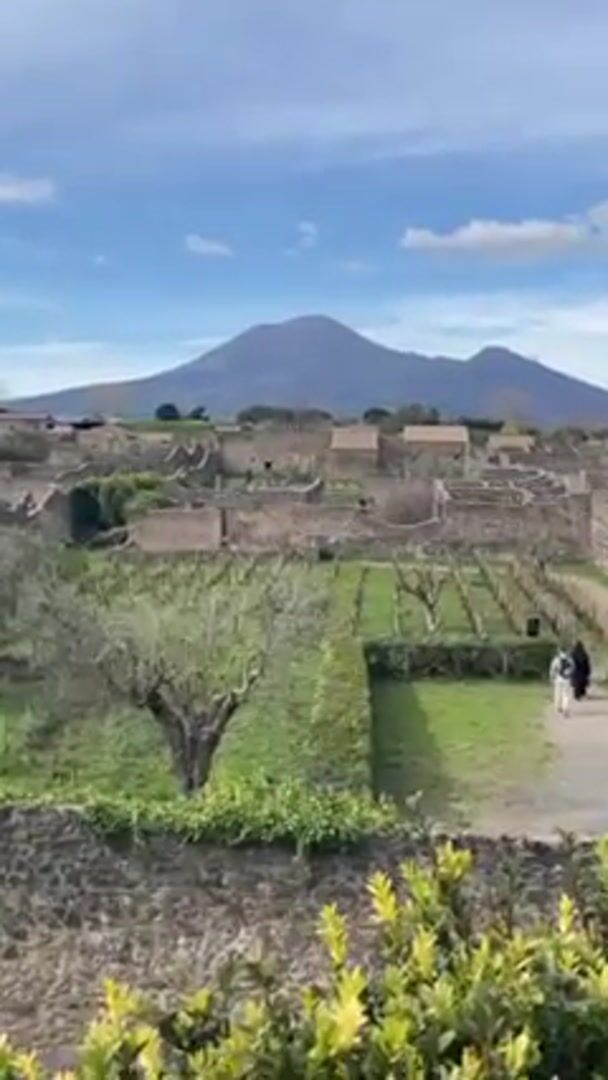
The image displays a panoramic view of the ancient city of Pompeii, Italy, with Mount Vesuvius dominating the background. Mount Vesuvius appears as a large, grey, conical mountain with subtle undulations on its surface, under a partly cloudy blue sky. In the midground, extensive archaeological ruins of Pompeii are visible, characterized by numerous stone walls, many standing to partial heights, and some structures retaining terracotta-tiled roofs. Clusters of trees and sparse vegetation are interspersed among the ruins. The foreground features cultivated land, specifically a vineyard, with rows of dormant grapevines supported by stakes and green grass covering the ground between them. A dirt path runs along the right side of the vineyard. No individuals or active subjects are present in the scene.
The image displays an archaeological ruin site in Pompeii, Italy, under an overcast sky. In the background, numerous tall, dark green cypress trees with dense, conical foliage rise prominently, indicating a natural or landscaped area surrounding the ruins.
In the foreground, two distinct stone structures are visible. To the left, a substantial, multi-tiered masonry wall constructed from irregular grey stones presents a series of architectural features. The lower tier includes a large, dark, arched entryway in the center, flanked by smaller, rectangular niches containing sparse green vegetation. The upper tier features a horizontal row of smaller arched niches. Several of these niches contain white pedestals supporting stone busts, predominantly depicting male figures. A rectangular white plaque is positioned beneath one of the central busts. Green plant growth adheres to the stone surfaces and within some niches of this structure.
To the right, a smaller, classical-style stone structure stands, resembling a small temple or shrine. This structure is composed of reddish-brown brickwork and grey stone. It features two prominent, reddish-brown, fluted columns supporting a horizontal entablature and a flat roof section. The interior of this structure appears dark and recessed.
No individuals or active interactions are present in the scene. The overall environment suggests an ancient, preserved ruin within a natural setting.
The image displays an panoramic view of the archaeological site of Pompeii, Italy, with Mount Vesuvius dominating the background.
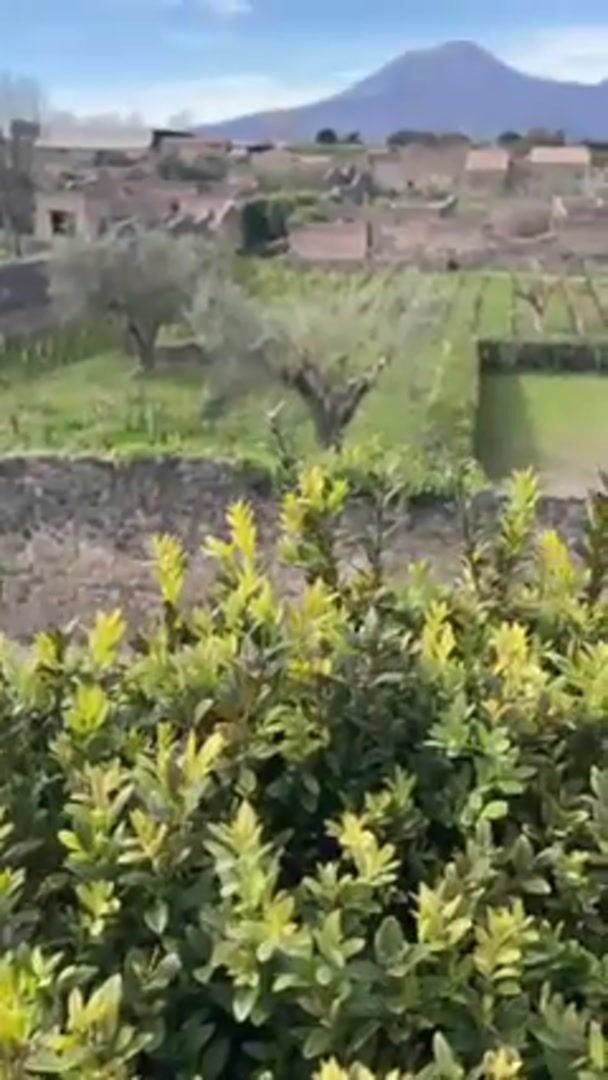
In the immediate foreground, a low stone wall is partially visible, topped by dense, vibrant green foliage. Beyond this, the midground consists of meticulously reconstructed ancient vineyards featuring rows of young grapevines supported by wooden stakes set within green grassy plots. Several mature olive trees with gnarled trunks are interspersed among the vineyards and within adjacent grassy areas. A light-colored gravel path extends from the right, traversing through the cultivated sections.
Further back, the extensive ruins of the ancient Roman city are evident, characterized by numerous low stone walls, building foundations, and partial structures of varying heights, indicating former residential or public buildings. These ruins are largely uncovered and display the typical Pompeian stone construction.
The background is dominated by the distinct conical silhouette of Mount Vesuvius, appearing dark and somewhat hazy, with a smaller peak visible to its right. The sky above is a clear blue, with scattered patches of thin, white stratiform clouds. No individuals or discernible actions are present within the frame.
The image features a light-colored, textured plaster cast of a human individual, identified as an adult male, displayed supine within a clear glass exhibition case in Pompei, Italy. The cast rests on a dark grey platform, supported by clear acrylic risers. The individual's arms are bent and raised, with hands clenched into fists; the legs are extended. A phallic detail is visible on the cast. In the background, a second, similarly presented plaster cast is visible in an adjacent glass enclosure. The environment is an indoor exhibition space with a light-colored concrete floor. Reflections on the glass cases reveal other visitors, including one wearing dark pants and shoes, indicating an active museum setting.
The image displays a weathered ancient Roman stucco relief integrated into a rough grey stone wall in the city of Pompeii, Italy. The central subject is a prominent, erect phallus with discernible testes, rendered in faded light-colored relief. This phallus is positioned within a framed niche designed to resemble a small temple or aedicula, complete with a triangular pediment at the top and a tiered plinth at the base, all executed in stucco relief. The background within the niche appears as a faded reddish-brown. A smaller, upward-pointing phallic symbol is centered on the pediment above the main relief. To the left of the main niche, approximately three additional smaller phallic symbols are clustered in relief on the surrounding weathered stucco. A lighter-colored, indistinct form, possibly a hand or wing, is visible to the right of the central phallus within the niche. The stucco surface exhibits extensive cracking, material loss, and discoloration, exposing underlying grey masonry. A single stone step is visible at the base of the structure. This type of phallic imagery, known as a 'fascinum,' was commonly displayed on public structures, commercial establishments, or private residences throughout Pompeii, often serving as an apotropaic charm or a symbol of prosperity.
This image presents a panoramic view of an archaeological site within the ancient city of Pompeii, Italy. Mount Vesuvius dominates the horizon in the upper-middle background under a partly cloudy blue sky featuring scattered altocumulus and cirrocumulus formations.
In the foreground, a robust, rough-hewn stone wall spans the lower portion of the frame, with a narrow concrete strip visible directly beneath it. Immediately behind this wall lies a cultivated area characterized by parallel rows of dormant grapevines supported by wooden stakes, growing in bright green grass. Several mature olive trees with dark, gnarled trunks are interspersed among the vine rows. Further into the midground, beyond the cultivated area, are the extensive, excavated ruins of ancient Pompeii, consisting of numerous low, roofless stone structures and building remnants. Some partial red terracotta roof tiles are visible on select structures within the ruins. A groomed green hedge borders a dirt path that leads from the cultivated area on the right, extending deeper into the archaeological site. No individuals are present in the scene.
The image displays an outdoor scene within the archaeological site of Pompeii, Italy, under an overcast sky. A large, mature Stone Pine (*Pinus pinea*) with a dense, umbrella-shaped green canopy and a thick, dark brown trunk dominates the central and upper frame. The tree stands on a grassy slope that descends towards the foreground and sides. In the lower left, remnants of ancient stone masonry, constructed from irregular grey blocks, are visible on a terraced area. Towards the middle left background, a multi-arched stone bridge or aqueduct structure is partially visible. The distant background on the left horizon features a mountain range, including a distinct volcanic peak consistent with Mount Vesuvius. The landscape consists of green, undulating terrain covered with varying types of bushes and smaller trees, with scattered patches of yellow flora on the grassy slopes. A small, light-colored wooden shed with a dark, sloped roof is situated on a lower grassy level in the far right mid-ground. No individuals or active elements are present in the scene.
A female subject is depicted in a head-and-shoulders portrait against a stone wall in the city of Pompeii, Italy. She has brown hair, wears round-framed spectacles, and a light-colored ribbed top under a dark brown herringbone-patterned overcoat with a wide collar. A light-colored strap is partially visible on her right shoulder. Her expression is a slight smile, with subtle dimples visible on her cheeks. The background wall is composed of irregular, rough-hewn stones of varying sizes and light earth tones, characteristic of ancient masonry found at the archaeological site.
This image depicts a landscape within the archaeological site of Pompeii, Italy. The foreground features a low, weathered dry-stacked stone wall, partially covered with green ivy-like vegetation. Above the wall, a grassy expanse stretches horizontally, dotted with various trees.
Prominently featured slightly left of center is a large, mature stone pine (Pinus pinea) with a characteristic flat, umbrella-shaped canopy of dark green foliage and a thick, gnarled trunk. To its right, another cluster of trees, some bare and deciduous, others evergreen, stands. Further to the left, additional deciduous trees with bare branches are visible. A small, white, rectangular object rests on the ground between the stone wall and a cluster of trees to the left of the prominent stone pine.
In the background, the iconic Mount Vesuvius rises as a large, dark grey, conical volcano, its summit visible against the sky. Other smaller hills and mountains are discernible on either side of Vesuvius. The sky is partly cloudy, displaying patches of clear blue interspersed with scattered white cumulus clouds and some thinner, higher clouds. No individuals or specific actions are visible within the frame.
The image displays a vineyard located within the archaeological park of Pompei, Italy. In the foreground and midground, numerous rows of dormant grapevines are visible, each supported by a vertical wooden post, some tied with yellow material. The ground between the vine rows is covered in green grass with patches of bare earth. In the mid-distance, beyond the cultivated field, ancient stone walls of varying heights, consistent with Roman ruins, form a barrier. Several mature trees are scattered around the periphery, including olive trees with silvery foliage and at least one tall, distinctive pine tree. Further in the background, a modern town with scattered buildings is discernible, situated at the base of a prominent mountain range. The sky overhead is overcast with broken clouds, suggesting a cloudy day. No individuals or animals are present in the scene.
A young adult female is depicted outdoors at the archaeological site of Pompeii, Italy. She is positioned with her head and upper torso angled slightly right, wearing round, gold-framed sunglasses with dark lenses. Her lips exhibit a reddish tint. She wears a dark brown wool coat with a herringbone pattern over a light grey ribbed top. A light-colored strap is visible on her left shoulder. Her hair is styled up, with strands loose around her face. The background features a large stone pine tree (Pinus pinea) on the left and several tall, slender cypress trees (Cupressus sempervirens) on the right, above green foliage and a dark metal railing. The sky is overcast with significant cloud cover.
A woman is taking a selfie outdoors. She is wearing round sunglasses, a gray ribbed shirt, and a brown tweed coat. The background includes the ruins of an ancient city, a vineyard, and a mountain. The sky is blue with scattered clouds.
A light-skinned hand, with neatly manicured nails, holds a circular, multi-colored souvenir magnet in the foreground. The magnet depicts a stylized scene of Mount Vesuvius with a green base and brown crater, overlooking ancient Roman-style buildings, with the word "POMPEII" visible at its base.
In the midground, beyond the hand and magnet, the archaeological ruins of Pompeii, Italy, are visible under daylight conditions. These ruins consist of low stone walls and fragmented structures, interspersed with rows of green vegetation, possibly vineyards, and a visible dirt path. Two blurred figures, perceived as individuals, walk away from the viewer on this path. One figure wears a dark top, the other a red top.
The background is dominated by the blurred form of Mount Vesuvius, a large, dark, conical mountain, situated under a partly cloudy sky. The sky displays a mix of light blue and white with scattered clouds.
The image depicts an ancient Roman funerary monument and adjacent ruins within the archaeological site of Pompeii, Italy, consistent with structures found along the Via dei Sepolcri. The central subject is an elevated, shrine-like monument constructed from a combination of weathered grey stone and reddish-orange brick. It features a recessed chamber framed by two cylindrical brick columns, each topped with a worn capital, supporting a flat entablature and roof section made of brick and mortar. Sparse green vegetation grows on the roofline.
Within the recessed chamber, two seated marble figures are present. The left figure is larger, depicting a draped individual with discernible facial features and body contours. A smaller, less distinct seated figure is positioned to its right. The base of this monument is composed of rough-hewn stones of various sizes and dark grey to brownish hues, interspersed with smaller brick fragments.
To the left of the main monument, a separate, lower-lying ruin is visible, constructed from irregularly stacked dark grey stones. This ruin features a small, arched opening in its upper left section. The background is dominated by two tall, slender, dark green cypress trees that ascend against a pale, overcast sky. Scattered green vegetation, including grasses and small plants, grows on the stone surfaces of both structures and in the surrounding soil.
The image captures an outdoor scene in the city of Pompeii, Italy, under an overcast sky. The upper two-fifths of the frame are filled with scattered grey and white stratocumulus clouds. In the far background, a range of hazy blue mountains, likely the Monti Lattari, spans the horizon. Below the mountains, several modern buildings are visible, including a structure with a reddish-brown tiled roof on the left and a yellow building further right.
The midground features a paved street running horizontally, bordered by a dense line of mature, dark green evergreen trees. A black metal fence or railing separates this street level from a lower archaeological area. Two dark-colored sedans are parked on the street, one to the left and one to the right.
The foreground presents an archaeological landscape. A prominent retaining wall, constructed from rough-hewn grey stones, defines the lower elevation, sloping gently downwards from left to right. Below this wall lies a well-maintained grassy area. A tall, slender, dark green cypress tree stands prominently on the right side, extending from the bottom to nearly the top of the frame. To its left, a small, square-shaped, reddish-brown brick or stone structure with a flat, overgrown top is situated within the grassy expanse. No human figures or discernible activities are present.
An outdoor portrait depicts a young adult female positioned against the ancient stone ruins of Pompei, Italy. The subject has fair skin, dark hair pulled back, and wears a dark brown herringbone-patterned overcoat over a grey ribbed top. Ray-Ban aviator-style sunglasses with dark lenses are suspended from her neck, resting on her chest. Her face is illuminated by sunlight from the left, highlighting light makeup including pink blush and red lipstick, and her gaze is directed towards the viewer's right. The background consists of a weathered stone wall, characteristic of the archaeological site, constructed from irregular stones and mortar. This wall features a small, irregular opening in its upper left section and hints of a larger doorway or opening further to the right. The sky above is clear blue with sparse, wispy white clouds.
The image depicts a street scene within the ancient city of Pompeii, Italy. The view is down a cobblestone street, which features large, irregular stepping stones forming a raised pedestrian crossing in the mid-ground. Raised stone sidewalks flank the street. On the right, a two-story stone building with visible roof tiles, multiple rectangular window openings, and a prominent stone band is present. A modern metal gate secures a large entrance on this building, adjacent to a light-colored information panel. On the left, a series of similar stone buildings extends into the distance, with some exhibiting modern protective roofing structures. The sky is partly cloudy, with a bright sun visible in the upper left quadrant. Multiple individuals, appearing as tourists in contemporary casual attire, are observed walking along the sidewalks and further down the street. One person is walking away from the camera on the right-hand sidewalk, while a group is congregated on the left sidewalk near the stepping stones. No discernible interactions between individuals are clearly visible.
This image depicts an outdoor scene within the archaeological site of Pompei, Italy. A multi-stemmed tree with light brown-grey bark and sparse, narrow green leaves dominates the central foreground. Its base is surrounded by dense, vibrant green undergrowth. In the background, ruins of ancient structures, characterized by thick walls of irregularly cut dark grey stone, are visible. To the left, a portion of a building with a dark-tiled roof is partially obscured. To the right, an opening between stone walls reveals a grassy area beyond, secured by a horizontally strung, light-colored rope barrier. A heavy, light-colored beam spans horizontally above this opening. The sky, visible through the tree's upper branches, is overcast and light grey. No human or animal subjects are present.
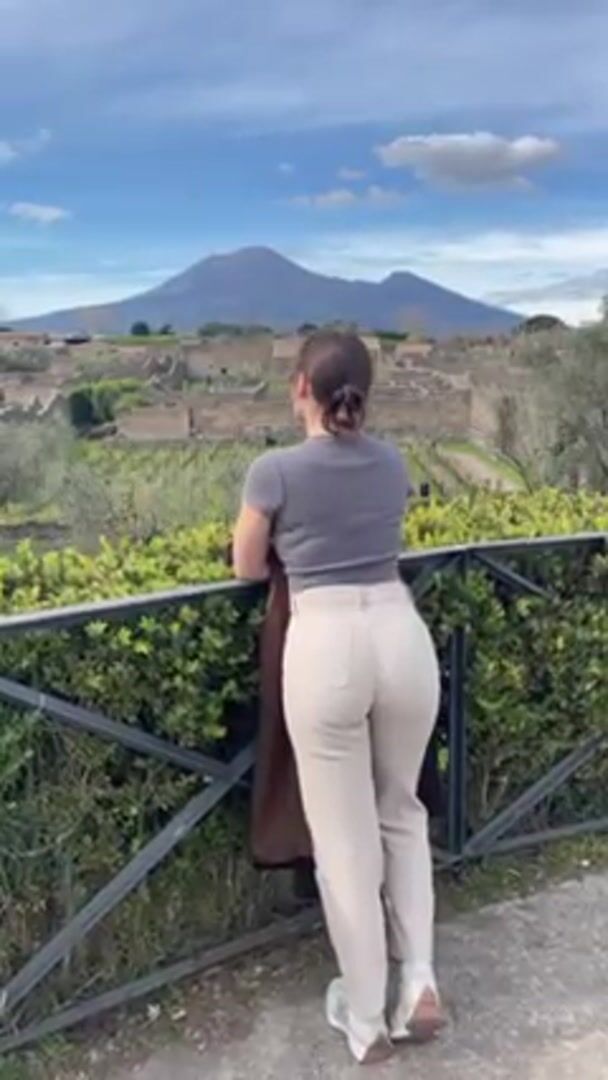
A woman stands on a viewing platform overlooking the ruins of Pompeii, Italy. She is facing away from the camera and toward the ruins and Mount Vesuvius in the distance. She wears a gray t-shirt, light beige pants, and white sneakers. Her hair is pulled back. She is wearing sunglasses and leaning against a black metal railing, with a brown coat draped over the rail. The day appears sunny with some clouds in the sky. A hedge runs alongside the railing.
A young adult female stands in the foreground, facing slightly left with her head turned to look left, hands in the pockets of her light-colored pants. She wears a grey ribbed short-sleeved crop top with round sunglasses hanging from the collar. Behind her is a green hedge and a black metal fence. Beyond this barrier, the archaeological ruins of Pompeii, Italy, are visible, featuring stone foundations and partial walls of ancient structures. A cultivated vineyard with trellised rows and scattered olive trees occupies the midground. In the far background, Mount Vesuvius rises prominently under a partly cloudy blue sky, with a smaller peak to its right. The scene is illuminated by natural daylight.
The Amphitheater of Pompeii, Italy, is depicted under a partially cloudy blue sky. A young adult female stands centrally on the light-colored gravel arena floor. She wears a dark, long overcoat, a grey short-sleeved crop top with sunglasses hanging from the neckline, light beige straight-leg trousers, and white chunky athletic shoes. Her left hand holds a light-colored shoulder bag and the front of her coat, while her right hand is placed inside her trouser pocket. She looks directly forward at the camera. The background consists of the ancient stone amphitheater structure, featuring tiered seating partially covered with green grass and ruinous upper walls with multiple arched openings. Several other individuals are visible in the distant background, walking on the arena floor. Bright daylight illuminates the scene, casting a distinct shadow of the primary subject to her right.
This image depicts a section of the archaeological park in Pompeii, Italy, specifically an area with reconstructed vineyards, with Mount Vesuvius visible in the background. The scene is dominated by a clear blue sky with scattered white clouds.
In the mid-ground and right foreground, a vineyard features numerous rows of young grapevines, supported by stakes, planted in vibrant green grass. A tall, slender cypress tree stands prominently in the mid-right, with a second, smaller cypress tree further back and to its left.
A low, ancient stone and brick wall runs diagonally from the bottom right towards the center-left, defining the edge of the vineyard. Parallel to this, further into the mid-ground, another similar wall creates a narrow, elongated grassy pathway or trench between the two walls. To the immediate left of this pathway, a wider expanse of green grass leads towards the foreground, where bushy green foliage with small yellow blossoms partially obscures the lower left corner.
Beyond the vineyard and walls, in the mid-distance, remnants of ancient Roman structures composed of tufa and brick are visible, indicating the ruins of the city. In the far background, the imposing, conical peak of Mount Vesuvius rises under the partially cloudy sky. Two white utility vehicles, appearing to be a van and an SUV, are parked on a higher grassy bank in the mid-left background, near the base of the volcano. The overall environment is one of reconstructed ancient agricultural land amidst archaeological ruins.
This image captures the interior of ancient Roman architectural ruins located in Pompei, Italy. The scene features a partially preserved stone structure, likely part of a large domus or public building. The foreground consists of an uneven, light grey flagstone floor, which exhibits subtle patterns of small, light-colored tesserae in some areas. Two circular depressions, possibly related to an impluvium or basin, are visible in the floor to the right, protected by a cordon of black metal stanchions connected by white ropes. These ropes extend along the right side, guiding visitors.
Dominating the right foreground is a light-colored, presumably stone, table with a rectangular top and a fluted, classical pedestal base. The primary architectural elements include robust walls constructed from dark grey volcanic stone (tuff), showing a weathered and eroded texture. Several tall, fluted columns, rendered in a lighter, off-white or beige material, stand partially intact, framing multiple doorways. A wide, dark rectangular opening in the center serves as a main entrance or passage, topped by a broad, light-colored modern lintel for structural support.
Through this central opening, an inner courtyard or garden is visible, featuring a mature tree with dense green foliage (possibly an olive tree) against a distant wall. To the left of the central opening, another dark, narrower passageway recedes into deeper ruins. Sections of the original roofline are absent, with some exposed wooden beams and remnants of tiling visible on the left side. The sky overhead is a uniform, pale grey, indicating an overcast day. No individuals are present in the scene.
The image depicts the Grand Theater (Teatro Grande) within the ancient city of Pompeii, Italy. The scene is observed from an elevated position within the upper tiers of the theater.
The environment features an overcast sky with grey clouds, distant mountains, and trees. The theater consists of multiple tiers of stone seating (cavea), with the uppermost sections constructed from rough, grey stone blocks. A curved, lower section of seating, partially restored with white stone, defines the edge of the orchestra.
The orchestra, a large, semi-circular area, is covered with grey gravel. A single individual stands near the front of the white stone seating, facing away from the viewer, appearing to interact with a mobile device. Further into the orchestra, a group of approximately five individuals stands clustered, engaged in conversation.
Beyond the orchestra, a rectangular wooden stage platform (pulpitum) is visible. Behind this platform lie extensive ruins of the stage building (scaenae frons), characterized by walls of brick and rough stone, with some preserved archways and structural elements. Another group of approximately six individuals stands near the right side of the stage platform, observing the ruins. One solitary figure walks on the stage platform from the left, moving towards the stage ruins.
On the upper tiers of the stone seating to the left, a single person stands near the top, looking towards the center of the theater. Modern railings and fences are visible in various sections, providing safety barriers. In the background, beyond the ancient structures, modern buildings with red tile roofs and additional trees are visible. A distant bell tower rises above the modern landscape to the left.
The image depicts the Large Theatre of Pompeii, Italy, viewed from an elevated position within the upper seating tiers. The scene is under an overcast sky with prominent grey and white clouds.
In the foreground, the ancient stone tiers of the theatre's seating are visible, curving towards the central orchestra. The lower, closer rows are constructed of lighter-colored stone, while the upper tiers are made of darker, rough-hewn stone blocks. Two individuals are positioned on these lower, lighter steps: one person in dark attire descends towards the orchestra, while another person in light clothing, carrying a bag, stands a few steps above, facing right.
The central orchestra area is a flat, unpaved expanse. A group of approximately five to six individuals is gathered here, engaged in interaction. One person in the group wears a red shirt, another a dark jacket, and others wear lighter-colored attire. To their right, a raised, rectangular stage platform with a dark surface, possibly wood, extends across the width of the performance area.
Behind the stage and orchestra, the ruins of the theatre's scaenae frons (stage building) are visible, consisting of weathered brick and stone walls with remnants of doorways and structural elements. Beyond these ruins, a townscape is present in the midground, featuring residential buildings, scattered trees, and a distant white church steeple. Mountains are visible on the horizon beneath the cloudy sky. On the far left, a person is observable on the upper steps of the theatre's upper seating section. Several Mediterranean pine trees and other deciduous trees are interspersed throughout the distant landscape and the surrounding perimeter of the ruins. An arched stone passage is visible on the left side of the stage area, beneath the seating.
The image displays a vineyard located within the ancient city of Pompeii, Italy. Numerous rows of dormant grapevines, characterized by gnarled woody trunks and supported by individual vertical wooden stakes, are planted in a vibrant green, grass-covered field. The terrain gently slopes towards the background. A prominent, weathered stone wall, constructed from irregular blocks, forms a horizontal barrier in the mid-ground. Behind this wall, remnants of ancient Roman architecture are visible, including a larger stone building with a dark rectangular doorway and a section of a tiled roof on the right. To the left, an olive tree with silvery-green leaves stands near another ancient stone wall. The scene is illuminated by natural daylight under a blue sky with scattered white clouds. No human figures or active subjects are present.
The image displays the excavated remains of a Roman bakery within the archaeological site of Pompeii, Italy. The scene features multiple heavy stone mill components. Prominently on the right, a conical upper millstone (mola asinaria) is visible, partially intact within a circular stone base. In the immediate foreground, a heavily eroded, circular stone structure, likely a lower millstone or basin, rests on the ground. The floor consists of large, uneven flagstones. Walls, constructed from a mix of rough-hewn stone and brick, exhibit exposed mortar, areas where plaster has deteriorated, and an arched brick passageway on the left. Rectangular recesses are visible within the brickwork. A modern translucent roof, supported by a metal framework, covers the site overhead. A white rope barrier crosses the lower left of the frame. No human subjects are present.
A male individual is captured in a selfie at the archaeological site of Pompei, Italy, with Mount Vesuvius visible in the background. The man, light-skinned with short brown hair and a reddish-brown goatee, is wearing circular, red-tinted sunglasses, a red and blue plaid button-down shirt, and a dark brown leather jacket. He is positioned slightly off-center, looking directly towards the camera.
The environment behind him comprises the ruins of ancient Pompei, characterized by low stone walls forming the foundations of structures and dividing cultivated land with bare trees, possibly vineyards or olive groves. A paved path is visible in the midground. Beyond the ruins, Mount Vesuvius stands prominently on the horizon, its distinct conical shape under a blue sky with scattered white clouds. The scene is illuminated by bright daylight, casting visible shadows.
This image depicts an indoor exhibition space located within the Archaeological Park of Pompeii, Italy, likely the Antiquarium or another designated exhibition hall. In the foreground, a large, gnarled, and desiccated tree root or lower trunk stands upright on a dark, reflective display platform. The wood exhibits significant cracking and a weathered appearance.
To the left, a transparent barrier, possibly glass, separates the foreground display from a wall featuring multiple framed images, including botanical illustrations and frescoes, alongside bilingual interpretive text panels in Italian and English. Visible text fragments reference "Pompei," "Nocera," and organic materials. The wall itself has a textured, light-colored lower section transitioning to a darker upper display section.
In the mid-ground to the right, a glass-topped display case on a dark base contains several artifacts, including a light-colored ceramic vessel. Behind this, a large screen or projection displays an obscured image. A single individual is partially visible in the far right background, walking away from the viewer. The exhibition space features a smooth, light-colored floor, a dark, ribbed ceiling with recessed lighting, and indirect natural light from an unseen source to the left, reflecting on the glass barrier.
The image presents an archaeological exhibition located within the city of Pompeii, Italy. The foreground is dominated by a long, horizontal glass display case containing various artifacts.
Inside the display case, positioned on a dark base, are numerous archaeological finds. To the left, several bone fragments and mollusk shell pieces are individually presented on clear acrylic risers. Below these, a small, grey, coarse stone bowl rests directly on the base. Partially obscured labels indicate items such as "Walnuts (Juglans)" and "Prunus." The central and right sections of the case feature multiple clear acrylic boxes holding carbonized organic remains, including clumps of black material, possibly charred food, and smaller dark, round items. A prominent light brown, unglazed terracotta vessel, possibly a jug or small amphora, with some surface damage, stands directly on the dark base to the right.
The background, visible through and reflected in the display glass, reveals elements of the ancient city. Old brick and stone walls, characteristic archways, and distant green vegetation suggest an open-air or semi-enclosed exhibition space within the ruins. Reflections of individuals are visible in the glass, including one person on the far right wearing a dark garment and a distinct bright green backpack. On the wall behind the left side of the display, a framed poster or painting depicting a red and green fresco-like design is mounted above a white informational text plaque.
This image depicts a long, covered walkway within the Great Palaestra (Grande Palestra) at the archaeological site of Pompei, Italy.
The scene shows a spacious corridor with a textured, light beige, rough-hewn stone wall on the left. Along the base of this wall, dark grey, rectangular, box-like structures are regularly spaced. The ceiling is composed of dark horizontal wooden beams and planks, from which a series of modern track lights with small spotlights are suspended. On the right side of the walkway, a modern glass partition system with dark frames separates the corridor from an outdoor area. Behind this glass, several ancient-style cylindrical columns constructed from reddish-brown brick are visible, appearing somewhat eroded. Beyond the columns and glass, an expansive green lawn or field extends, with sparse trees visible in the distance under an overcast sky.
The floor of the corridor is a uniform, smooth, dark grey surface. Multiple individuals are present, walking generally away from the viewer. In the foreground, two individuals are walking side-by-side. The person on the right wears a brown jacket, light trousers, and dark shoes. The person on the left wears a dark top, light grey trousers, and white shoes. Further down the corridor, several other figures, predominantly dressed in dark clothing, are visible in varying distances, also walking in the same direction. No specific interactions or objects are clearly distinguishable among the distant figures. The environment is well-lit, with light entering primarily from the right side through the glass enclosure.
The image displays an outdoor scene at the Large Palaestra (Palaestra Grande) in Pompei, Italy. The foreground is dominated by a flat expanse of vibrant green grass. Several large, bare deciduous trees, characterized by their light grey trunks and intricate network of leafless branches, frame the upper portion of the foreground and midground, with one prominent multi-trunked tree positioned towards the right of the central axis.
In the midground, a substantial ancient stone wall, constructed from dark grey masonry, extends horizontally across the entire width of the frame. This wall features a series of regularly spaced, semi-circular arched openings, arranged in at least two tiers, forming a layered arcade. Several tall, slender Italian stone pine trees (Pinus pinea), with their distinctive long trunks and dense, flat-topped canopies of dark green foliage, are positioned in front of this wall, their canopies extending above its upper edge. Integrated into the lower right section of the ancient wall is a smaller, red-brick structure with a dark, arched entrance and a light-colored, triangular pediment above it.
The background consists of a light blue sky with scattered white, cumulus clouds. On the far left horizon, a faint, conical mountain peak, identifiable as Mount Vesuvius, is visible rising behind the ancient wall. No individuals are present in the scene.
A young adult female with light complexion, light eyes, and light brown hair pulled back is depicted in a close-up, self-portrait style photograph. She wears a dark brown herringbone-patterned overcoat over a grey ribbed crop top, with dark-lensed, gold-framed round sunglasses clipped to her top. She is positioned indoors, behind a large, clear glass partition.
Through the glass on the left, an outdoor park area is visible, featuring a green lawn, several bare deciduous trees, and a distant park bench. Beyond the trees, a long, low-rise building with uniform vertical elements is present. Through the glass and reflected on the right, a long, modern-style indoor corridor with a dark, possibly slatted ceiling and light-colored walls is visible, with distant figures present.
This scene is located within a modern visitor facility or museum structure at the Archaeological Park of Pompeii, Italy, likely the Antiquarium of Pompeii.
The image displays an information panel within an exhibition space at the archaeological site of Pompei, Italy, dedicated to the 79 AD eruption. The panel, a light-colored wall or board, features prominent black text in both Italian and English. The main headline reads "POMPEI 79 D.C." and "POMPEII AD 79." Below this, two columns titled "Avviso ai visitatori" (Advice for visitors) and "Advice for visitors" provide identical messages. The English text states, "In this exhibition space the original casts of the victims of the eruption in Pompei are displayed. If you think these may be upsetting for you to see then take a moment and decide whether to enter. Once inside, we ask you to proceed with respect and in silence." Partially visible in the lower left foreground is a dark, roughly textured plaster cast of a human figure. The figure appears to be in a seated or crouched posture with its head bowed, suggesting a state of distress or contemplation. Its surface is uneven and fragmented, consistent with the method of creating casts from voids left by bodies in volcanic ash. Only the upper torso, head, and parts of the limbs are visible, cropped by the bottom and left edges of the image frame.
This image depicts a walking path within the archaeological site of Pompeii, Italy, specifically in the vicinity of the Amphitheater, with Mount Vesuvius visible in the background.
The sky is overcast with a dense layer of grey and white clouds. In the foreground, a wide, unpaved dirt path, interspersed with patches of light green grass, extends from the bottom center towards the background.
To the left, a large, ancient stone structure, identifiable as part of the Amphitheater, features multiple dark arched openings and a broad external staircase leading upwards. A group of approximately five to six individuals is walking away from the viewer on a parallel dirt path adjacent to this structure. One individual among them wears a red backpack.
To the right, a cluster of four prominent Umbrella Pines (Pinus pinea) with thick, dark green, flat-topped canopies and thick, straight trunks stands beside the path. A weathered stone wall with crenellated features extends horizontally behind these trees. Further along the path in the mid-ground, a lone individual wearing a backpack walks away from the viewer. In the far distance, several more indistinct figures are visible on the path, and a light-colored building with a domed roof is partially visible behind trees.
The background is dominated by a range of hazy, bluish mountains, with the distinctive cone shape of Mount Vesuvius visible as the tallest peak, partially obscured by the pine trees on the right. The overall environment suggests an archaeological park or a preserved ancient site.
The image depicts the interior of the Amphitheatre of Pompeii, Italy, viewed from the arena floor. The foreground is dominated by a wide, flat expanse of light grey gravel. A low, dark stone wall separates the arena from the tiered seating area. The seating structure rises in a curved fashion around the perimeter, featuring sections of dark stone steps interspersed with vibrant green grass covering the earth banks. Remnants of arched openings and stone walls are visible along the upper parts of the seating structure. Trees are present above the amphitheater's far right wall. Approximately eight to ten individuals are visible within the amphitheater. On the far right, a person in light trousers and a dark jacket walks rightward across the gravel. Near the center, a small cluster of people stands on the arena floor, with others distributed along the base of the seating area. The sky above is overcast with patches of brighter light, and a small dark object, possibly a bird, is visible in the upper left quadrant. The scene is illuminated by natural daylight, with no harsh shadows.
Pompei, Italy · Mar 16, 2026, 12:48 PM
A female individual, appearing to be a young adult, is depicted in a head-and-shoulders, self-portrait photograph. She has light brown hair pulled into an untidy bun, with several loose strands around her face and forehead, suggesting wind exposure. She wears gold-rimmed, circular Ray-Ban sunglasses, which reflect ambient light and shapes. Her lips are closed in a slight smile, with a natural pink hue. The individual is dressed in a dark brown, herringbone-patterned wool coat with wide lapels, worn over a light grey, ribbed long-sleeve top. The background consists of a weathered, irregularly coursed stone wall, composed of various shades of grey and brown, with visible mortar lines. A small cluster of green foliage is growing from a crevice in the wall on the upper right side of the frame. The lighting is bright and natural, indicating an outdoor setting. The location is the city of Pompei, Italy.
A female subject is positioned in the foreground, angled from the front-left, looking towards the right with a slight upward tilt. She wears round, dark-lensed sunglasses with gold-colored frames, a light grey ribbed top, and a dark brown herringbone patterned coat. Her brown hair is styled with volume on top. The scene is located within the ancient Grand Theatre of Pompei, Italy. In the midground, a light-colored gravel-like surface extends. The background features ancient stone walls forming tiered seating structures, characteristic of the theatre's cavea. To the left, a significant green grassy slope rises behind a segment of the stone walls, topped with trees. To the far right, additional ancient stone ruins are visible, with several small, blurred human figures present, indicating other visitors. The sky is clear blue with scattered white clouds, suggesting bright daylight conditions.
The image displays a view from within the Amphitheatre of Pompeii, Italy. The scene is framed by two tall, rugged stone walls, composed of irregular masonry and some brickwork, forming a passageway that opens into the amphitheater's arena. The left wall contains a prominent arched opening secured by a black metal grate, while the right wall features a smaller, rectangular grated access point.
The central area is the amphitheater's arena, a large, open space with a light-colored gravel or dirt surface. Beyond the arena, tiered stone seating rises, with a substantial section of the upper structure and outer wall covered by a lush green grassy slope. Multiple arched openings are visible along the top perimeter of this grassy bank. A large, dark arched tunnel entrance is situated at the far end of the arena.
In the midground of the arena, two individuals are prominent. One person, dressed in dark attire, stands with their back mostly to the viewer, holding what appears to be a camera or mobile phone, directed towards the amphitheater. Adjacent to them, another person, clad entirely in black, stands similarly. Several other smaller figures are dispersed across the arena floor and near the seating areas, indicative of visitor presence. The sky is bright blue with scattered white clouds, illuminating the ancient stone structures and modern visitors.
This image depicts a long, dark, arched stone passage or tunnel within the ancient city of Pompeii, Italy. The perspective is from inside the tunnel, looking towards a brightly illuminated exit at the far end.
The tunnel features a barrel-vaulted ceiling and rough, unadorned stone or concrete walls, appearing weathered and uneven. The floor is paved with large, dark flagstones that appear wet or reflective, creating shimmering patches of light. Along the lower portions of the walls, particularly on the right, raised stone ledges or benches are visible.
The primary light source is the intensely bright daylight emanating from the double-arched exit at the tunnel's end, creating a strong silhouette effect.
One individual, silhouetted against the bright exit, is positioned approximately two-thirds of the way down the tunnel, walking away from the viewer towards the exit. This person appears to wear a long garment. Beyond the exit archway, two additional figures, also heavily silhouetted, are visible standing or moving in the distant daylight, with a potential third, fainter silhouette to their right. No direct interactions between the individuals are discernible.
The image depicts the interior of the Amphitheatre in Pompeii, Italy, under a clear blue sky with scattered white clouds. The central arena floor is composed of light-colored gravel. Surrounding the arena are ancient stone structures, including stepped seating (cavea) on the right and grassy slopes on the left, which rise towards a continuous, weathered stone wall with multiple arched openings. A prominent dark arched tunnel entrance is visible in the background, leading into the arena.
Multiple individuals are present on the arena floor, appearing to be tourists. In the immediate foreground, to the right, a female wearing a black coat, dark pants, dark boots, and a purple backpack stands facing slightly right, holding a white object, likely a phone or camera, to her face. In the mid-ground, to the left, two individuals walk away from the camera, holding hands. The person on the left wears a dark hoodie and pants with white sneakers, while the person on the right wears a dark long dress or coat. Several other smaller groups and individual figures are scattered further back on the arena floor, observing the architecture or moving towards the tunnel entrance.
A fair-skinned female, estimated to be in her 20s or early 30s, with light brown hair loosely pulled back and blue-green eyes, is centered in a medium close-up, facing the camera directly with a neutral expression. She wears a dark brown herringbone-patterned overcoat over a light grey ribbed top. A pair of round, gold-framed sunglasses with dark lenses hangs on her chest. The background depicts a dimly lit, vaulted stone tunnel with rough, textured walls and ceiling, consistent with ancient Roman construction. In the distance, a sequence of arched openings leads to a brightly illuminated exterior. Two human figures, indistinct and silhouetted, are visible walking towards this light at the far end of the tunnel. This architectural setting is a passageway within the archaeological site of Pompeii, Italy.
This image depicts a scene within a stone-lined tunnel, identified as the Porta Marina in Pompeii, Italy. In the immediate foreground, a young adult female is positioned centrally, facing directly towards the camera, suggesting a self-portrait. She possesses fair skin, light-colored eyes, and her lips are subtly tinted pink. Her brown hair is partially gathered, with loose strands framing her face. She is dressed in a dark brown, possibly tweed, double-breasted coat featuring broad lapels and shoulder epaulets, worn over a grey crew-neck top. Black sunglasses with a metallic bridge are visible hanging around her neck, resting between the coat's lapels.
In the distant background, two human silhouettes are visible, walking away from the viewer towards a brightly illuminated arched opening at the end of the tunnel. The tunnel itself is constructed from large, irregular stone blocks, forming an arched ceiling and rugged walls. The floor is an uneven, dark stone pathway, appearing wet or reflective in areas, particularly where it catches light from the exit. The interior of the tunnel is dimly lit, with the primary light source being the strong natural light emanating from the distant exit.
An overhead view captures the lower legs and feet of two individuals standing on an ancient, irregularly paved stone street in the archaeological city of Pompeii, Italy. The ground consists of large, dark grey volcanic stone slabs, exhibiting significant wear and containing dirt, small pebbles, and sparse dry vegetation within the crevices.
The individual positioned towards the top of the frame wears beige corduroy trousers and white athletic shoes with visible orange and silver accents. The individual in the lower foreground also wears beige corduroy trousers and white athletic shoes, which feature light brown or beige accents on the toe and sole. A dark brown coat or garment is partially visible on either side of their legs. Both individuals appear to be standing or in the process of walking on the historical pavement.
The image depicts a vineyard set against the ancient Roman Amphitheater in Pompei, Italy, under an overcast sky. No people are visible.
In the immediate foreground, to the right, a rough, dark grey stone wall is partially visible, with a cluster of green foliage extending from its top edge. The midground is dominated by a cultivated vineyard, featuring numerous rows of dormant grapevines with dark, gnarled trunks supported by thin wooden posts. The ground throughout the vineyard is covered in vibrant green grass and scattered lighter green weeds, with faint dirt paths discernible between rows.
Towards the left side of the mid-background, a large, dark green deciduous tree stands. A small, light-colored building with a brown-tiled roof is situated at the left base of the larger structure. The prominent central subject is the Roman Amphitheater, a substantial circular structure made of dark, textured stone. It features a high, solid wall punctuated by multiple arched openings at varying levels.
In the background, a range of hazy, dark mountains extends horizontally. A white church steeple with a golden dome is visible above the amphitheater wall, set against these distant mountains. The sky above is entirely overcast, displaying a mix of light and dark grey cloud formations.
This image depicts the ancient city of Pompeii, Italy, specifically showing a vineyard in the foreground with the Amphitheatre of Pompeii in the midground.
In the immediate foreground, a vineyard occupies the lower half of the frame, featuring rows of dormant, gnarled grapevines supported by wooden stakes. The ground between the vines is covered in green grass with sparse yellow wildflowers.
Midground elements include a low stone wall separating the vineyard from a small, light-brown building with a reddish-brown tiled roof, positioned slightly left of center. Behind this, the prominent, massive stone structure of the Amphitheatre rises. It is constructed from dark grey volcanic stone and features a long series of arches at ground level, with a solid wall above. The amphitheatre's exterior exhibits weathered surfaces and some vegetation growth on its upper sections. A dark green deciduous tree stands to the far left, partially obscuring the amphitheatre.
In the background, beyond the amphitheatre and a line of trees, a distinct mountain peak with a gentle slope is visible under a heavily overcast sky, suggestive of Mount Vesuvius. To the far right, a small bell tower topped with a cross can be seen above the amphitheatre, belonging to a modern structure outside the ancient ruins. The sky is filled with numerous light and dark grey clouds, indicating an overcast day. No individuals or active interactions are visible in the scene.
Pompei, Italy · Mar 16, 2026, 12:59 PM
The image depicts an ancient Roman impluvium or courtyard within an archaeological site in Pompeii, Italy. The scene is viewed from beneath a modern wooden ceiling beam, looking into an open-air, rectangular space.
The foreground consists of a concrete pathway leading to a central, sunken rectangular area covered with short green grass and weeds, bordered by stone. A rough wooden plank ramp descends from the left edge of the stone border into the grassy area. A small, square stone or concrete object is partially visible within the grass on the right.
The courtyard is surrounded by the partially preserved walls of an ancient structure. These walls primarily consist of stone and rubble, with significant remnants of red and white frescoed plaster showing extensive damage, exposing the underlying brickwork and stone. On the left, several weathered brick columns support a roof structure with modern gutters and clay tiles. In the background, along the rear wall, multiple door-like openings are present. One central opening is fronted by a low wooden platform or stage with a metal handrail. Further right, a damaged wall section reveals exposed stone and a large, irregular opening. Above the immediate courtyard structures, higher walls of unmortared stone rise against an overcast sky. A prominent, light-colored stone dome structure is visible on the upper right, situated behind the main roofline. A small, dark bird is perched on the clay roof tiles in the upper right quadrant, near the dome. No human figures are present.
The image presents a longitudinal view of an ancient, stone-paved street within the archaeological park of Pompeii, Italy. The sky is uniformly overcast and light grey.
The street, constructed from large, irregularly shaped grey paving stones, extends from the foreground into the distance. It is bordered on both sides by elevated stone sidewalks and the substantial, partially ruined walls of ancient structures. These ruins consist of exposed stone blocks and brickwork, exhibiting varying degrees of deterioration, with some sections having collapsed entirely. Patches of green vegetation are visible growing on top of and within some of the ruined walls and embankments behind them.
In the mid-ground, slightly right of the central axis, a male adult, characterized by dark hair and a beard, is observed walking towards the left. He wears a dark brown long-sleeved top, light-colored trousers, and dark footwear, with a dark garment tied around his waist. He is carrying a young child, approximately a toddler or preschooler, who wears a light blue top and light shoes. The child is held facing forward in the man's arms, supported by his left arm around the child's waist and his right arm beneath the child's legs.
Further down the street, on both sides, numerous individuals are dispersed, walking along the pavement and sidewalks. They appear to be tourists, dressed in casual contemporary clothing. On the far left, a modern-looking metal railing or barrier is partially visible. The overall scene depicts a well-trafficked historical site.
This fresco, located on a wall within the House of Venus in the Shell (Casa della Venere in Conchiglia) in Pompeii, Italy (Regio II, Insula III, 3), depicts Venus with accompanying figures. The central subject is a nude female figure, identified as Venus, reclining diagonally from left to right on a large, open scallop shell that floats on a body of water. Her head is slightly turned to the left, gazing forward. Her left arm is raised, with pale drapery flowing behind her, and her right arm extends forward. She wears a necklace, a bracelet on her right wrist, and red anklets on both legs.
To the left, a smaller, nude, winged putto stands in the water, holding a tall staff with a light-colored, flowing banner. This putto looks towards Venus. To the right, a second smaller, nude, winged putto is positioned behind Venus's lower body, also looking towards her. The background consists of a faded greenish-blue, representing a seascape or sky.
The fresco exhibits significant degradation, including extensive cracking, pigment loss, and discoloration across its entire surface. Areas of plaster are missing, particularly along the upper and lower borders, exposing the underlying wall material. A visible patterned border runs along the bottom edge of the fresco panel.
This image depicts an interior corner of an ancient Roman structure located within the archaeological site of Pompeii, Italy. Two walls, meeting at a perpendicular angle, are adorned with deteriorated frescoes. The left wall features a painted white urn on a rectangular pedestal against a cracked, ochre-toned background, with faint indications of avian figures above. The right wall displays a larger fresco centered on a standing male figure, depicted nude save for a helmet and a red mantle over his left shoulder, holding a spear in his right hand and a round shield in his left. This figure stands on a white pedestal. The background behind the figure is a stylized green landscape populated with birds and foliage, while the lower section of the wall features a geometric diamond pattern. A dark, open doorway is positioned at the intersection of the two frescoed walls, leading into a shadowed interior. The ground consists of an uneven, light-colored surface. Above the walls, remnants of original masonry are visible, with the open sky and a modern corrugated metal roof partially covering the area.
A young adult female is captured in a close-up, likely self-portrait, centered in the frame. She has light brown hair, styled with some strands uplifted by wind, and fair skin with minimal facial makeup, displaying a subtle, closed-lip smile. She is dressed in a light grey ribbed long-sleeved top layered under a dark brown, herringbone-patterned wool coat. A pair of round, gold-rimmed sunglasses with dark lenses hangs suspended from the collar of her coat. The background consists of ancient architectural ruins, characteristic of the city of Pompei, Italy. To the viewer's right, a substantial, weathered stone wall or pillar remnant is visible. To the viewer's left, a section of reddish-brown brick wall is present. The sky above is light blue with scattered clouds. In the far left background, several blurred figures of other individuals are discernible, indicating a public or tourist environment.
The image displays an archaeological site in Pompeii, Italy, specifically resembling the Necropolis outside the Porta Ercolano, characterized by ancient funerary structures and prominent cypress trees. The scene is observed under an overcast, light grey sky.
In the midground, a significant multi-tiered stone structure dominates the left-center. Its lower section features a large, dark, arched entryway built from rough-hewn grey stones, flanked by smaller rectangular niches. Above this, a second tier of similar stone construction presents a series of open rectangular niches, some containing white busts or funerary urns on ledges. The stone exhibits signs of weathering and partial overgrowth with green vegetation.
To the right of this primary structure stands a distinct, taller ruin with a classical Roman architectural influence. This comprises two prominent, reddish-brown brick columns supporting a rectangular entablature, creating a recessed opening, indicative of a tomb or monument. Its base is constructed from irregular grey stone blocks.
The background is densely populated with numerous tall, slender, dark green cypress trees, their columnar forms reaching towards the sky, interspersed with other dark green foliage. The immediate foreground consists of uneven terrain with patches of dry earth and sparse green grass, containing two partially buried, rough-cut stone blocks. No individuals, actions, or direct interactions are depicted within the frame.
This image depicts an outdoor display area within the archaeological park of Pompeii, Italy. Three plaster casts of human figures, likely victims of the Vesuvius eruption, stand prominently on a raised, grey, rectangular platform.
From left to right:
1. A headless, standing figure draped in robes, presenting a smooth, light grey texture. The arms appear bent, with hands near the torso.
2. A standing, heavily draped figure, darker in tone and rougher in texture, with the right hand covering the lower face or mouth area. The head is obscured by drapery or erosion.
3. A roughly cylindrical, severely weathered or incomplete cast, light grey, with minimal discernible features.
Below the main platform, numerous fragmented architectural elements, including carved capitals and irregular stone blocks, are scattered on the ground. Patches of green vegetation grow among these fragments. The background consists of a dark, rough stone wall, appearing to be either a natural rock face or an ancient construction. Overhead, a modern, corrugated translucent roofing structure, supported by dark metal beams, provides shelter to the display.
This image depicts the archaeological site of Pompei, Italy, specifically focusing on the Porta Marina, one of the city's ancient gates. A weathered stone archway stands centrally, framing a cobbled ancient path that leads inward. Through the archway and in the distance, the conical peak of Mount Vesuvius is clearly visible. To the immediate left of the path are partial stone wall foundations and the tiled roofs of smaller, low-lying structures. To the right, a grassy slope with some bushes ascends, bordered by a lower stone wall. Further left and right, the landscape consists of green, undulating hills. The sky above is blue with scattered white cumulus clouds. No people or animals are present in the scene. The environment is an outdoor historical ruin under daylight conditions.
The image displays an archaeological site within the city of Pompeii, Italy, under a clear blue sky dotted with scattered white clouds. A cobbled street, composed of irregular grey stones, extends from the lower center of the frame, narrowing as it leads towards a prominent ancient stone archway. This archway, constructed from dark grey, irregular masonry and reinforced with horizontal wooden beams, stands centrally in the midground. Through the archway, the conical peak of Mount Vesuvius is visible in the distant background, appearing dark blue-grey.
To the left of the street, a low stone wall runs parallel, topped by earthen mounds and partially revealing a terracotta-tiled roof structure further back. The right side of the street features additional fragmented stone ruins, grassy slopes, and a green metal fence section. Sparse green vegetation, including grass and small shrubs, grows along the edges of the street and on the tops and sides of the stone structures. No individuals or animate subjects are present in the scene.
This image depicts an archaeological site in Pompeii, Italy, likely situated within a major public area such as near the Amphitheatre. In the foreground, a weathered, rectangular grey stone pillar, approximately 1.5 meters in height, stands upright on a broad, roughly pyramidal base constructed from dark grey, irregularly shaped stones. The pillar's visible face bears a carved Latin inscription, heavily eroded and obscured by prominent orange and green lichen, with the uppermost line partially legible as "VICTORIVS" or similar. The base also exhibits lichen and sparse vegetation. The ground immediately surrounding the pillar and extending into the midground is paved with large, irregularly shaped light grey flagstones, characteristic of ancient Roman streets or courtyards.
Beyond the paved area, the midground presents additional ancient stone ruins, including various low walls, foundations, and terraced structures. To the right, a partial structure with a reddish-brown terracotta tiled roof is visible. The background features a significant grassy earthen embankment or mound, supported by an extensive, multi-tiered ancient retaining wall composed of large, light-colored stone blocks. Several tall, dark green cypress trees are prominent on the left side of the embankment, accompanied by other smaller trees and shrubs on the higher ground. The sky is partly cloudy with visible patches of blue. No individuals or animals are present in the scene.
Pompei, Italy · Mar 16, 2026, 1:24 PM
The image displays an outdoor scene within the archaeological site of Pompeii, Italy, specifically appearing to be the Necropolis of Porta Ercolano (Street of Tombs). In the foreground, a light-colored, unpaved pathway with three subtle horizontal markers traverses a sparse green lawn. To the left, a partially reconstructed ancient Roman brick structure with a dark reddish-brown tiled roof rises from overgrown vegetation and low stone walls. A winding, unpaved path ascends through the midground, bordered on both sides by neatly trimmed green hedges. This path curves slightly to the right as it progresses uphill, eventually disappearing beneath a dense canopy formed by dark green deciduous trees and tall, slender evergreen cypress trees. A faint wooden railing is visible on the right side of the ascending path further into the midground. The sky above is uniformly overcast and light grey. No individuals or animals are present in the scene.
The image presents a daytime, static scene overlooking the ancient city of Pompeii, Italy, with Mount Vesuvius dominating the background. The sky is bright blue with scattered white and light gray stratocumulus clouds.
In the background, Mount Vesuvius appears as a large, dark gray volcanic mountain with visible ridges and a distinct, open crater at its summit. To its right, a smaller, darker peak is partially obscured by haze. The mountains display minimal vegetation, suggesting a rocky, arid surface.
The mid-ground reveals a landscape incorporating both natural and anthropogenic elements. Green, grassy slopes rise towards the base of the mountain. Immediately below Vesuvius, a cluster of ancient-looking stone structures with terracotta-colored roofs, characteristic of Pompeii's archaeological ruins, is visible. To the left, a modern building with a dark roof and white supports is partially visible, alongside a patch of vibrant green grass and a dense, conical evergreen tree.
In the lower mid-ground, a white panel van is prominently parked or stationary. Another white vehicle is partially visible to its left. Further left, partially obscured by a rise in the terrain and vegetation, a red portable toilet is identifiable.
The immediate foreground is occupied by a dense, uniformly trimmed dark green hedge, extending across the width of the frame and obscuring the ground level beyond. No individuals are visible within the scene, and no specific actions or interactions are depicted.
The image depicts a panoramic view of a vineyard located within the archaeological park of Pompeii, Italy. In the immediate foreground, a dry-stacked stone wall, composed of irregular grey and tan rocks, extends horizontally across the lower third of the frame. Above this wall, a well-maintained vineyard displays parallel rows of pruned grapevines set in vibrant green grass.
To the left, a tall, slender, dark green columnar cypress tree stands prominently. Towards the center-right within the vineyard, a leafless deciduous tree with a light-colored trunk and intricate bare branches is visible; a black cat is perched on one of its lower branches, facing left. Beyond the vineyard, scattered ruins of ancient Roman structures from Pompeii are observable. Further in the background, another smaller cypress tree is visible, and on the far left, a white modern van is partially parked on an elevated green embankment. The distant background features a large, conical mountain, identifiable as Mount Vesuvius, under a bright blue sky with scattered white clouds. No human subjects or active interactions are present in the scene.
A female subject, positioned in a selfie-style composition, occupies the foreground, her face directed towards the camera with eyes closed and a subtle smile. She has dark hair styled loosely and wears a brown herringbone-patterned overcoat over a grey top. Dark-lensed sunglasses with a gold-colored frame hang from her neck, resting on her chest.
Behind the subject, a gravel path is visible to the left, running alongside a manicured green hedge. Beyond the hedge, the archaeological park of Pompei, Italy, extends into the mid-ground, featuring grassy areas and the stone ruins of ancient structures. A tall, slender cypress tree stands prominently. Further in the background, to the left, two white vans are parked on a grassy field near a dirt track. Dominating the far distance is Mount Vesuvius, its peak visible under a sky with scattered clouds and patches of blue.
This image depicts a paved pathway within the archaeological park of Pompeii, Italy. The light gray, worn concrete path occupies the central and lower portions of the frame, ascending gradually and curving subtly to the right into the distance.
The pathway is bordered on both sides by dense, trimmed green hedges, each approximately 1 to 1.5 meters in height. Along the left side of the path, behind the hedge, a large, mature tree with dark green, elongated foliage dominates the upper left quadrant. Further in the background on the left, a portion of another tree with a distinct, flattened canopy is visible against the sky. A faint, distant white figure, possibly a person, is barely discernible far up the path on the left side.
On the right side of the path, behind the hedge, a dark metal railing or fence with vertical bars and a curved top section follows the path's contour. Beyond this, several trees are visible, including one with dense green foliage similar to the large tree on the left, and a prominent bare deciduous tree with thin, light-colored branches standing against the sky in the mid-ground. The sky above is uniformly overcast and light gray, with subtle darker cloud formations near the horizon. The ground adjacent to the hedges shows minimal sparse vegetation and exposed soil.
A young adult female is positioned in the foreground of an outdoor scene within the archaeological site of Pompeii, Italy. She has light brown hair, with strands disturbed by wind, and exhibits a light complexion with subtle facial flushing. She wears a dark brown herringbone-patterned wool coat over a grey ribbed top. Dark sunglasses with gold frames are suspended from her neckline. Her right hand is placed on the back of her neck. Her gaze is directed off-camera to the viewer's upper left.
The background features a distinct, long, green pathway or vineyard row, bordered by a low stone wall on its right side, receding into the distance. Multiple tall, slender cypress trees are visible along this pathway. In the mid-ground, characteristic ancient Roman ruins are discernible, and a white van is parked on a grassy area further down the path to the left. The prominent, conical peak of Mount Vesuvius dominates the distant horizon under a bright blue sky with scattered white clouds.
The image depicts an archaeological site in Pompeii, Italy, under a clear blue sky with sparse clouds. A central, unpaved pathway, flanked by low, mortared stone walls, recedes into the distance. To the left, several tall, bare deciduous trees stand among the ruins of ancient stone structures. Similar ruined walls and foundations are visible on both sides of the pathway. In the midground, on the pathway, a group of approximately five individuals, dressed in dark clothing, are gathered. One person appears to be holding a white object, possibly a phone, pointed towards another individual within the group. In the background, prominently visible under the bright sky, is the distinct cone of Mount Vesuvius, appearing dark grey, with other distant mountains to its right. The environment suggests an archaeological park with natural landscape features.
A young adult female is depicted in a selfie, positioned in the foreground of an outdoor scene within the archaeological site of Pompeii, Italy. She has medium-brown hair, pulled back, with strands loose around her face, and is looking slightly to her right with a gentle smile. Her cheeks show a faint flush. She is wearing a short-sleeved, ribbed, charcoal-gray crop top and light-colored, possibly white or cream, high-waisted pants, partially visible. Dark-lensed, gold-rimmed Ray-Ban sunglasses hang from the collar of her shirt. Her left arm is extended towards the camera, capturing the image.
The background reveals the ancient city of Pompeii under a bright blue sky with sparse white clouds. Prominently in the distance is Mount Vesuvius, a large, dark-hued volcano. Closer to the foreground, a long, well-preserved stone wall runs diagonally from the lower left to the mid-left of the image, appearing to define a pathway or boundary. Adjacent to this wall are cultivated green fields with visible rows of dormant grapevines, indicative of vineyards. Scattered olive trees and other sparse deciduous vegetation are present throughout the landscape. Stone ruins of ancient buildings are visible further back, forming part of the historical site. A wooden fence or railing is partially visible to the left of the woman, and dense green foliage is immediately behind her right shoulder. The scene is illuminated by natural sunlight.
This image depicts a paved pathway within the archaeological site of Pompeii, Italy.
In the foreground, three large, rough-hewn rectangular stone blocks are positioned on a light grey, concrete-like pathway that extends into the mid-ground, subtly curving right. The path is bordered on both sides by dark metal railings featuring a crosshatch design, behind which are dense, trimmed green hedges. Beyond the hedges, on the left, a large, dark green tree with dense foliage stands prominently. Further into the mid-ground on the right, another similar large tree is visible, and behind it, a tall, distinctive stone pine (Pinus pinea) with a flat, umbrella-shaped canopy rises against the sky. In the far background on the right, several slender, conical cypress trees are present. The sky above is largely overcast with scattered light clouds. No individuals are present in the scene.
The image presents an elevated, wide-angle view of the archaeological site of Pompei, Italy. In the distant background, Mount Vesuvius is visible as a large, dark gray volcanic mountain with two distinct peaks, partially obscured by light clouds. The sky above is bright blue with scattered white cumulus clouds.
Below Vesuvius, the extensive ruins of the ancient Roman city of Pompeii unfold, characterized by numerous low-lying stone walls, foundations, and partially preserved structures. Some structures display small, reddish-brown tiled roofs.
The midground and foreground feature an agricultural landscape. A vineyard occupies a significant portion, consisting of orderly rows of leafless, stake-supported vines planted in green grass. Several mature olive trees with silver-green foliage are interspersed within this cultivated area. A prominent dry-stone wall runs horizontally across the midground, separating different sections of the landscape. A dirt or gravel path traverses the vineyard, leading towards the ruins. In the immediate foreground, out-of-focus green and yellow-green foliage from bushes partially obscures a lower stone wall.
On the far left, beyond a grassy slope, several modern structures are visible: a white building with a red roof, a long, low brown facility, and a greenhouse-like structure. A tall, dark green cypress tree stands alongside several bare deciduous trees. A white vehicle is partially visible near the modern buildings. No individuals are present in the scene.
Pompei, Italy · Mar 16, 2026, 1:33 PM
The video shows a high-angle view of an archaeological site. In the foreground are green shrubs and a stone wall. Beyond that are ruins of ancient buildings, some with visible roofs. A vineyard with rows of grapevines and olive trees occupies the center of the frame. Two people are walking along a path. In the background is a mountain with a visible peak under a sky with scattered clouds.
A partially visible female subject is captured on the left side of the frame, positioned in the foreground, with the archaeological site of Pompeii, Italy, extending into the background. The subject's face, visible from below the eyes to the chin, shows a slight smile. She wears a grey ribbed top beneath a dark brown coat with a herringbone pattern. In the immediate foreground, a dense mass of green and yellow foliage, resembling a hedge, is present, partially obscured by a dark grey metal railing. Beyond this, the midground displays extensive archaeological ruins of ancient Roman structures, consisting primarily of stone walls and foundations. Scattered within these ruins are olive trees and organized rows of green grapevines, indicative of agricultural cultivation. Dirt paths traverse these areas. In the distant background, Mount Vesuvius, a large volcanic mountain, dominates the skyline under a blue sky dotted with white clouds. Faint modern structures are also visible on the far left horizon.
A female subject stands in the foreground at the archaeological site of Pompei, Italy, facing slightly left and looking towards her left. She wears dark, circular sunglasses, a grey ribbed short-sleeved crop top, light-colored trousers, and a dark brown long coat draped over her shoulders. A light-colored shoulder bag strap is visible on her right side. Her hands are clasped in front. Behind the subject, a dark metal railing and a dense green-yellow hedge separate the foreground from a midground containing a vineyard with olive trees and stone ruins of ancient Roman structures. In the distant background, Mount Vesuvius, a large grey mountain with two distinct peaks, dominates the horizon under a bright blue sky with scattered white clouds. The scene is illuminated by natural daylight.
The video shows a view of the ruins of Pompeii in Italy, with Mount Vesuvius in the background. In the foreground, there is a green bush. Behind the bush, there is a stone wall. Beyond the wall are the ruins of the ancient city, including buildings, gardens, and trees. The sky is blue with some clouds. The camera slowly pans up to reveal the broader scene.
The image displays an archaeological landscape within the city of Pompei, Italy, with Mount Vesuvius in the background. The foreground features a vineyard with numerous rows of dormant grapevines, characterized by bare wooden stakes and branches, set in a field of green grass. In the midground, the grey stone ruins of ancient Roman buildings are visible, comprising various walls, foundations, and some partially reconstructed structures with terracotta tile roofs and dark wooden support beams. Patches of wild greenery grow among the ruins. To the left, an out-of-focus leafy tree branch is partially visible. The background is dominated by the large, greyish-blue volcanic cone of Mount Vesuvius, flanked by a smaller mountain peak to its right, all beneath a blue sky with scattered white cumulus clouds. No human or animal subjects are present, and no active actions are depicted.
The image depicts an archaeological landscape identified as the Necropolis of Porta Nocera in Pompeii, Italy. The scene is dominated by numerous ancient Roman funerary monuments and structures, primarily rectangular stone tombs, situated on grassy areas. These structures exhibit exposed masonry and remnants of original stucco. A winding, paved stone road, characteristic of ancient Roman thoroughfares, traverses the necropolis, intersected by narrower unpaved paths. Dense clusters of tall, slender cypress trees and other broad-crowned evergreen trees are dispersed throughout the site, forming a verdant backdrop. Above the distant tree line, modern multi-story buildings with red-tiled roofs and light-colored facades are visible, indicating the adjacent contemporary urban area. In the lower foreground, two small, utilitarian structures with red-tiled roofs are observed at a lower elevation, one featuring a visible stairway. The sky is partially obscured by numerous scattered grey and white cumulus clouds. No human or animal subjects are present within the frame.
The scene presents a high-angle view of a person's lower body, located on a rough, dark gray ground surface, consistent with compacted earth or weathered pavement. The given location is Pompei, Italy.
The individual is wearing light beige, vertically ribbed corduroy pants, white ankle socks, and white athletic shoes with light gray accents and a visible brown sole tip. The legs are crossed at the ankles, with the right leg positioned over the left. A dark brown coat, featuring a prominent black button, is visible along the lower left edge of the frame. The person's bare right hand rests on their left thigh. The ground surface shows minimal scattered debris, possibly small pebbles or dried plant fragments. The environment is illuminated by bright, direct sunlight.
A young adult female is depicted in a chest-up selfie-style photograph taken outdoors in the archaeological park of Pompeii, Italy. She wears round, dark-lensed sunglasses with thin gold frames, a dark brown herringbone-patterned overcoat with wide lapels, and a light grey ribbed top. A beige strap is visible on her left shoulder. Her brown hair is partially pulled back, and her face exhibits light-toned skin, subtle blush, and glossy pink lips. She is looking slightly to her right with a gentle smile.
The background, consistent with a view within the ancient city of Pompeii, features a dark metal railing immediately behind the subject, followed by dense green shrubs. Beyond this, a sloping landscape includes a prominent, large stone pine tree with a broad, flat crown on the left and a line of tall, slender cypress trees on the right. Distant low hills are discernible under a partially cloudy, light blue sky. The scene is illuminated by natural daylight.
A daytime outdoor photograph depicts a panoramic view of the archaeological site of Pompeii, Italy, with Mount Vesuvius in the background, under a blue sky with scattered white clouds. In the foreground, a fair-skinned hand holds a circular souvenir, approximately 7-8 cm in diameter, which displays an aerial image of the Pompeii ruins including an amphitheater, with Mount Vesuvius, and the word "POMPEI" visible. The hand's fingernails are clean and unpainted.
Below the hand, a rough stone wall forms the immediate base of the image. Beyond this wall, the midground reveals extensive ancient ruins of Pompeii, characterized by low stone walls and foundations, interspersed with cultivated rows of green vegetation, indicative of an agricultural section within the park, possibly vineyards. A dirt path leads through these ruins. Two individuals are seated on a low stone structure or elevated ground to the right of the path; one wears a red shirt, the other a dark shirt. Further right, olive trees with silver-green foliage partially obscure the view, and a metal accessibility ramp is visible. Another person is seated further in the distance under the trees on the far right.
The background is dominated by the dark, conical silhouette of Mount Vesuvius, an inactive volcano, under a bright blue sky with wispy white clouds. The mountain's slopes appear largely barren.
A male individual stands in the foreground, positioned right of center, looking towards the right side of the frame. He has light brown hair, wears red-tinted sunglasses, a dark leather motorcycle jacket over a red and black plaid shirt, and light-colored trousers. His hands are in his pockets. He stands behind a low green hedge.
The background depicts the archaeological site of Pompeii, Italy. Stone structures, partial walls, and roofs of ancient buildings are visible, interspersed with trees and what appear to be cultivated plots or vineyards. Dominating the distant background is Mount Vesuvius, a large, grey volcanic mountain with a clear summit, set against a blue sky with scattered white clouds. To the right of Vesuvius, smaller mountains are visible.
Pompei, Italy · Mar 16, 2026, 1:54 PM
A male individual is depicted standing outdoors at the archaeological site of Pompeii, Italy, with Mount Vesuvius in the background. The man, with light brown hair and stubble, wears red circular sunglasses, a red and black plaid button-up shirt, a dark distressed leather jacket with visible zippers and buckles, and light-colored trousers. His arms are crossed at chest level, and he gazes towards the right of the frame. He is positioned behind a dark metal railing topped by dense green foliage. Beyond the railing, the midground reveals the excavated ruins of ancient Pompeii, characterized by low stone walls, partial structures, and linear rows of low-growing plants. Mount Vesuvius rises prominently in the far background under a blue sky with scattered white clouds.
A female subject stands on a narrow pathway flanked by tall, rough-hewn stone walls within the archaeological site of Pompeii, Italy. The pathway, appearing unpaved or worn, recedes into the distance. The subject is positioned slightly left of the center, facing forward with her head turned slightly to her left. She wears dark, round sunglasses. Her attire consists of a dark brown, floor-length overcoat, a grey long-sleeve crop top, light beige high-waisted pants, and chunky white athletic shoes. A light taupe or greyish-brown soft leather handbag hangs from her left arm. Her right hand is raised to her right ear, appearing to adjust her hair or sunglasses. In the background, beyond the walls, two leafless trees are visible against a clear blue sky with scattered white clouds. The prominent conical peak of Mount Vesuvius is clearly visible in the distant background.
The image presents an archaeological site in Pompei, Italy, viewed along a paved street or pathway. A large, bare deciduous tree with numerous branches stands prominently on the left side of the foreground. Two weathered stone walls, constructed from irregular dark grey and brown masonry, flank the grey paved pathway, which recedes into the distance. Beyond these immediate structures, additional low stone ruins and foundations of ancient buildings are visible. In the far distance, Mount Vesuvius, a dark grey, conical volcano, dominates the horizon under a clear blue sky with scattered wispy white clouds. A smaller, less defined peak is situated to the right of Vesuvius. Two indistinct human figures are observed walking away from the viewer on the distant pathway. Sparse green vegetation is interspersed among the ruins and at the base of the mountains.
The image displays a landscape located within the Archaeological Park of Pompeii, Italy. In the foreground, parallel rows of leafless grapevines, supported by weathered wooden posts, extend across a field of green grass. A prominent, multi-tiered stone wall, indicative of ancient Roman construction, runs horizontally across the midground. Behind this wall, several mature olive trees with silver-green foliage and other deciduous trees are visible. A single, tall, dark green stone pine stands prominently behind the wall on the right side. Distant modern buildings with light-colored walls and at least one reddish-orange roof are partially visible beyond the ancient structures and trees. The background features a range of bluish-grey mountains, specifically the Lattari Mountains, under an overcast sky populated by dense grey and white stratocumulus clouds. A faint, small, dark object (possibly a bird or debris) is discernible in the upper left sky. No people or animals are present. The scene is static, with minor indications of wind movement in the foliage on the far left.
A female subject with light brown hair and a light complexion is depicted taking a selfie outdoors. She wears a dark brown herringbone-patterned wool coat over a light grey ribbed top. A light-colored strap with dark circular patterns is visible on her left arm. Her expression shows a slight smile.
The background reveals a vineyard with rows of dormant grapevines supported by wooden posts and ropes, set in green grass. To the left, mature olive trees are visible. To the right and further back, ancient stone walls, characteristic of the archaeological site of Pompeii, Italy, are present, along with a tall, dark green pine tree. Distant mountains are visible under a partly cloudy sky, confirming the location in the region of Pompeii, Italy. The lighting suggests daylight conditions.
The image displays white sans-serif text presented against a uniform blue background. The text reads: "Pompeii froze in a single breath. Vesuvius didn't warn, didn't judge—just acted. We still pretend tomorrow is promised." This textual content references the ancient Roman city of Pompeii, Italy, and the catastrophic eruption of Mount Vesuvius in 79 AD, which instantaneously preserved its inhabitants and structures. No visual depiction of the city, people, volcanic activity, or specific objects from Pompeii is present within the image; the scene is purely textual, conveying a reflective statement about the event and human perception of mortality.
The image displays white sans-serif text against a solid orange background. The text reads: "They laughed, loved, built futures under a sleeping mountain. One indifferent morning, eternity arrived. Tomorrow is the ultimate illusion." This narrative directly references the ancient Roman city of Pompeii, Italy, located at the base of Mount Vesuvius, the "sleeping mountain." The text describes the inhabitants of Pompeii, who lived their daily lives until the catastrophic eruption of Vesuvius in 79 AD, which is alluded to as "one indifferent morning" when "eternity arrived." The image itself contains no visual elements of Pompeii, its people, or the environment, but rather uses textual language to evoke the historical events and location.
The image displays white sans-serif text against a solid lime green background. The text is left-aligned and reads: "Vesuvius stayed silent for centuries. Then it reminded everyone: nature doesn't negotiate deadlines. Our plans are written in ash."
The image itself does not depict a physical location in the city of Pompeii, Italy. Instead, the text directly refers to Mount Vesuvius and the devastating effects of its eruption, particularly the burial of plans "in ash," which alludes to the destruction of cities like Pompeii and Herculaneum in 79 AD. No people, subjects, objects, actions, or interactions are visually present in the image; all content is conveyed textually, reflecting on the historical event impacting Pompeii. The environment is a uniform green digital canvas.
The image displays an outdoor informational sign situated within an archaeological site in Pompeii, Italy. The sign's text, presented in English, describes the discovery of 13 victims—adults, children, masters, and servants—in a vineyard. These individuals perished during the AD 79 eruption while attempting to flee towards Porta Nocera, succumbing to thermal shock and suffocation from volcanic ash and gas under 3.5 meters of pumice. The text further explains the process of creating plaster casts by filling the voids left by their decomposed bodies with gypsum and water, thus preserving their final positions.
Below the textual information, two grey-toned photographic reproductions are depicted. The left panel illustrates at least six human plaster casts, numbered (e.g., figure 36 visible), lying in various positions consistent with sudden death, including curled, collapsed, and supine postures. The accompanying caption identifies these as a graphic restoration of "the 13 victims found during the 1961 excavations." The right panel displays an additional six numbered plaster casts (figures 42 through 47 visible), also showing human figures in contorted, huddled, or prone positions. The caption for this panel states "Graphic restoration of the plaster casts." The overall environment visible around the sign consists of gravel and sparse vegetation.
The image displays a forensic plaster cast of a human figure, located within an archaeological exhibit in the city of Pompeii, Italy. The central cast, predominantly light grey, depicts an individual in a crouched or kneeling position, leaning forward with its head bowed. The right arm extends towards a lower, indistinct grey mass on the ground. Faint textural details on the figure's back suggest clothing. To the immediate right and in the foreground, additional irregular grey forms, consistent with other plaster casts of remains or objects, are partially visible on the ground. The ground itself is composed of uneven, light grey soil mixed with small pebbles. A rough, dark grey stone wall forms the background of the exhibit. The entire scene is viewed through a reflective transparent barrier, evidenced by prominent vertical and horizontal glare and superimposed reflections across the image surface. The color palette is monochromatic, dominated by shades of grey.
Pompei, Italy · Mar 16, 2026, 2:17 PM
Three plaster casts of human figures, representing victims of the 79 AD Vesuvius eruption, are displayed within the archaeological site of Pompeii, Italy, likely in an open-air exhibition area such as the Orto dei Fuggiaschi. The casts rest on a coarse, dark grey substrate of volcanic debris, viewed through a reflective glass barrier.
In the foreground, a smaller human figure, potentially a child, lies prone with its head turned downwards, partially obscured by the debris. To its right, a larger figure is positioned on its left side, with knees bent and both arms raised towards its head in what appears to be a protective or distressed posture. A third, partially visible larger cast is located to the far left, showing only a portion of its torso. The background, visible through the display and reflected on the glass, reveals an outdoor environment with ancient stone walls and sparse vegetation, consistent with the excavated ruins of Pompeii.
The image depicts a young adult female posing in front of ancient ruins. She has light skin, dark brown hair, and blue-green eyes. Her right hand is raised, covering her mouth and lower nose, while her eyes are wide and directed towards the camera. She is wearing a dark brown, herringbone-patterned coat over a grey, ribbed top. Gold-rimmed, dark-lensed circular sunglasses are suspended around her neck.
Behind the subject, a weathered stone wall constructed of irregular masonry is visible, showing signs of significant age and deterioration. To the right, a prominent stone relief stands on a plinth. This relief depicts the Roman god Priapus, characterized by an erect phallus, framed within a small aedicula structure featuring a pediment and two columns, and resting on a stepped base. Faint remnants of reddish-orange pigment are discernible on the relief. A thin, white rope barrier is partially visible in the lower right, near the base of the relief. Overhead, dark wooden beams are partially visible against the sky.
This scene is located within the ancient city of **Pompeii, Italy**. The specific relief of Priapus, often associated with protection and fertility, is a notable feature found at the entrance of prominent structures, such as the **House of the Vettii (Casa dei Vettii)**.
An elevated view captures the interior of the Large Theatre of Pompeii, Italy, under an overcast sky. In the immediate foreground, a person's lower legs and feet, wearing light beige corduroy pants and white and grey athletic shoes, rest on weathered grey stone steps interspersed with dark metal rails. To the left, a dark-feathered pigeon stands on an identical step.
The middle ground features the ancient theatre's curved, tiered seating (cavea) constructed from rough-hewn grey stone. A circular gravel-covered orchestra pit occupies the center. Approximately 15 individuals, presumed tourists, are scattered across the orchestra and the modern wooden stage platform at the rear of the orchestra. One individual, dressed in a dark jacket, kneels in the gravel orchestra pit, aiming a device, likely a camera or phone, towards the stage area. Other groups of two to five individuals stand and observe.
The background reveals the remains of brick and stone structures comprising the ancient theatre's stage and supporting buildings. Beyond these ruins, distant green trees, modern buildings with tiled roofs, and a distinctive white campanile (bell tower) rise against a backdrop of hazy mountains.
This image shows the Large Theater (Teatro Grande) in the archaeological site of Pompeii, Italy. The perspective is from the upper tiers of the semi-circular stone seating area (cavea), looking down towards the orchestra and stage. The cavea is constructed from grey, rough-hewn stone steps, with the innermost curved seating rows appearing lighter, possibly white or newly restored.
In the central orchestra area, four individuals are standing together in a group, facing each other in conversation. One additional individual is visible further up on the left side of the stone steps, descending. Beyond the stage, the remains of brick and stone structures form the background, consistent with the ancient *scaenae frons* and surrounding architectural elements. In the far distance, trees, scattered modern buildings, and a range of mountains are visible beneath an overcast sky. Metal strips are embedded into the stone steps in the immediate foreground. The scene is illuminated by natural, diffused daylight.
An outdoor, eye-level photograph captures a young adult female posing in the foreground against the backdrop of an ancient Roman theater. The location is identifiable as the Large Theater (Teatro Grande) within the archaeological site of Pompeii, Italy, with the prominent bell tower of the Sanctuary of the Madonna of the Rosary visible in the distant background.
The primary subject, a female with dark hair, stands slightly right of center, facing the camera directly. She wears a dark brown, possibly wool, long overcoat with a high collar, her right hand lightly touching the collar. A light brown or beige shoulder bag with a wide strap hangs from her left hand at her side. She is positioned on one of the weathered stone steps of the theater.
Behind the subject, the tiered, semicircular stone seating (cavea) of the ancient theater dominates the mid-ground, ascending to the left. Below the seating, the central orchestra area and remnants of the stage structure are visible, characterized by crumbling stone walls, arches, and exposed brickwork. A wooden railing marks an entrance within the lower theater structure. Two small, distant figures are discernible within the theater's stage area: one in red clothing to the left, and another in darker attire near an archway to the right.
The distant background features a landscape with scattered trees, other buildings, the aforementioned bell tower, and a faint mountain range under a predominantly overcast sky with diffused lighting. The archaeological structures display signs of age and wear.
The image depicts the Great Theatre within the ancient city of Pompeii, Italy. The foreground presents a dark grey gravel floor, transitioning to curved rows of light-colored stone steps that form the lower section of the seating (imma cavea). Above these, extensive tiers of weathered dark grey stone seating rise in a semi-circular arrangement, characteristic of the media and summa cavea. Vertical stone stairways (scalaria) segment these tiers. Horizontal sections of lighter stone are visible, possibly delineating praecinctiones or significant structural breaks. Small, dark reddish-brown metal railings are sporadically visible along some stairways and lower sections.
Five individuals are present on the upper seating tiers. On the far left, two individuals are seated together. Further right, a solitary individual sits on a higher tier, facing left. On the far right, another pair of individuals is seated together. A single dark-feathered pigeon rests on one of the lower light-colored stone steps, towards the left of the frame. Above the uppermost visible stone wall of the theatre, a solitary dark green, conical tree, consistent with a cypress, is visible. The overhead sky is a pale, uniform blue-grey, indicating overcast or partly cloudy conditions.


 Pompei, Italy