Thursday, March 26, 2026 · Updated Thursday, March 26, 2026
Nyasvizh, Belarus
Nestled in Nyasvizh, Belarus, the historic Nesvizh Castle, also known as Radziwill Castle, stands as a magnificent testament to centuries of rich European history and architectural grandeur. This UNESCO World Heritage site invites visitors on a captivating journey through its imposing exteriors, opulent interiors, and fascinating museum exhibits, offering a profound glimpse into a bygone era.
A taxidermied brown bear skin rug is laid flat on an ornate parquet floor within a room in Nyasvizh, Belarus. The bear's head is oriented towards the viewer, with its mouth agape, exposing teeth and a pink tongue. Its front paws are extended to the sides, and its brown fur covers the floor from the mid-forefront to the mid-background. The parquet floor features a distinctive geometric pattern of light and dark wood, incorporating circular and linear designs. In the background, a large, dark-framed window with multiple panes allows light to filter through a diffused outdoor scene. The window is flanked by two floor-length, grey curtains with gold-colored patterns, tied back with braided ropes. Dark wooden paneling covers the walls on either side of the window. To the far left of the image, a portion of a silver-toned, wheeled appliance with a grated side, bearing the partial inscription "ROS," is visible against the wood paneling. To the far right, a section of a tall, dark wooden cabinet or piece of furniture is present. No individuals are visible in the scene.
Nyasvizh, Belarus · Mar 26, 2026, 9:39 AM · 16.3k attention
The castle's exterior is a striking sight, characterized by pale yellow walls, distinctive red-tiled roofs, and a prominent central tower crowned with a dark conical roof and spire. An elegant gateway building, adorned with an arched entrance and intricate detailing, serves as the primary entry point. A multi-arch bridge gracefully spans a reflective moat, mirroring parts of the castle and the sky, all set against a backdrop of gently sloping grassy embankments under a partially cloudy sky.
The image displays the Nesvizh Castle in Nyasvizh, Belarus, observed from an opposing bank across a moat. In the foreground, a substantial tree trunk with rough bark occupies the left side, exhibiting exposed roots. On the right, a thinner, gnarled tree trunk with bare branches extends into the upper frame. The ground in the immediate foreground consists of bare earth with some sparse vegetation, bordering a light-colored brick paved walkway on the lower right.
A dark, reflective moat runs horizontally through the mid-ground, mirroring parts of the castle structure and the sky. Behind the moat, a steep, grassy embankment, predominantly green-brown, rises toward the castle's foundations.
The castle, positioned in the background, is a large architectural complex with light-colored (beige/yellow) walls and reddish-orange tiled roofs. A prominent central octagonal tower with a dark, domed roof and a spire dominates the upper castle profile. To its right, a grand gatehouse with an arched entrance and ornate detailing is situated above a multi-arched stone bridge spanning the moat. Several dark, chimney-like structures are visible on the gatehouse roof. Smaller turrets and wall-mounted light fixtures are present along the castle's perimeter. Sections of red brickwork reinforce the base of the castle walls near the gatehouse entrance.
The sky above is partly cloudy, featuring white and light gray clouds interspersed with areas of light blue. The overall lighting suggests daytime conditions. No individuals are discernible within the frame.
Venture inside, and the castle reveals its opulent interiors, where grand halls boast vaulted ceilings, intricate frescoes depicting cherubic figures, and gilded decorations. Central to many rooms are lavish, multi-tiered chandeliers, casting a warm glow on fluted columns and elaborate stucco work. Notably, a crowned 'M' monogram, likely representing the powerful Radziwill family, recurs throughout the ornamentation, emphasizing the castle's aristocratic past.
The image displays an exterior view of the Nesvizh Castle complex in Nyasvizh, Belarus, observed from across its surrounding moat under an overcast sky.
In the foreground, a dark, still body of water, identifiable as the moat, reflects the bright sky and portions of the castle structure. A narrow dirt path with sparse green grass runs along the bottom right, adjacent to the water. Rising steeply from the far bank of the moat is a large, earthen embankment, covered in brown and light green grass, dominating the mid-left section of the image.
Above the embankment, the main castle complex is visible. It features light yellow-cream colored walls, red-tiled gabled roofs, and numerous dark chimneys. A prominent, multi-tiered tower with a light yellow base and a dark, spired dome is positioned left of the image center. To the right of this tower, a grand stone entrance gate, characterized by arched openings and decorative stonework, spans a multi-arched bridge over the moat. A distinct red, rectangular structure is observed at the base of the bridge on the castle side. Several historic-style lampposts are affixed to the castle walls.
The upper portion of the frame is occupied by a uniformly bright, overcast sky. Bare tree branches are partially discernible against the sky in the upper right corner. No individuals or active subjects are present in the scene.
The image displays the exterior of the Slutsk Gate in Nyasvizh, Belarus. The structure features a pale yellow facade with prominent grey architectural details and a red tiled roof culminating in a central triangular pediment. A black surveillance camera is mounted centrally below the pediment, above an arched window. An ornate heraldic crest, predominantly white and blue on a white background, is affixed to the facade below the window, flanked by grey pilasters and cornices.
The primary entrance is a deep, arched passageway constructed from light-colored stone blocks, with two black, wrought-iron wall-mounted lanterns positioned on the pale yellow wall sections on either side of the arch. These wall sections incorporate decorative grey stone blocks. The archway leads into a barrel-vaulted tunnel. Inside the tunnel, multiple dark, pendant-style lanterns hang from the ceiling, providing illumination. Dark-colored benches or ledges are visible along the lower sections of the tunnel walls. The floor of the tunnel is paved with dark cobblestones.
A single individual, dressed in a dark hooded garment and light-colored shoes, is depicted walking away from the viewer, deeper into the tunnel. Beyond the tunnel's exit, several additional indistinct human figures and portions of light-colored buildings are visible in an open area. The sky above is overcast.
The castle also functions as a comprehensive museum, showcasing a wealth of historical artifacts and detailed exhibits. Among the most striking displays is a life-sized equestrian statue of a Polish-Lithuanian Winged Hussar, clad in polished metal armor with distinctive feathered wings. Nearby, a taxidermied brown bear skin rug lies on an ornate parquet floor, its open mouth revealing teeth, alongside historical military items such as cannonballs. Even areas undergoing restoration, visible through scaffolding in an elaborate ecclesiastical building adorned with frescoes and chandeliers, speak to the ongoing preservation of this cultural heritage.
The image displays the paved inner courtyard of Nesvizh Castle in Nyasvizh, Belarus, under an overcast sky. Centrally positioned in the foreground is a circular stone well, topped with an elaborate black wrought-iron canopy featuring a bird finial and decorative bell-shaped elements. Two black buckets are suspended from the well's mechanism. The courtyard floor consists of irregularly shaped grey flagstones, with a rectangular metal drainage grate visible in the lower left foreground.
The courtyard is enclosed by multi-story, light yellow-colored buildings with red-tiled roofs. These structures feature numerous dark-framed rectangular windows arranged symmetrically, along with ground-floor arcades composed of rounded arches. Temporary metal truss structures, indicative of event staging or scaffolding, are erected against the facades of the buildings in the background, particularly in the central and right sections.
Approximately 15 to 20 adults are present in the courtyard. A majority of these individuals are clustered in small groups on the right side of the central well, standing and engaged in conversation. Several other individuals are observed walking across the left side of the courtyard. All individuals are dressed in varied casual clothing. No specific discernible actions or interactions beyond standing, walking, and conversing in groups are evident.
The image displays the courtyard of Nesvizh Castle in Nyasvizh, Belarus, featuring a decorative well as the central foreground subject. The well has a light-colored, multi-tiered stone base, from which two dark metal buckets are suspended by hooks. An ornate black wrought-iron structure rises from the well, featuring intricate scrolls, a central pulley wheel, and a bird figure atop its highest point.
Surrounding the cobblestone courtyard are multi-story historical buildings with light yellow/beige facades and numerous rectangular windows. The building on the left has a reddish-brown tiled roof and visible chimneys. The building in the background to the right exhibits a more elaborate architectural style with a pediment at its roofline. A large, temporary black-framed stage or tent structure is visible in the mid-ground, positioned in front of the right-side building. Metal scaffolding elements are present near this structure. The sky is partially cloudy with patches of blue. One female subject, dressed in a light pink coat and light pants, is walking rightwards away from the viewer on the right side of the cobblestone courtyard. Another partially obscured figure is visible in the distance near the left-side building.
An ornate rectangular wall panel, located within Nesvizh Castle in Nyasvizh, Belarus, displays a large, stylized heraldic eagle against a gold leaf background. The eagle, rendered in shades of brown with outstretched wings and legs, faces left with its beak open and a reddish tongue protruding. A red and gold crown rests above its head. Centered on the eagle's chest is a quarterly shield. The upper-left quadrant (blue field) shows three silver, serpentine 'S' shapes. The upper-right quadrant (red field) features a silver horseshoe surmounted by a silver cross. The lower-left quadrant (red field) depicts two silver fish, one inverted, facing each other. The lower-right quadrant (blue field) contains a silver crescent moon with a six-pointed star above it. The gold leaf background is composed of rectangular sheets, exhibiting subtle reflections. A thick, white-painted frame, intricately carved with recurring floral and foliate relief motifs, surrounds the gold panel. The lower part of this white frame transitions into a substantial white base structure, indicating it is likely part of a large decorative architectural feature such as an elaborate fireplace surround or a fixed wall installation. To the right, a darker brown wooden panel or doorframe is partially visible, while the overall lighting suggests an interior setting.
Nesvizh Castle is more than just a historical structure; it is a meticulously preserved narrative of Belarusian and European history. From its formidable architecture to its richly decorated interiors and compelling museum exhibits, it offers an immersive travel experience, inviting visitors to explore the stories and splendors of one of the region's most significant cultural landmarks.
This image displays a large, ornate heraldic emblem, likely a carving or painted relief, situated within an interior setting in Nyasvizh Castle, Nyasvizh, Belarus. The central subject is a two-headed eagle, depicted in shades of brown and gold, with wide-spread wings and talons extending downwards. A single, stylized crown rests centrally above the two heads of the eagle, which each feature a visible red tongue.
On the eagle's chest is a quartered shield. The top-left quarter of the shield features three interconnected silver crescents on a blue field. The top-right quarter shows a silver crescent surmounted by a cross on a red field. The bottom-left quarter contains two silver fish arranged vertically on a red field. The bottom-right quarter displays a silver crescent pointing upwards, with a five-pointed star contained within it, all on a blue field.
The heraldic eagle is set against a rectangular background panel constructed from multiple rectangular sheets of gold leaf or gilded material, exhibiting visible seams and minor signs of wear. This gilded panel is enclosed by a substantial, light blue-painted wooden frame. The frame features elaborate decorative carvings, including a horizontal frieze along the top section with repeating geometric patterns and a central band adorned with a continuous leafy vine or floral scroll motif. The vertical side elements of the frame also exhibit repeating geometric designs. The overall composition suggests an integrated architectural feature, such as a mantelpiece or a prominent wall panel, flanked by dark wooden paneling visible at the extreme left and right of the frame.
Nyasvizh, Belarus · Mar 26, 2026, 9:18 AM
The image presents a detailed view of the Nesvizh Castle (Radziwill Castle) in Nyasvizh, Belarus, under a bright, partially cloudy sky. The castle complex features large sections of pale yellow walls and red-tiled roofs. A prominent central tower, characterized by its multi-tiered dark conical roof and spire, stands in the left-center, flanked by smaller turrets. Directly to its right, a classical-style gateway building, also pale yellow with decorative pilasters and a central arched entrance, serves as the primary entry point.
Extending from this gateway across a dark body of water, identified as a moat or canal, is a multi-arch bridge constructed of a similar pale yellow material with light gray stone accents and railings. The water's surface reflects portions of the castle and bridge structures. The castle is situated atop gently sloping grassy embankments. Below the left segment of the castle, a reddish-brown brick retaining wall runs along the water's edge, adjacent to a patch of white material, possibly residual snow or ice. The immediate foreground shows a dirt path and a grassy bank with sparse green growth. In the upper right quadrant, bare tree branches extend into the frame from an unseen tree. A small, dark, open-sided gazebo or pavilion is visible on a distant, higher grassy mound to the right of the castle's main structure. No individuals or active subjects are present.
The image depicts a richly decorated interior room, likely within the Radziwill Castle complex in Nyasvizh, Belarus. The perspective is taken from a low angle in the foreground, looking towards the back and right side of the room.
The ceiling is white with elaborate, light-colored decorative molding along the cornice. A multi-arm chandelier, brightly illuminated and causing significant lens flare, hangs from the center of the ceiling. The walls are divided horizontally: a lower section features dark wooden paneling, a middle section displays a patterned frieze with green and gold botanical motifs, and an upper section is painted a solid dark green-grey.
On the left wall, four framed portraits with dark frames are arranged: three rectangular (two vertical, one horizontal) and one octagonal. A two-arm, wall-mounted candelabra is positioned between two of these portraits. An open double doorway in the center-left of the back wall reveals a darker, lower-level interior space with a staircase and red drapes. A white rectangular object, possibly a speaker or utility fixture, is mounted on the wall to the right of this doorway.
On the right wall, a large, horizontally oriented framed oil painting depicts a gathering of numerous figures in historical attire. To its left, another two-arm, wall-mounted candelabra is present.
In the midground, a dark wooden desk with ornate carvings occupies the center-right. Its top surface is covered with a teal-colored material. Several dark-colored books or objects are stacked on the desk. A high-backed, dark wooden chair with a tufted upholstered seat and back is positioned behind the desk, and another similar chair is visible to its right. A table lamp with a cream-colored, pleated shade stands on the right side of the desk.
To the left of the desk, closer to the open doorway, is a dark wooden credenza or cabinet, fronted by two dark wooden chairs with upholstered backs and seats.
The floor is composed of light-colored parquet wood, laid in a herringbone pattern. A rectangular oriental rug with red, blue, and cream patterns is partially visible in the lower-left foreground. A smaller, irregularly shaped dark rug (possibly an animal hide) is seen on the floor through the open doorway.
In the lower-right foreground, a person's hands are visible, holding a black smartphone vertically. The phone's screen displays a real-time, vertical image of the room, indicating the person is actively photographing the scene.
A taxidermied brown bear skin rug is laid flat on an ornate parquet floor within a room in Nyasvizh, Belarus. The bear's head is oriented towards the viewer, with its mouth agape, exposing teeth and a pink tongue. Its front paws are extended to the sides, and its brown fur covers the floor from the mid-forefront to the mid-background. The parquet floor features a distinctive geometric pattern of light and dark wood, incorporating circular and linear designs. In the background, a large, dark-framed window with multiple panes allows light to filter through a diffused outdoor scene. The window is flanked by two floor-length, grey curtains with gold-colored patterns, tied back with braided ropes. Dark wooden paneling covers the walls on either side of the window. To the far left of the image, a portion of a silver-toned, wheeled appliance with a grated side, bearing the partial inscription "ROS," is visible against the wood paneling. To the far right, a section of a tall, dark wooden cabinet or piece of furniture is present. No individuals are visible in the scene.
This image depicts an ornate, unoccupied room within a historical building in Nyasvizh, Belarus.
The room features dark green patterned wallpaper covering the upper walls, bordered by a decorative teal and gold trim at the top and bottom. Below this, dark wood paneling extends to the floor. White crown molding adorns the ceiling edge, which is white and supports a multi-arm brass chandelier with electric candle-style lights. The floor is covered in light-colored parquet flooring laid in a square block pattern.
On the far wall, a large, rectangular framed oil painting is prominently displayed, depicting multiple figures in historical attire, predominantly women and children. Below this painting, a two-arm wall-mounted brass candelabra is visible. A white rectangular speaker is mounted high on the wall to the left of the painting.
In the center-right of the room, a large, elaborately carved dark wooden desk with a teal felt or leather top surface is positioned. Several books and a few small, unidentifiable objects are stacked on the desk's surface. Behind the desk stands an ornate dark wooden chair with a tufted dark leather backrest. Another dark wooden chair, designed with an X-frame base, is situated to the right of the desk, facing towards it. On the right side of the desk, a table lamp with a patterned fabric shade illuminates the area.
To the far right, a large window is visible, covered by heavy, light brown drapes pulled back to allow natural light into the room. A white radiator is installed directly below the window. A modern white cabinet or display unit is positioned to the right of the X-frame chair, near the window.
To the left, an open double doorway, framed in dark wood, leads into an adjacent room. Through this doorway, elements of the adjoining space are visible, including dark wood furniture, red patterned wall coverings, and what appears to be part of a four-poster bed. On the floor, just inside the adjacent room, a light-colored animal skin rug, possibly a fox or similar pelt, is laid out.
No individuals are present in either visible room, and no explicit actions or interactions are occurring. The scene is static.
The image displays the Nesvizh Castle in Nyasvizh, Belarus, observed from an opposing bank across a moat. In the foreground, a substantial tree trunk with rough bark occupies the left side, exhibiting exposed roots. On the right, a thinner, gnarled tree trunk with bare branches extends into the upper frame. The ground in the immediate foreground consists of bare earth with some sparse vegetation, bordering a light-colored brick paved walkway on the lower right.
A dark, reflective moat runs horizontally through the mid-ground, mirroring parts of the castle structure and the sky. Behind the moat, a steep, grassy embankment, predominantly green-brown, rises toward the castle's foundations.
The castle, positioned in the background, is a large architectural complex with light-colored (beige/yellow) walls and reddish-orange tiled roofs. A prominent central octagonal tower with a dark, domed roof and a spire dominates the upper castle profile. To its right, a grand gatehouse with an arched entrance and ornate detailing is situated above a multi-arched stone bridge spanning the moat. Several dark, chimney-like structures are visible on the gatehouse roof. Smaller turrets and wall-mounted light fixtures are present along the castle's perimeter. Sections of red brickwork reinforce the base of the castle walls near the gatehouse entrance.
The sky above is partly cloudy, featuring white and light gray clouds interspersed with areas of light blue. The overall lighting suggests daytime conditions. No individuals are discernible within the frame.
The scene depicts the interior of a historical building in Nyasvizh, Belarus. A large, ornate, multi-tiered brass chandelier with approximately 25-30 illuminated faux-candle bulbs hangs centrally from a dark wooden ceiling. The ceiling features parallel dark wood beams and recessed sections with a lighter, reflective checkered wood pattern. Below the chandelier, a dark wood-paneled wall displays a row of at least six framed historical portraits. Each portrait, rendered in oils, depicts an individual in period costume, with identifying text plaques visible beneath. The lower section of the wall consists of dark wood wainscoting. A white, fluted architectural element, possibly part of a fireplace or door frame, is partially visible on the far right.
The image displays an exterior view of the Nesvizh Castle complex in Nyasvizh, Belarus, observed from across its surrounding moat under an overcast sky.
In the foreground, a dark, still body of water, identifiable as the moat, reflects the bright sky and portions of the castle structure. A narrow dirt path with sparse green grass runs along the bottom right, adjacent to the water. Rising steeply from the far bank of the moat is a large, earthen embankment, covered in brown and light green grass, dominating the mid-left section of the image.
Above the embankment, the main castle complex is visible. It features light yellow-cream colored walls, red-tiled gabled roofs, and numerous dark chimneys. A prominent, multi-tiered tower with a light yellow base and a dark, spired dome is positioned left of the image center. To the right of this tower, a grand stone entrance gate, characterized by arched openings and decorative stonework, spans a multi-arched bridge over the moat. A distinct red, rectangular structure is observed at the base of the bridge on the castle side. Several historic-style lampposts are affixed to the castle walls.
The upper portion of the frame is occupied by a uniformly bright, overcast sky. Bare tree branches are partially discernible against the sky in the upper right corner. No individuals or active subjects are present in the scene.
The image presents a view into the large, irregularly cobblestone-paved courtyard of Nesvizh Castle in Nyasvizh, Belarus, framed by the dark wooden mullions and transoms of an interior window. Surrounding the courtyard are multi-story buildings characterized by light yellow facades, numerous dark-framed windows, and red-tiled hip roofs with multiple chimneys. A prominent tower with a dark, multi-tiered conical roof and yellow walls, featuring arched openings and rectangular windows, is visible on the left side of the complex, above an arched entryway. A grand stone staircase with a dark, ornate metal railing descends into the courtyard from the left.
In the foreground, three adult individuals are observed from behind, walking across the cobblestones towards the background. Two wear dark coats, and one wears a lighter, possibly beige, jacket. Further into the courtyard, an individual in a blue jacket stands facing right. A group of four individuals is positioned near the base of the stone staircase on the left. Several other individuals are scattered across the courtyard, including one near a circular stone structure in the mid-right and two standing near the buildings on the far right. Adjacent to the building on the far right, several covered market stalls or awnings are visible. The sky is uniformly overcast and light grey, with sparse, bare tree branches visible above the distant rooftops, indicating a cool climate.
The image displays the exterior of the Slutsk Gate in Nyasvizh, Belarus. The structure features a pale yellow facade with prominent grey architectural details and a red tiled roof culminating in a central triangular pediment. A black surveillance camera is mounted centrally below the pediment, above an arched window. An ornate heraldic crest, predominantly white and blue on a white background, is affixed to the facade below the window, flanked by grey pilasters and cornices.
The primary entrance is a deep, arched passageway constructed from light-colored stone blocks, with two black, wrought-iron wall-mounted lanterns positioned on the pale yellow wall sections on either side of the arch. These wall sections incorporate decorative grey stone blocks. The archway leads into a barrel-vaulted tunnel. Inside the tunnel, multiple dark, pendant-style lanterns hang from the ceiling, providing illumination. Dark-colored benches or ledges are visible along the lower sections of the tunnel walls. The floor of the tunnel is paved with dark cobblestones.
A single individual, dressed in a dark hooded garment and light-colored shoes, is depicted walking away from the viewer, deeper into the tunnel. Beyond the tunnel's exit, several additional indistinct human figures and portions of light-colored buildings are visible in an open area. The sky above is overcast.
This image depicts a formal dining room within the Nesvizh Castle complex in Nyasvizh, Belarus. The room features dark wood paneling with polished gold trim covering the lower two-thirds of the walls. Above the paneling, the walls are light-colored and adorned with intricate white plaster molding, including a repeated frieze pattern and a decorative swag design near the right doorway. The floor is composed of polished wooden parquet laid in a geometric pattern.
A long, oval-shaped dining table, covered with a white textured tablecloth featuring a fringed hem, is centrally positioned. It is surrounded by at least fourteen dark wooden chairs with red velvet upholstery on the seats and backrests, accented by light trim and carved details on the frames and armrests. The table is set for a tea or coffee service, with multiple individual place settings each comprising a white and gold patterned teacup, saucer, and small plate. Central to the table are two white vases containing mixed floral arrangements, a multi-tiered fruit stand holding various fruits, and a tall, ornate silver urn. Additional smaller matching tea service items like creamers and sugar bowls are also present.
Two large, framed paintings adorn the paneled walls. On the left wall, a vertical painting depicts a historical or allegorical scene with numerous figures in elaborate period clothing, including a kneeling woman and several men, one appearing to be a high-ranking clergyman. On the right wall, a smaller vertical painting portrays two women in dark, ornate period dresses with white lace collars. Below the left painting, a dark, polished grand piano or similar keyboard instrument is visible. On the far right, a grand doorway with dark wooden double doors is partially open, revealing an interior space beyond. This doorway is framed by heavy red velvet drapes with an inner layer of gold patterned fabric pulled back. Two white candles are visible in a wall-mounted sconce on the right wall, between the smaller painting and the doorway. The room is currently unoccupied.
The image displays a grand dining room or hall located in Nyasvizh, Belarus. The room features dark wood paneled walls accented with gold trim. Three large, framed oil paintings are visible: a multi-figure historical or religious scene on the left wall, a portrait of two women in historical attire centrally on the far wall, and a partial view of a portrait of a man in dark attire on the right wall. The ceiling is white with elaborate decorative molding. The floor is composed of polished wooden parquet laid in a geometric pattern.
A long, oval table, draped with a white, fringed tablecloth, is centrally positioned. The table is set with multiple individual places, each consisting of a small decorative plate and a matching teacup. Several white vases containing white and yellow floral arrangements, alongside bowls of fruit, are distributed along the table's length. A silver teapot or serving vessel is also present. The table is surrounded by numerous dark wood armchairs upholstered in deep red velvet with light trim. In the far-left corner, a dark grand piano is visible. A central section of the far wall features white ornamental relief above an opening adorned with heavy red and gold patterned drapes. Wall sconces with candle-like elements are affixed to the right wall. No individuals are present in the scene.
This interior photograph depicts a grand hall within Nesvizh Castle in Nyasvizh, Belarus. The room features a light-toned herringbone parquet wooden floor, centrally overlaid with a rectangular ornamental rug exhibiting intricate patterns in pink, burgundy, and dark brown.
Against the back wall, a large, arched gilded mirror is centered, flanked by two illuminated gold sconces with multiple candle-shaped bulbs. The mirror reflects a female individual, likely the photographer, capturing a selfie with a smartphone; she is wearing a dark green long-sleeved top and light blue jeans, with her hair pulled back. Also visible in the reflection are a large crystal chandelier suspended from the ceiling and decorative wall paneling. Below the mirror, a wooden console table with fluted legs supports a prominent gilded mantel clock adorned with classical ornamentation.
Dark blue velvet curtains, featuring elaborate valances with tassels, frame both the mirror and a large window situated to its right. These curtains are tied back with decorative ropes, revealing sheer white curtains behind the window. To the right of the window, an ornate two-seater settee with a gilded wooden frame, light-colored upholstery, and an oval medallion on its back rests on the parquet floor. In the far right background, a white rectangular unit, possibly an air conditioning component or covered radiator, stands next to a gray wall-mounted radiator grill. The room's walls are light-colored with decorative paneling and molding.
An interior view depicts a formal room within a historical building, likely Nesvizh Castle in Nyasvizh, Belarus. The foreground features light-colored parquet wood flooring laid in a diagonal pattern, partially covered by a large, rectangular area rug exhibiting a floral and foliate motif in pink, cream, and dark blue/black. The walls are paneled in light grey with light blue trim, featuring ornate plasterwork and a curved archway on the left. A large white fluted column with a prominent base is visible on the far left. Two ornate armchairs with gilded frames and light-colored upholstered seats and backs are positioned in the mid-ground. Towards the right, a tall window is covered by heavy dark blue drapes with ornamental tassels and sheer white under-curtains, allowing bright natural light into the space. A dark wood rectangular console table with a single drawer is placed against the right wall. On this table sits a gilded mantel clock adorned with classical figures, likely cherubs or angels. Above the table, a large rectangular mirror with a gilded frame reflects sections of the room, including a window and another wall sconce. Two gilded wall sconces, each with two candle-like fixtures, illuminate the walls. No people are present in the scene.
The image depicts the interior of a grand hall within a historic building in Nyasvizh, Belarus, consistent with the Nesvizh Castle complex. The hall is unoccupied. Rows of approximately 40-50 chairs, featuring dark wooden frames and light reddish-orange upholstered seats and backs, are arranged on a parquet wood floor, facing a decorative wall. A white twisted rope barrier, supported by four silver stanchions with white bases, delineates the foreground space from the seating area.
The main wall displays a two-tone decorative scheme: a lower section covered in patterned orange-red wallpaper, and an upper section painted teal-green, both bordered with gold trim. White and gold heraldic motifs are applied to the upper teal sections. Centered on this wall is a large, ornate classical-style mantelpiece in light grey/blue with gold accents, which includes a mirrored recess and a dark decorative object on its shelf. Three large, gold-framed oil portraits of historical figures in formal attire hang on the orange-red wall section, two flanking the mantelpiece and one partially obscured on the far left.
Two tall windows with dark red velvet drapes are visible on the right wall, emitting bright light. A white, tiled stove with a textured pattern is partially visible on the far left wall. The high ceiling is adorned with intricate gold-leaf plasterwork and a central painted or sculpted panel. Two multi-tiered brass-toned chandeliers with multiple candle-style bulbs are suspended from the ceiling. The overall scene is static, with no people, actions, or interactions depicted.
The image depicts the Grand Meeting Hall within the Nesvizh Castle in Nyasvizh, Belarus. The hall features a high white ceiling adorned with elaborate gold rococo-style stucco, intricate moldings, and subtle painted frescoes. Multiple large, ornate chandeliers, predominantly in dark metal with numerous light sources, illuminate the space. The walls are covered in red patterned wallpaper, framed by dark teal and gold trim panels. Several large, framed oil portraits depicting historical figures hang on the walls.
On the right side of the room, a prominent light-colored marble or stone fireplace mantelpiece, featuring gold accents and a framed mirror, stands against the wall. To its left, a tall window is draped with red velvet curtains. Rows of dark wood chairs with red upholstered seats are arranged in an auditorium-style configuration, facing away from the camera, partially cordoned off by white rope barriers on stands. The floor is composed of polished wooden parquet, with a patterned rug visible on the left side leading towards a doorway.
In the foreground, two individuals are visible from behind. One person on the left wears a red plaid shirt, dark pants, and light-colored shoes, looking upwards. Another person in the center wears a dark long-sleeved top, dark pants, and dark shoes, walking further into the room and also looking upwards. A third individual is partially visible in the brightly lit doorway on the far left.
Nyasvizh, Belarus · Mar 26, 2026, 9:30 AM
The image captures a mirror selfie taken inside an ornate room within Nesvizh Castle, Nyasvizh, Belarus.
In the foreground, a large, rectangular mirror with a thick, gilded frame is positioned above an elaborate fireplace mantel. The mantel is constructed from white and green-veined marble, featuring intricate carved scrollwork and decorative motifs. Centered within the fireplace opening is a dark iron fireback embossed with a double-headed eagle emblem. Two symmetrically placed, lidded porcelain urns, intricately patterned with multi-colored floral designs, gold accents, and central scenic cartouches, rest on the marble mantel shelf. To the immediate right of the mirror's frame, a small, partially obscured white sign with red text is visible.
The mirror's reflection shows the subject, a female with dark hair styled in a bun, holding a smartphone to capture the image. Behind her reflection, the grand interior of the room is depicted. The ceiling is dark wood with extensive gold-painted decorative carvings and beams, from which a multi-armed gold chandelier hangs prominently. The walls feature dark wood paneling interspersed with sections of red patterned wallpaper or fabric. Tall windows with light peach-colored drapes are visible on both the left and right sides of the reflected room. Other individuals are present in the reflection's background: an adult and a child are observed near a display case or table on the left, while a partially visible female figure stands towards the right. Wall-mounted sconces provide additional ambient lighting.
The image displays a large, ornate neoclassical vase exhibited on a console table within a grand interior, likely a gallery or historical room of Niasvizh Castle in Nyasvizh, Belarus.
The central subject is a tall, urn-shaped vase, predominantly teal green and gold. It features two prominent, scrolled gold handles, each terminating in a circular floral rosette. The main body of the vase presents a rectangular pictorial panel depicting a pastoral landscape with multiple human figures and several horses beneath a tree. Below this panel, the vase's lower body and pedestal are adorned with intricate raised gold patterns against the teal background. The vase rests on a square, gold-colored plinth.
The vase is positioned on a console table with a polished dark brown marble top, exhibiting distinct white and reddish-brown veining. The table's base is white, intricately carved, and accented with gilded trim, including a central shell motif.
Two rectangular white informational cards are visible on the marble surface. The card to the left, partially obscured, provides details in Cyrillic and English, identifying the object as a "Vase" from the "XIX century" and mentioning the "National Academy of Arts". The card to the right displays a prominent warning in red capital letters: "Пожалуйста, РУКАМИ НЕ ТРОГАТЬ!" (Please, DO NOT TOUCH!).
The background consists of light-colored, possibly off-white, walls extensively decorated with ornate gilded neoclassical molding and trim, forming framed panel sections. No individuals are present in the scene. The illumination appears bright and even, typical of an indoor exhibition space.
An ornate, emerald green and gold decorative vase, featuring a painted pastoral or hunting scene with multiple figures, is prominently displayed on a white console table with a dark, possibly marble, top. The table is adorned with gold trim and a central gilded shell motif. The vase itself has two elaborate gold scroll handles and extensive gold foliage patterns on its lower half. Above the vase, centered on the wall, is a gilded wall sconce featuring multiple crystal drops and imitation candles. The off-white wall behind the display is decorated with intricate gold molding, forming rectangular panels and corner scrolls, characteristic of a lavish interior. Two small informational signs rest on the console table: one detailing the vase's description and another explicitly stating "Пожалуйста, РУКАМИ НЕ ТРОГАТЬ! Please, DO NOT TOUCH!" in both Russian and English. This scene is located within a historical building, likely Nesvizh Castle, in the city of Nyasvizh, Belarus.
An ornate, dark blue and gold two-handled classical-style vase, featuring a central frieze of white-relief figures and a medallion with a single figure, is displayed centrally on a white and gold console table with a mottled brown marble top. The console table includes a central shell motif on its apron. To the left of the vase on the table, a white sign with red text states "Пожалуйста, руками не трогать! Please, DO NOT TOUCH!". To the right, a smaller informational sign is present. The vase and table are positioned against a light-colored wall with extensive gold-gilded decorative molding, forming rectangular panels and scrollwork. Directly above the vase, mounted on the wall, is a large, ornate gilded wall sconce with a mirror back, featuring multiple candle-like lights and crystal embellishments. No individuals are present in the scene. The setting is an opulent interior, consistent with a grand hall or museum within the Nyasvizh Castle in Nyasvizh, Belarus.
A large, ornate French Empire-style vase from the 19th century is centrally displayed on a dark brown, marble-topped console table in an exhibition room at Nesvizh Castle in Nyasvizh, Belarus. The vase is predominantly dark blue with extensive gold embellishments, featuring two elaborate scrolled gold handles adorned with five-petal floral motifs. An oval medallion near the top of the vase depicts two classical figures, while a lighter central band showcases a continuous frieze of numerous monochrome classical figures in various poses. The dark blue sections of the vase are decorated with intricate gold foliage and patterns. The vase rests on a gold-colored square pedestal, which sits on a dark blue base with gold patterns.
To the left of the vase on the marble surface, a white rectangular sign with red text reads, "Пожалуйста, РУКАМИ НЕ ТРОГАТЬ! Please, DO NOT TOUCH!" To the right, a cream-colored informational plaque identifies the object as a "Vase" of "French Empire. The XIX century" and states, "It was given by the National Academic Yanka Kupala Theatre." The console table beneath the marble top features white or cream-colored curved elements with gold trim. The background wall is light-colored, adorned with multiple horizontal gold moldings and decorative relief work, indicating an opulent interior setting.
A large, multi-paneled mirror with a thick white and gold ornate frame occupies the central and lower right portion of the image. The mirror reflects a grand interior room located in Nyasvizh, Belarus.
The reflected room features walls adorned with red wallpaper displaying repeating gold patterns, including floral baskets, wreaths, and geometric motifs. A dark wooden ceiling with multiple exposed beams is visible, each beam decorated with intricate gold scrollwork. The flooring is parquet, and a blue and white patterned rug is centrally placed on the floor.
In the reflection, a white, classical-style fireplace mantel with a dark firebox opening is positioned against a wall. Two ornate white urns sit atop the mantel. Above the fireplace, a large window with dark red drapes provides a view of exterior greenery. Directly above the mantelpiece and centered over the fireplace is a second, smaller mirror with a prominent gold, curvilinear frame.
To the left of the reflected fireplace, dark wooden paneling extends from the floor upwards, topped by the red wallpaper. A dark wooden doorway is visible within this section, with a green illuminated "EXIT" sign positioned above it. Two gold wall sconces with candle-like lights are mounted on the wall to the left of the fireplace.
The immediate foreground on the left shows a heavy, dark red curtain. The wall around the main mirror is consistent with the red and gold patterned wallpaper seen in the reflection. The base of the large mirror features a dark wooden element with a small, circular gold rosette ornament on the lower left. No individuals are present in the scene.
The image displays an opulent interior ceiling within the Nesvizh Castle (Niasviž Castle) in Nyasvizh, Belarus. The ceiling is white, adorned with extensive gold stucco and gilded relief ornamentation. Centrally positioned is a large, elaborate coat of arms sculpted in raised gold and white. This heraldic emblem features a crowned escutcheon (shield) draped by a white, fabric-like mantle with intricate gold borders, tassels, and gathered folds. The escutcheon's dexter (viewer's left) half displays a crowned eagle holding a scepter and orb, while the sinister (viewer's right) half shows a Patriarchal Cross positioned above a six-pointed star; both halves are topped with smaller crowns. The entire central coat of arms is surmounted by a larger, ornate gold crown. Surrounding this central motif, the ceiling is decorated with symmetrical gold floral scrollwork, rocaille, and volute patterns. Gilded architectural moldings delineate panels and borders across the ceiling structure. Portions of ornate crystal chandeliers, with visible illuminated bulbs, are present at the top edge of the frame. No individuals, actions, or interactions are visible within the scene.
The image displays a grand interior room located within Nesvizh Castle, Nyasvizh, Belarus. A large, ornate rectangular mirror with a gold and white layered frame and elaborate gilded scrollwork at the top is centrally positioned. The wall surrounding the mirror is covered in deep red wallpaper featuring a repeating pattern of golden diamonds and stylized floral motifs. A dark wooden beam runs along the top of the wall. To the right of the mirror, a gold wall sconce with two white, candle-shaped light bulbs is mounted.
In the foreground, a white marble console table with carved decorative elements, including a volute on the left, stands before the mirror. Two ornate white urns with gold accents and draped gold chain designs are placed symmetrically on the table; one is fully visible on the left, and the other is partially visible on the right. A small white sign with black text, reading "Пожалуйста, РУКАМИ НЕ ТРОГАТЬ" and "Please DO NOT TOUCH," rests on the console in front of the right urn.
The mirror's reflection shows a richly decorated, dark coffered ceiling with gold detailing, dark red floor-length curtains framing multi-paned windows, and a polished floor. An indistinct, dark human figure is partially visible in the lower-left portion of the reflection, situated within the reflected room. Another gold-framed mirror or artwork is visible on the far wall within the reflection.
A large, multi-tiered glass and metal display case containing mineral and crystal specimens is centrally positioned within an ornate room in Nyasvizh, Belarus. The case, featuring clear glass shelves illuminated by internal lighting, exhibits approximately 30-40 distinct geological samples, including white crystalline clusters, green malachite formations, purple amethyst geodes, brown geode slices, and various other rock and mineral specimens, some displayed on transparent acrylic risers. Multiple white rectangular informational labels, primarily in Belarusian, are visible within the case; one prominent label states "DO NOT TOUCH." The background wall is covered in red wallpaper with a repeating gold damask or floral pattern, situated above dark wooden wainscoting adorned with gold circular decorative medallions. The floor in the foreground consists of an intricately patterned geometric parquet wood. Reflections of the surrounding interior are evident on the glass panels of the display case.
This image depicts the interior of a room, identified as being in Nyasvizh, Belarus. The primary subject in the foreground is a green-felted billiard table with wooden rails. On the table, a black triangle rack contains 15 off-white billiard balls, positioned towards the center-left. A single yellow billiard ball rests on the felt to the right of the racked balls.
In the midground, a large, taxidermied brown bear stands upright on its hind legs to the left of the billiard table, with its left paw extended forward. Behind the bear, a tall, multi-paned window with patterned, light-colored curtains tied back is visible on the left wall. A radiator is situated beneath this window. On the right wall, a substantial white fireplace structure with intricate carvings dominates. The lower portion of the fireplace features blue and white patterned tiles. Perched atop the fireplace mantelpiece are at least four taxidermied birds, appearing to be waterfowl or shorebirds.
The upper walls display multiple mounted animal antlers, primarily from moose or elk. A multi-branched, wall-mounted sconce chandelier with candle-like lights is affixed to the right wall, providing illumination. The lower sections of the walls feature dark wood paneling. The floor consists of parquet flooring with a geometric pattern. The room appears to be a formal space, possibly a game room or trophy room within a historical building.
Nyasvizh, Belarus · Mar 26, 2026, 9:39 AM
The image displays a wooden museum display case with a glass front, situated within Niasviž Castle in Nyasvizh, Belarus. Inside the case, four antique long firearms, likely shotguns or rifles with wooden stocks and dark metal components, are mounted vertically against a dark green fabric background. A dark hunting horn with brass elements is centrally positioned between the upper halves of the two middle firearms. Below the horn, a small, white rectangular informational plaque with text is visible.
Prominently reflected in the glass is a person, identifiable as the photographer, wearing dark long-sleeved attire and trousers, with hair pulled into a bun, holding a smartphone to capture the image. To the photographer's left, the reflection includes a man with a beard and a young child in lighter clothing, standing in a patterned room. To the photographer's right, another individual, dressed in a dark shirt, is reflected, appearing to hold a device to their head.
The reflected background behind the display case reveals an interior room with white walls, ornate wall-mounted lighting fixtures, mounted deer antlers, and dark decorative items. Tall, multi-paned windows draped with light-colored curtains and lower wooden wall paneling are also discernible. The floor in the reflection is light-colored with a geometric pattern.
The image portrays a grand room, identified as being within Nesvizh Castle in Nyasvizh, Belarus. The room features light-colored walls, dark wooden wainscoting, and an ornate parquet floor composed of light and dark wood in geometric patterns. A large, white, elaborately carved stone fireplace, adorned with blue and white tiled panels depicting maritime scenes, is prominent on the left. The fireplace mantel displays several taxidermied small birds and a deer skull with antlers. Above the fireplace, a tall, white, pyramidal hood is present.
Taxidermied animals are a central feature of the room. A large, dark brown bear stands upright on a low wooden pedestal on the right side of the image, with its mouth slightly ajar. In the foreground, centered on the floor, lies a brown bear skin rug with the head intact and mouth open, revealing teeth. To the far left, a tall, grey, long-legged bird, possibly a crane or heron, stands on a round wooden base. The walls are extensively decorated with multiple mounted taxidermy specimens, including several sets of deer antlers with skull plates, and various taxidermied game birds, some displayed as full mounts and others as fanned tails, affixed to wooden plaques. Two ornate dark metal wall sconces, each with two candle-like fixtures, are mounted on the left wall.
The image depicts an interior room within Nesvizh Castle in Nyasvizh, Belarus, functioning as a trophy display or hunting hall. The room features white upper walls and dark brown wooden paneling along the lower sections. The flooring is a polished wooden parquet with a repeating geometric pattern of light and dark wood.
In the center of the room, a taxidermied brown bear stands upright on a square light-colored wooden base, facing slightly right with its mouth open. In the lower left foreground, a taxidermied brown bear rug lies flattened on the parquet floor, with its head facing right, mouth agape, revealing teeth.
On the left side of the room, a large, ornate fireplace mantelpiece made of light-colored stone or plaster features intricate carvings. Below the mantel, a section of white tiles with blue patterns is visible. Two smaller taxidermied birds are positioned on top of the mantelpiece: one on the far left and another slightly to its right.
The walls are adorned with various hunting trophies. Mounted on the upper left wall is a dark-feathered bird, possibly a capercaillie or grouse. Above the standing bear, a set of large antlers, likely from an elk or deer, is mounted on a round brass plaque. Within a recessed section of the back wall, another large dark bird, possibly a capercaillie with fanned tail feathers, is mounted on a wooden plaque. A second set of antlers on a similar plaque is partially visible on the upper right. Multiple ornate black metal sconces with three candle-shaped bulbs each illuminate the walls. A small red indicator light is present on the upper left wall.
A taxidermied moose (Alces alces) head is mounted centrally on a light-colored wall in a building located in Nyasvizh, Belarus. The moose head exhibits dark brown fur, elongated antlers with multiple points, and artificial dark eyes. It is affixed to an oval-shaped, light-colored wooden plaque featuring a carved rope-like border and a decorative scrolled base. The plaque is suspended from a gold-colored metal hook on the wall by two strands of braided cord. Above the moose head, along the top portion of the wall, an ornate, light-colored decorative molding with a continuous scroll and leaf pattern is visible. The wall appears to be off-white or light beige, and a subtle shadow is cast to the right of the mounted head, indicating a light source from the left. No people or other active subjects are present in the frame.
An overhead view captures the central courtyard of Niasviž Castle in Nyasvizh, Belarus, on an overcast day. The courtyard is paved with irregular cobblestones featuring a grid of reddish-brown lines and scattered patches of lighter moisture or residue.
The castle complex forms a U-shape around the courtyard, consisting of multi-story buildings with light yellow facades and steeply pitched red tiled roofs. The roofs display multiple arched dormer windows and ornate, crown-like chimneys. To the left, a large building presents several dark-framed rectangular windows and two prominent exterior staircases leading to main entrances. Along its base, several covered, open-sided market stalls are positioned. To the right, a building features a distinct multi-tiered tower with a dark, conical roof topped by a weathervane shaped like an eagle. An arched gateway is visible beneath this tower. Bare deciduous trees are visible beyond the castle walls in the background.
In the lower-left foreground, a silver-colored metal truss structure, composed of interconnected beams, stands with support feet on the cobblestones. A black strap extends from the truss to a white intermediate bulk container (IBC) with a red cap, filled with a yellowish liquid, serving as ballast.
Multiple groups of people are dispersed across the courtyard. Approximately five individuals are gathered at the base of the left building's staircase. Near a stone fountain or well structure in the mid-right, a small group of about five to seven people is present. Closer to the arched gateway, a larger cluster of approximately twenty to thirty individuals, many appearing young, are congregated, facing inwards, possibly listening to a guide. A dark backpack lies on the ground nearby. Several solitary figures are also observed walking or standing independently across the courtyard. No specific interactions beyond group congregation are discernible. The overall scene suggests a public space with visitor activity, possibly related to tourism or an organized event given the truss structure.
A six-stringed, reddish-brown viola da gamba, featuring a carved rosette soundhole, a multi-fret neck, and an ornate, contoured body, is prominently displayed vertically within a clear glass exhibition case. The instrument rests on a dark stand inside the case. The glass surface reflects three indistinct human figures: two prominent silhouettes, one facing left with long hair and dark attire, and another partially obscured, facing right; a third, fainter silhouette is also present.
To the left of the case, a large, ornate gold-framed mirror leans against a light-colored wall, positioned above a carved, light-colored wooden console table. A stanchion with a chain barrier is present in the lower-left foreground, indicating an exhibit boundary. In the background, a dark, carved wooden display cabinet contains what appears to be a lute-like stringed instrument and a decorative urn.
Through the glass reflections, a bright window with white curtains is visible, revealing an external building with a red roof. The floor throughout the room is covered with a patterned wooden parquet. A light-colored wooden frame for the display case runs vertically on the right, and an information panel is partially visible on the far right. This scene is situated within an exhibition space, consistent with a museum or historical interior, in the city of Nyasvizh, Belarus.
A reddish-brown, multi-stringed historical musical instrument, possibly a viola da gamba, is displayed vertically within a clear, reflective glass case. The instrument features a distinctive, somewhat scalloped body, a round rosette sound hole, a black tailpiece, and a light-colored bridge, with seven visible strings extending up its neck.
The background, viewed through and reflected by the glass, reveals a room with historical features. To the left, an ornate, dark-framed mirror reflects a blurred room interior and a light-colored object, possibly another instrument or part of the decor. Below the mirror, a dark, intricately carved wooden console table is visible. To the right, a large window with white sheer curtains provides an exterior view of an old building with a reddish roof. Faintly visible behind the main instrument and in reflections are a dark wooden cabinet and what appears to be another string instrument, possibly a lute or mandora, in a dark display.
Two human figures are reflected as dark silhouettes on the glass. One figure is positioned to the left of the window, facing away from the viewer. The second figure, likely the photographer, stands to the right of the window, also facing away, wearing a hooded garment and pants, with light-colored footwear visible. The scene is illuminated by natural light from the window and ambient indoor lighting.
This scene is located within a historical building or museum in the city of Nyasvizh, Belarus.
This image displays a detailed wooden miniature theater, a historical exhibit located in Nyasvizh, Belarus. The structure features a light-toned wooden proscenium arch, topped by a central silver-colored decorative plaque depicting a dynamic human figure within an ornate frame. Red, heavy fabric curtains are pulled aside, revealing the stage. The stage's backdrop is a painted landscape portraying a classical garden with structures. On the stage, several miniature figures in period costumes are positioned, with two central figures appearing to dance or interact, and another on the left seemingly playing a violin. Overhead, white cloud-like fixtures illuminate the stage area, which features a patterned floor and tiered scenic elements. In the foreground, representing an audience or pit area, two standing male figures are visible on the left, and two seated female figures on chairs on the right, all facing the stage. Two miniature candelabras with candles are present. A horizontal strip of blue light illuminates the space directly in front of these figures. The lower section of the miniature theater's facade is decorated with geometric and scrollwork patterns.
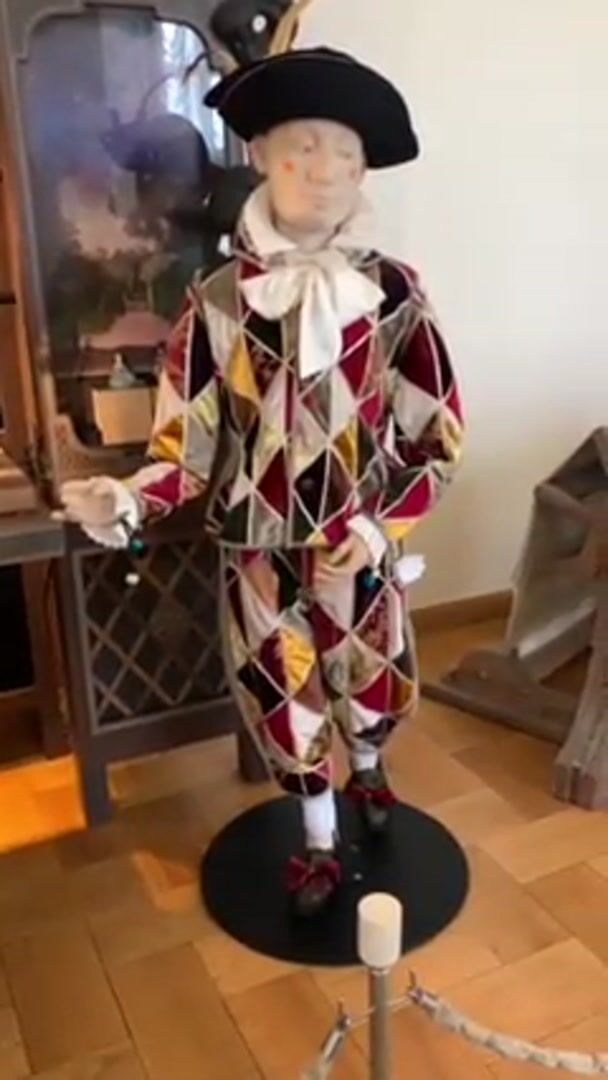
The video shows a full-body mannequin dressed as a Harlequin with a black hat, white ruffle around the neck, and a diamond pattern jacket and pants. It stands on a round black base in a room with wooden floors. The camera pans to a complex mechanical model of a theater stage with miniature figures performing a play behind red and white curtains. The stage is illuminated with blue and white lights.
The image displays a decorated scroll mounted on a wooden stand, situated within a room in Nyasvizh, Belarus.
**Subject/Objects:**
The central subject is an off-white, fabric or parchment scroll, vertically oriented and partially unrolled. It features a stylized, embellished capital letter "R" in dark beading or embroidery, positioned centrally in the upper half. Below this, a horizontal band of repeating diamond-shaped motifs in muted brown and mauve tones is present, bordered by small dark beads. Suspended from the bottom edge of this band are multiple short tassels or fringes, each adorned with a small bead. The vertical edges of the scroll exhibit a continuous pattern of small, dark stitches or perforations.
The scroll is held by a dark brown, possibly stained, wooden display stand. This stand consists of two upright supports with decorative carvings, connected at the top and bottom by horizontal rods around which the scroll is wound. The uprights are secured to broad, flat base supports that rest on the floor. A dark wooden handle with two brass-colored rings and a metal fitting extends horizontally from the upper left upright, suggesting a winding mechanism.
**Environment:**
The floor beneath the stand is covered in light brown wooden parquet or laminate planks. The background consists of a plain, light-colored (off-white) wall. A faint vertical line, indicative of a wall corner or seam, is visible on the right side of the background. To the far left, partially obscured by the stand, a dark, indistinct object (possibly furniture or fabric) is visible. A portion of a human foot, specifically a white sock and a dark shoe or slipper, is visible on the floor in the lower left foreground, adjacent to the stand's base.
**Actions/Interactions:**
No explicit actions or interactions are depicted. The scene presents a static display of an artifact within an interior setting.
Nyasvizh, Belarus · Mar 26, 2026, 9:44 AM
This image depicts an interior scene, likely an exhibit space within a historical building or museum in Nyasvizh, Belarus. The floor is covered in a black and white checkered tile pattern. The walls are dark, possibly black or a dark gray. Prominent red drapes with a satin finish adorn the space; a swagged valance runs across the top of the image, and floor-length curtains are present on both the left and right sides. The curtain on the right is tied back with a gold cord and tassel.
On the far left, a portion of a dark wooden structure or door with decorative metal strapping and a circular metal pull is visible. To its right, against the dark wall, two roughly hewn, light-colored stone architectural fragments, possibly capitals or corbels, are mounted. Below them, a tall, clear glass display case houses four rectangular, carved stone panels, stacked vertically. The carvings on these panels depict ornate patterns; a faint orange glow is observable behind the middle panels.
Towards the center-right, a dark, arched doorway with a multi-paned transom window above it leads into an adjacent, dimly lit space. This inner area features exposed brick walls and a lighter-colored brick floor. A small, distant orange light source is visible within this secondary space.
In the lower right foreground, a silver-colored sign on a gold-colored stand indicates direction with a left-pointing arrow. Partially visible text on the sign includes "THE TOUR CONTINUES" and "MUSIC," alongside Cyrillic script. A smaller arrow sign points further left. No individuals are present in the scene.
The image depicts a static display of historical weaponry against a plain white wall, located within a historical building in Nyasvizh, Belarus, likely Nesvizh Castle or an associated museum.
The central feature is a symmetrical arrangement of five metallic armaments mounted on a dark, horizontally-oriented wooden bracket with decorative scrolled ends. In the center of the bracket is a circular, dark-toned metal shield, approximately 0.6 meters in diameter, adorned with eight radial riveted segments and an embossed border. Flanking the shield on the bracket are two distinct metal helmets: a light-colored, bell-shaped morion-style helmet on the left, and a light-colored, pointed, Turkic-style helmet on the right. Below these, two curved sabers in dark scabbards with metallic accents are diagonally crossed in front of the lower portion of the shield. The hilts rest on the wooden bracket, with the left saber's blade angled down and right, and the right saber's blade angled down and left, their tips converging towards the bottom center.
Approximately 0.5 meters above the armament display, centered horizontally, a rectangular white-framed decorative grille is affixed to the wall. This grille features an intricate, repeating geometric pattern of interconnected circles in white against a dark recessed background, possibly serving as a vent cover or an ornate decorative panel.
In the lower right corner of the frame, a partial view of a dark wooden structure with a curved, scrolled element is visible, extending from the bottom edge upwards and left. Beneath this wooden piece, a flat, horizontal surface of dark turquoise material is present. The entire scene is well-lit, indicating an indoor exhibition space. No individuals are present.
The image displays a static arrangement of historical weaponry mounted on a white wall in Nyasvizh, Belarus. A dark, horizontal wooden plank serves as the primary display support. Centrally positioned on this plank is a circular metal shield, featuring a central boss and eight radiating, embossed segments with intricate patterns, surrounded by a decorated rim. To the left of the shield, a silver-colored morion helmet rests on the plank, above a curved sword partially drawn from a black scabbard with metallic fittings. To the right of the shield, a silver-colored conical or fluted helmet (Zischagge-type) rests on the plank, above a second curved sword, also partially drawn from a black scabbard with metallic fittings. Above the weaponry, a white, rectangular decorative grate with an interlocking circular pattern is affixed to the wall. A dark wooden object is partially visible in the lower right corner.
A glass-fronted museum display case, located in Nyasvizh, Belarus, exhibits antique flintlock firearms against a turquoise felt background. The display is framed by dark, visibly grained wood.
In the upper-left quadrant, a single flintlock pistol with a dark wooden stock, ornate metal lock plate, and brass-colored butt cap is oriented horizontally, with its barrel pointing right. Centrally, two long-barreled flintlock muskets or rifles are displayed diagonally; their wooden stocks are towards the lower left, and their barrels extend towards the upper right. A dark metal chain is draped near the lock mechanisms of these two long guns. In the lower-right quadrant, a fourth, shorter firearm, possibly a pistol or carbine, is partially visible, showing its metal lock mechanism and part of the barrel, oriented right. Small, light-colored circular markers are present on the turquoise background near several firearms.
Above the display, a blurry, framed informational plaque with text, primarily in Cyrillic, is mounted on a wooden structure. The scene is static and devoid of any individuals.
This image depicts a museum display case containing historical weaponry, located in Nyasvizh, Belarus. The display case features a dark wooden frame and is lined with a teal-green fabric background, viewed through a glass panel.
On the left side of the display, five bladed weapons are arranged horizontally. These include a saber with an ornate brass-colored hilt and curved guard, another saber with a dark grip and a silver-toned guard featuring a prominent relief (possibly a stylized face or skull), and several other sabers or swords with varying blade lengths and hilt designs, some partially sheathed. A long, slender rapier-style blade with a small decorative finial tip is also present, extending from the left.
On the right side of the display, three firearms are exhibited. The uppermost is a large flintlock pistol with a dark wooden stock and detailed metal mechanisms. Below it, a second, slightly smaller flintlock pistol with similar construction is displayed. In the lower right quadrant, a compact, short-barreled pistol with a light-colored grip is visible.
All artifacts are secured in place with small metal brackets or clips. White circular adhesive markers are present near several items. Reflections are visible on the protective glass surface of the display. Above the display case, a framed informational plaque, containing text predominantly in Cyrillic with some English translations (e.g., "18th century," "19th century," "20th century"), is mounted on a wooden wall.
The image displays an indoor historical exhibit within a building in Nyasvizh, Belarus. A large, antique bronze cannon, featuring a heavily textured barrel, is positioned centrally on a light-colored wooden wheeled carriage. The carriage has prominent wooden spokes with dark metal segments and rests on a raised platform constructed from dark wooden planks. The rear of the carriage includes two black metal rings.
The floor is composed of numerous light-colored, rectangular wooden blocks laid in a tessellated pattern. The walls are predominantly white, with a section on the right exhibiting an exposed red brick design where plaster has been intentionally removed. To the rear-left of the cannon, a large, dark wooden chest stands with its lid open, revealing a green interior lining. A low-standing stanchion with a beige rope barrier is visible in the extreme left foreground.
On the far-right wall, a partial, faded historical mural or tapestry depicts several figures in period clothing, interacting with what appears to be military equipment including other cannons and wagons. Above the exposed brick section, an ornate gold-colored wall sconce is mounted. The white, vaulted ceiling features a large, dark metal chandelier with multiple candle-style light fixtures and blue decorative accents. No people are present in the scene.
The image displays a historical cannon exhibited indoors, likely within a museum in Nyasvizh, Belarus. The cannon features a dark, ornate bronze barrel with raised decorative patterns. It is mounted on a light-colored wooden carriage with dark metal straps, hardware, and two large wooden spoked wheels. Each wheel has eight spokes, a central dark hub, and a rim composed of alternating wooden sections and black metal segments.
The entire cannon assembly rests on an elevated display platform constructed from dark-stained wooden planks. This platform is supported by stacked, darker wooden blocks. The floor surrounding the display is paved with numerous light-colored, square-cut wooden blocks arranged in a staggered pattern. A dark metal chain and hook assembly lies on the wooden platform in front of the cannon's carriage. In the background, partially visible, are sections of other museum exhibits and the lower legs of an individual wearing light pants and white sneakers, indicating the presence of a visitor in the exhibition space.
A full suit of polished metal plate armor, comprising a helmet with a raised visor, gorget, pauldrons, breastplate, vambraces, articulated gauntlets, faulds, and tassets, is displayed on a dark wooden stand with a flared base. The armor's left gauntlet rests at its hip, while the right gauntlet grasps a brown leather strap attached to a dangling, dark, ribbed piece of leg armor. Brown leather straps are visible securing various sections of the armor. The stand's base partially obscures a white sign with black text. The display is situated in a room with off-white walls, one of which curves gently on the upper left. A small, framed informational sign hangs on the left wall. A white electrical outlet is present on the lower left wall. The floor is constructed from light brown, rectangular wooden blocks laid in a stretcher bond pattern, exhibiting wear. A plain white door is visible in the background to the right, adjacent to which a partial view of a silver-toned, wheeled utility cart is observed. This scene is located in the city of Nyasvizh, Belarus.
An intricately detailed, dark greenish-bronze cannon is displayed prominently in an indoor exhibit space within the city of Nyasvizh, Belarus. The cannon rests on a robust wooden wheeled carriage, featuring two large spoked wooden wheels reinforced with black metal bands. This entire assembly is elevated on a dark wooden platform, which is supported by smaller wooden blocks. The floor of the room is paved with light brown, rectangular wooden end-grain blocks arranged in a staggered pattern. The light-colored walls behind the exhibit show sections of exposed red brickwork, indicating an aged architectural setting. Large, illustrated banners or tapestries depicting historical scenes with figures in period attire, various cannons, and horse-drawn carts are hung across the walls. A small white sign with Cyrillic text is placed atop the cannon's breach, and a larger wooden-framed informational sign on a stand is positioned to the right of the cannon. A wall-mounted sconce with two imitation candles is visible on the upper right wall, and a standard electrical outlet is on the lower left wall. No individuals are present or actively interacting with the exhibit.
The image displays an overhead view into a museum exhibit located in the city of Nyasvizh, Belarus. Six historical bladed weapons, primarily swords and daggers, along with their scabbards, are arranged within a display case. The artifacts rest on a dark green felt surface and are secured by small, reddish-brown retaining straps. Small white circular markers with black numbers (1 through 6) identify each item.
From left to right:
1. A dagger or short sword with a light-colored hilt and a decorated scabbard.
2. A sword with a dark hilt, partially withdrawn from a dark scabbard.
3. A sword with a dark hilt and a scabbard featuring intricate gold-colored textured ornamentation.
4. A shorter bladed weapon with a dark hilt and a plain dark scabbard.
5. A sword distinguished by an elaborately decorated, metallic (likely silver-toned) hilt and scabbard, with a narrow blade.
6. The hilt and upper portion of a scabbard from a bladed weapon, with the blade largely obscured or sheathed.
The display case features a dark wooden frame and a clear glass top. Significant glare and reflections on the glass partially obscure the details of the artifacts and reflect elements of the surrounding room, including what appears to be a ceiling or light fixture. Above the display case, mounted on a wooden wall, is a framed informational plaque with text in Belarusian, providing context for the exhibition. No individuals are present in the scene.
Nyasvizh, Belarus · Mar 26, 2026, 9:51 AM
The scene depicts an interior view of a museum exhibit in Nyasvizh, Belarus, featuring a collection of antique weaponry displayed within a glass-topped, dark wooden case. The case interior is lined with a dark green fabric.
Within the display, five curved sabers and two daggers are arranged against the green background, secured by reddish-brown bands.
1. The uppermost saber has a dark, textured hilt with an animal-head pommel and a slightly discolored, reddish-brown blade.
2. Below it, a saber with an ornate gold-colored hilt and a lighter, silver-colored blade is visible.
3. A reddish-brown scabbard lies horizontally beneath the second saber.
4. Further down, a third saber features a dark hilt with a star-shaped gold-colored guard and a silver-colored blade adorned with gold-colored decorative etchings near the hilt.
5. A dark brown scabbard, also horizontally oriented, is positioned beneath the third saber.
6. On the far right, two daggers are displayed vertically. One has a white hilt and a silver blade partially sheathed in a dark scabbard, while the other is mostly obscured by its dark green scabbard with only a minimal portion of a light hilt visible.
The display case itself features dark wooden framing with visible metal studs and a large metal ring handle on the lower right portion of its exterior. A wooden beam runs horizontally across the top of the image, above the display. The surface below the case appears to be a light-colored tiled or brick floor. A significant reflection of a person holding a dark smartphone is visible on the lower left portion of the glass, indicating a viewer is actively photographing the exhibit.
A vertical textile banner, possibly velvet or heavy cloth, is depicted, predominantly featuring a central dark red field. Upon this red field, a black, stylized double-headed eagle emblem is centrally placed. The central red and black eagle design is bordered on both the left and right by a narrower, solid black vertical stripe. The fabric exhibits slight creases and texture, consistent with a hanging display under artificial illumination. No individuals or active subjects are present. This scene is situated within Nesvizh Castle, Nyasvizh, Belarus, where such heraldic displays, associated with the Radziwill family, are historically relevant artifacts or reproductions.
The image displays a dimly lit, vaulted interior corridor or crypt within a historic structure in Nyasvizh, Belarus. A prominent ornate wall sconce, crafted from dark metal and shaped like a stylized winged creature (e.g., eagle or phoenix), is affixed to an exposed brick wall in the foreground. This sconce contains a single, upward-facing, orange flame-shaped LED bulb, designed to simulate a flickering candle. The wall consists of reddish-orange bricks of varying tones, set with thick, light-colored mortar. A golden-brown horizontal beam or trim runs along the top of the brickwork, directly beneath the ceiling. The ceiling is a dark, segmented vaulted archway, receding into the distance to reveal multiple similar arches, indicating a long passage. Several identical wall sconces, each illuminated with an orange LED, are visible spaced along the right wall, receding into the progressively darker background. A localized faint, cool-toned light source illuminates a small section of the brickwork below the foreground sconce. No individuals, specific actions, or direct interactions are present.
An ornate, dark metal wall sconce, crafted in the form of a stylized heraldic eagle with outstretched wings and visible talons, is mounted on a reddish-brown brick wall. A single, illuminated yellowish-orange electric candle bulb is centrally positioned atop the sconce. The brickwork exhibits distinct mortar lines. The scene is dimly lit, with the electric candle casting localized illumination against the predominantly shadowed background. This fixture is located in Nyasvizh, Belarus. No individuals or active events are depicted.
The scene depicts an interior room in Nyasvizh, Belarus, characterized by dark walls and a dark ceiling. A prominent, multi-tiered chandelier made of gold-toned metal and clear crystal hangs centrally, illuminated and casting intricate shadows onto the adjacent wall. The chandelier features numerous arms, candelabra-style light holders, and an abundance of hanging crystal prisms and a large spherical crystal drop. To the left, a tall, dark-colored candlestick holding a single unlit white candle rests on a dark, unadorned shelf or mantelpiece. The wall behind the candlestick is uniformly dark. The wall to the right features a large-scale, monochrome mural or wallpaper depicting detailed classical architectural elements, including columns, arches, and ornate carvings, rendered in a style resembling an etching or engraving. In the lower right foreground, a partial view of an aged, painted wooden statue depicting a draped figure, possibly religious, is visible against the architectural backdrop. No individuals are present.
This image depicts the ornate interior of a grand hall or church, likely within the Radziwill Castle complex or a prominent religious building in Nyasvizh, Belarus.
The scene is dominated by a high, vaulted ceiling featuring intricate decorative elements. The central, recessed rectangular portion of the ceiling displays a faded fresco in hues of light blue and yellow, depicting stylized cherubic figures and a central circular motif containing a crowned 'M' monogram. Surrounding ceiling sections are adorned with detailed stucco or plasterwork, including classical moldings, geometric patterns, and bas-relief ornamentation in muted beige and pink tones.
Suspended centrally from the ceiling by a long, slender black rod with intermittent spherical nodes is a large, multi-tiered chandelier. This chandelier, appearing to be crafted from dark metal, features numerous illuminated candle-shaped electric lights, casting a warm glow.
The tall walls below the ceiling are predominantly light pinkish-beige, structured with vertical paneling and embellished with extensive bas-reliefs featuring floral scrolls, fantastical creatures, and classical motifs.
Centered at the bottom of the frame is a large, dark, intricately carved wooden or stone structure, appearing to be a reredos or altar. This structure features radiating sunburst elements at its apex, enclosing a circular emblem identical to the crowned 'M' monogram seen on the ceiling. A framed painting or icon is visible within a niche at the base of this structure.
Architectural elements include a partial view of a light-colored, curved balcony or gallery on the lower left, and the underside of another overhead balcony or gallery on the right, decorated with framed paneling. No people are present, and no actions or interactions are depicted. The environment is static and richly decorated, suggestive of historical and architectural significance.
The image depicts the interior of the Farny Church of Corpus Christi, located within the Nesvizh Castle complex in Nyasvizh, Belarus. The scene captures a high-ceilinged room with light-toned, possibly stuccoed or painted walls featuring various carved relief decorations, including heraldic crests and architectural motifs.
Centrally positioned against the far wall is a large, dark, ornate wooden altar or reredos. It features a prominent golden "M" monogram surmounted by a crown at the top, radiating points suggestive of a sunburst, and a framed painting depicting a Madonna and Child at its center. Below the painting, a simple crucifix is visible on a dark altar table, draped with dark fabric. Two tall, dark candlesticks with unlit yellow candles flank the altar. To the left and right of the main altar piece, lower on the wall, are two dark, ornate rectangular frames, possibly for mirrors or informational plaques.
The room is illuminated by a large, ornate metal chandelier with multiple electric candle lights hanging from the high ceiling. In the foreground, dark wooden pews are visible, with the back of a seated individual's head and shoulders visible on the far left. A light-colored rope barrier separates the foreground seating area from the altar steps.
Three individuals are present and actively moving. A woman in the mid-ground, wearing a light-colored long-sleeved top and blue wide-leg pants, carries a dark red handbag and is walking from right to left, her head tilted upwards as if observing the ceiling or upper wall. To the right of the altar, a dark doorway reveals a blurred adult figure partially visible within. A small child, wearing a light-colored top and jeans, is walking or running from right to left in the mid-ground, away from the doorway and towards the center of the room. A bluish glow is discernible around the child's feet, suggesting illuminated footwear. The floor in the active area appears to be dark, possibly tiled.
This image depicts the interior of a religious edifice, likely a church or cathedral, located in Nyasvizh, Belarus. The central focus is a large, dark, ornate altarpiece constructed from dark stone or carved wood. At its apex, a sunburst motif radiates from a gilded circular medallion featuring intertwined letters, possibly "MA" or "MRA." Below this, a rectangular framed painting of a crowned, elaborately robed figure, presumably the Virgin Mary, is centered. This painting is flanked by two carved figures, possibly angels. Two dark, decorative urn-shaped vessels rest on pedestals at the lower sides of the altarpiece.
In front of the altarpiece, a dark, rectangular altar table is draped with a white cloth, overlaid with a dark, scalloped fabric runner. Centered on the altar cloth is a brass crucifix with a corpus. To the left of the crucifix, an ornate metal candlestick holds a partially burned yellow candle. To the right, a matching candlestick holds an unlit candle.
The background walls are light beige with vertical paneling, adorned with faded, indistinct decorative carvings or frescoes, including what appear to be heraldic or religious emblems. Two dark, ornately framed plaques containing densely inscribed text are affixed to the side walls; one is visible on the left, and another on the right. No individuals are present in the scene.
The image displays a collection of historical tableware and decorative items, presented within a glass display case, likely in a museum context in Nyasvizh, Belarus. The background consists of a light-colored wall adorned with a subtle damask pattern.
On the upper glass shelf, from left to right:
1. A dark, lidded stein, possibly pewter or oxidized silver, with detailed relief carvings, resting on a clear acrylic riser.
2. A prominent, polished silver-plated samovar or tea urn, featuring a spigot, handles, and a footed base, positioned on a rectangular silver tray.
3. A small, footed silver creamer or pitcher.
4. A lidded, footed silver sugar bowl.
5. A partially open rectangular wooden presentation case, lined with dark green velvet, containing two light-colored utensils.
On a lower glass shelf, directly below the samovar:
1. A multi-tiered, gold-toned decorative stand, resembling a tree or rack for small implements, featuring numerous miniature sword-shaped picks. This stand rests on a clear acrylic circular base.
2. To the left, a partially visible ceramic plate features a pastoral scene with a hunter and a horse, rendered in green and brown tones.
3. To the right, two additional decorative ceramic plates with ornate borders and scenic designs are displayed vertically, partially obscured.
Reflections from the internal lighting and objects are visible on the glass surfaces and the patterned wall. No individuals are present in the scene.
The image depicts an interior museum exhibition in Nyasvizh, Belarus. A male wax figure, dressed in a dark blue velvet robe with a white ruffled cravat and a silver and red cross medallion, is seated behind a large, dark brown, ornately carved wooden desk with turned legs. The figure has a light beard and mustache, and its gaze is directed slightly upwards and to the viewer's right. A red velvet cushion serves as a footrest beneath the desk for the figure.
On the desk, directly in front of the figure, are several small, dark, intricate metallic decorative objects and a red-covered book or folder. Two red velvet upholstered chairs with light-colored, ornate wooden frames are positioned on either side of the desk.
The background features a tall, dark wooden cabinet. Resting atop the cabinet is a detailed model of a multi-masted sailing ship, flanked by dark sculpted busts and a pinkish glass object on the right. Behind the cabinet and to its left, a glass display case contains various artifacts, including decorative plates and a small statuette. Dark grey curtains are visible behind the display case and cabinet. The floor is constructed of light-colored wooden parquet with a geometric pattern. Overhead spotlights illuminate the scene.
Nyasvizh, Belarus · Mar 26, 2026, 10:00 AM
The image depicts an interior scene in Nyasvizh, Belarus, likely within Nesvizh Castle, showcasing a large model of a multi-masted sailing ship. The ship model, constructed primarily from light brown wood with dark blue hull accents and white fabric sails, features a bowsprit, numerous masts, and extensive rigging. A small flag, resembling a Union Jack, is affixed to one of the forward masts. The model rests on a dark, ornate wooden display cabinet with carved details and glass-fronted sections. Visible through one glass panel inside the cabinet is a light-colored stein or mug. To the left of the cabinet, a partial view of a dark, standing figurative sculpture is present. To the right, a pink glass lampshade atop a clear glass lamp base is partially visible. The background consists of dark blue-green drapes, and the ceiling overhead is light-colored, featuring several illuminated circular light fixtures, with one bright circular light prominently positioned in the upper right quadrant of the image. Reflections are apparent on the glass surfaces of the display cabinet.
The image displays an indoor museum exhibit in Nyasvizh, Belarus. A male mannequin, visible from the waist up, occupies the central foreground, positioned behind a dark wooden desk. The mannequin wears a dark blue velvet-like garment with wide white lace cuffs and a prominent ruffled white collar. A gold chain with a white and red cross medallion hangs around its neck. The mannequin has light brown hair, a reddish-brown beard, and a mustache, with its head turned slightly right and gaze directed upward. On the dark wooden desk in front of the mannequin, a red folder is present on the right, and a small, dark, ornate metallic object on the left.
Immediately behind the mannequin stands a large, dark wooden credenza or cabinet. Prominently displayed atop this cabinet is a detailed model of a three-masted sailing ship with white sails, a brown hull, and blue accents, resting on a stand. Flanking the ship model are several dark metallic sculptures, including figurative pieces and busts. To the right of the ship, a pink-topped lamp is visible alongside another dark sculpture. The background features a glass display case on the left, containing multiple shelves exhibiting various decorative plates and small figurines, including a white oval platter and other circular plates, and a figurine of a woman with a deer. The wall behind this display case is light-colored and patterned. To the right, dark grey curtains are drawn, obscuring the wall. Overhead spotlights provide illumination, creating visible glare in the upper sections of the image.
This image captures a museum exhibit display within a building in Nyasvizh, Belarus. The scene features a deep red wall and a matching red floor, suggesting an enclosed display area. Mounted on the upper left section of the red wall is a deer skull with antlers, affixed to a decorative wooden plaque. Below it, a taxidermied black grouse is presented perched on a small branch with artificial greenery, also mounted on a wooden base. To the right of the grouse, a taxidermied hawk or similar raptor is displayed with wings fully extended in a flight pose, mounted on a short branch extending from the wall. Shadows of these mounted specimens are distinctly visible on the red wall. On the red floor in the lower left quadrant, a taxidermied pheasant, primarily brown with iridescent blue and green on its head, is displayed. Centered on the red floor, an antique-style rifle with a wooden stock and long barrel rests horizontally on a dark support stand. To the right, a taxidermied wolf pelt, complete with an open-mouthed, snarling head, lies on the red floor. Two small black spotlights are positioned on the floor, illuminating the wolf pelt. A small white sign with dark Cyrillic text, likely a "do not touch" warning, is partially visible near the wolf's head. No people are present in the scene.
This image depicts a museum exhibit located in Nyasvizh, Belarus. The central subject is a taxidermied wolf pelt, presented as a full-body rug, laid prone on a rectangular, matte red display platform. The wolf's fur is predominantly light brown and tan, with areas of lighter cream and grey fur on its face, ears, and limbs. Its mouth is open, revealing visible teeth and a dark interior. The eyes are bright yellow-green.
On the same red platform, to the upper left of the wolf's head, a portion of a vintage-style rifle is visible, featuring a dark wooden stock and a metallic trigger mechanism. Two black, cylindrical, adjustable spotlights are also positioned on the red platform, aiming at the display. One spotlight is partially visible in the lower left foreground, and another is in the upper right background, behind the wolf's back. The display platform is set against a matching matte red wall panel. To the right of this panel, a white wall and a dark vertical frame are visible. The floor in the foreground and to the right consists of light-colored parquet wood, arranged in a herringbone pattern. No individuals are present in the scene.
An indoor exhibit within the city of Nyasvizh, Belarus, features taxidermied animals and hunting equipment against a deep red and white wall backdrop. A large deer skull with antlers, mounted on a dark wooden plaque, is affixed to the upper red wall. Below it, a dark-plumaged grouse or blackcock, mounted on a branch, protrudes from the red wall. To the far left, on a dark metal shelf, two dark statuettes, one resembling a bear and another a smaller animal, are present. On the adjacent white wall, a taxidermied bird of prey, possibly a hawk, with outstretched wings, is mounted on a wooden perch.
In the foreground, a prominent red display platform showcases additional items. From left to right: a taxidermied pheasant with brown, white, and red plumage, positioned as if in motion, is illuminated by a small black spotlight. A long hunting rifle with a dark wooden stock rests horizontally on the platform. To the right, a taxidermied blonde-furred dog, resembling a husky, lies on its side with its mouth slightly open, illuminated by two small black spotlights. The area is brightly lit by overhead and targeted display lighting.
The image depicts a taxidermy exhibit housed within a glass display case, located in Nyasvizh, Belarus. A large, light brown taxidermied bear bust, featuring an open mouth with visible teeth and upward-right gaze, occupies the central position. To the bear's left, a smaller, dark-furred, polecat-like animal stands upright on a curved wooden branch, its mouth also slightly ajar. To the bear's right, a red squirrel with a bushy tail perches on a small branch, while a second, lighter-colored squirrel-like rodent with prominent white facial markings is positioned below it on a lower branch section. The animals are arranged on a dark, flat base with wooden elements and metal support rods. The scene is viewed through a clear glass case, exhibiting multiple reflections; a faint, partial reflection of a child in light clothing and light blue shoes is visible on the right side of the glass, observing the display. The background behind the exhibit consists of light-colored, vertically pleated curtains, with overhead lights reflecting as bright circular points on the glass.
A taxidermied beaver is displayed within a glass enclosure, likely in a museum or exhibition space in Nyasvizh, Belarus. The beaver, with reddish-brown fur, is positioned as if gnawing on a horizontal piece of light-colored wood, which is held by its front paws. Its mouth is open, revealing prominent orange incisors, one of which appears broken or significantly worn. White whiskers extend from its snout. The beaver's body rests on what appears to be a flat, dark surface or a continuation of the display material.
The beaver and the wooden piece are supported by a dark-colored metal stand with angled crossbars. To the lower left, a cylindrical section of wood is visible on the floor. The background consists of a light-colored wall with a subtle, repeating geometric pattern, visible through the display case. Reflections are present on the glass, showing distorted outlines of the surroundings and a horizontal green strip at the top, possibly part of the display’s interior or a distant architectural feature.
The image depicts a taxidermy display case located in Nyasvizh, Belarus. Positioned centrally is a taxidermied brown bear, consisting of its head and upper torso, with its mouth agape, exposing teeth. To the bear's left, a smaller, dark brown taxidermied animal, resembling a ferret or polecat, is mounted on an artificial wooden branch, its mouth slightly open. To the bear's right, a taxidermied grey squirrel with a reddish-brown bushy tail is perched on a wooden element, also with its mouth open. Below the bear's head, a second, lighter brown taxidermied squirrel is positioned on a wooden base. All animals are enclosed within a clear glass display case, evident from reflections of overhead lights and indistinct background shapes, and a visible vertical seam of a glass panel on the right side. The background within the display case consists of dark, possibly brown or grey, draped fabric or curtains.
A taxidermy display is presented behind a reflective glass panel, likely within a museum or exhibition in Nyasvizh, Belarus. The central figure is a large, light brown Eurasian brown bear, mounted in a rearing or standing posture, with its mouth agape and head tilted slightly upwards and to its right. To the bear's left, a taxidermied European polecat, characterized by dark fur and a lighter face, is perched on a gnarled wooden branch, leaning forward with its mouth slightly open. To the bear's upper right, a taxidermied red squirrel is positioned on another gnarled branch, appearing to hold a small object in its front paws. A second red squirrel is visible near the base of the bear, also situated on a branch. The background consists of dark, vertically pleated fabric. Reflections of interior lighting and a vertical seam in the glass are visible across the foreground.
This image depicts an interior scene, likely within an exhibition space at Nesvizh Castle in Nyasvizh, Belarus. A large moose skull and antlers are mounted centrally on a carved wooden plaque against a plain, matte red wall. The antlers are multi-tined and light brown, extending horizontally, while the skull is bleached white. The wooden plaque, dark brown with a carved oak leaf design at its bottom, is positioned vertically. Below the mounted antlers, a small bronze equestrian statue rests on a multi-layered base composed of light and dark stone, placed on a dark, flat surface. The statue portrays a male figure in historical attire, including a tricorn hat, holding an object resembling a pistol in his raised right hand while astride a dynamically posed horse. Strong shadows from the antlers are cast onto the red wall, indicating overhead lighting. To the left, a portion of a white wall or partition is visible, against which hangs a yellow, swallow-tailed banner with a black, possibly heraldic, symbol. Overhead strip lighting and a faint blue light source are discernible in the upper left background. The floor in the lower-left foreground appears light-colored.
Nyasvizh, Belarus · Mar 26, 2026, 10:03 AM
The scene captures a display of five historical ceremonial swords and two leather cases within a transparent exhibit case, located in Nyasvizh, Belarus. Five ornate swords are arranged vertically, leaning against a plain, light-colored background wall. Each sword features an elaborate hilt, a distinctive cross-guard (some with attached chains), and a decorated scabbard. The sword grips are composed of either dark material (such as wood or ebony) or light material (consistent with ivory or bone), while scabbards are either dark-toned or silver-toned with intricate metallic overlays, engravings, and small attachment rings. In the foreground, two weathered brown leather cases are positioned horizontally. The upper case is a contoured, possibly weapon-specific, carrying case, exhibiting a central curved handle and a circular closure mechanism on its right end, with visible wear and scuffing. A lower, narrower brown leather strap or case component, also appearing worn, is partially visible beneath the larger case, featuring a loop handle. Reflections on the transparent display surface indicate overhead lighting and external room elements.
Inside a glass display case at a location in Nyasvizh, Belarus, a collection of historical bladed weapons is presented. Six bayonets are vertically mounted on a black metal display rack. From left to right: the first bayonet features a long, slender blade; the second has a ribbed, dark-colored grip and a straight blade; the third possesses a dark, grooved grip and a straight blade; the fourth is a distinct saw-back bayonet with a dark grip and prominent serrations along the spine of its blade; the fifth displays a dark grip and a curved quillon; and the sixth exhibits a light-colored, possibly bone or plastic, grip. The bayonets are secured by their hilts resting on an upper horizontal bar of the black rack, with their blades extending downwards. Below these, on the light-colored base of the display case, a combined axe and bayonet entrenching tool is horizontally positioned, featuring a wooden handle, a metal axe head, and a bayonet blade integrated into a dark leather scabbard. Several additional dark scabbards lie horizontally on the base of the display behind the bayonet blades. No people are visible. No actions or interactions are depicted. The environment is an interior museum or exhibition setting, evidenced by the display case and reflections on the glass.
This image captures an interior scene, likely within a museum or historical exhibition in the city of Nyasvizh, Belarus. The primary subject is a dark-framed wooden display case, viewed from a slightly elevated perspective, showcasing a collection of military medals and badges.
The display area is lined with a vibrant red velvet or felt fabric, creating a contrasting background for the metallic decorations. A clear glass or acrylic panel covers the display, exhibiting multiple bright circular reflections from overhead light sources. The artifacts are arranged in three horizontal rows, each placed on small, transparent acrylic stands.
The top row features approximately ten distinct military badges, including circular emblems, a star-shaped medal, and a teardrop-shaped badge with red and black detailing. The middle row displays eleven hanging medals, each attached to a ribbon of various color combinations (e.g., striped yellow/blue/red, yellow/green, white/red). These medals are predominantly circular or cross-shaped. The bottom row presents approximately seven additional hanging medals, similar in style to those above, featuring ribbons and metallic medallions, including a cross-shaped design with a central circle.
Below the display case, a white rectangular sign, centrally positioned on a lighter wooden ledge, reads "Пожалуйста, РУКАМИ НЕ ТРОГАТЬ!" (Please, DO NOT TOUCH!) in Cyrillic script. The floor visible beneath the display case is made of light-colored wood, laid in a geometric or parquet pattern, reflecting ambient light. No individuals or active interactions are depicted in the scene.
An indoor museum exhibit in Nesvizh Castle, Nyasvizh, Belarus, displays a full-scale mannequin of a Polish-Lithuanian Winged Hussar mounted on a dark brown horse mannequin. The Hussar wears polished, silver-colored plate armor, including a helmet with a closed visor, and features large feather wings projecting upwards from the back of the armor. The rider's lower legs are represented by unfinished wooden forms.
Beneath the horse, on a geometric-patterned tiled floor, lies a light-brown bearskin rug with its head facing forward and mouth agape. A crimson velvet cloth is draped beneath the horse's hooves. To the right of the horse, a small wooden pedestal holds several dark, spherical cannonballs and one larger, lighter-colored spherical projectile.
On the white wall behind these objects, two vertical banners are suspended: one yellow banner featuring a circular black stylized symbol, and an adjacent solid black banner. The background on the left includes red architectural elements, possibly arches or structural walls, and the ceiling features glass panels with integrated spotlights.
The image displays an indoor museum exhibit located within Nesvizh Castle in Nyasvizh, Belarus. The central subject is a life-sized equestrian mannequin featuring a knight's full suit of metallic armor, adorned with prominent wings attached to the helmet or backplate, mounted on a dark brown horse mannequin posed in a dynamic stance. A dark red velvet cloth is draped under the horse's front legs. In the foreground, a large, light-colored bear skin rug with its head facing the viewer, mouth agape in a snarl, is spread across the light-wood parquet floor. To the right of the rug, a small dark red velvet pedestal supports two wooden bases: one holds three stacked dark spherical cannonballs, and the other presents a single large, grey stone sphere. The background features a solid dark red wall with a visible arched entryway to the right of the horse. On the left wall, a large, intricate, earthy-toned tapestry or relief artwork extends vertically. The environment is well-lit by modern overhead lighting. No individuals are present in the scene.
A taxidermied Eurasian lynx is exhibited within a clear glass display case at a museum in Nyasvizh, Belarus. The specimen is posed in a dynamic, aggressive, or mid-leap posture, featuring light brown fur with subtle darker spotting. Its mouth is agape, exposing prominent canines and incisors, while its eyes are wide and ears are slightly drawn back. One front paw rests atop a bark-covered wooden log stump, which serves as a display prop. The glass panels of the display case reflect elements of the surrounding museum environment, including a dark curtain on the left and a distant display shelf containing various historical artifacts such as pottery and metalware. The display case's base is dark-framed, with visible metallic clasps on the right-side glass panel. The immediate floor outside the case is light-toned wood.
The image depicts an interior view of a museum exhibit, identified as being located in Nyasvizh, Belarus, likely within Nesvizh Castle.
In the center, a life-sized, dark-colored equestrian statue is displayed. The horse, facing slightly left, is in a dynamic, rearing pose, wearing a bridle. Mounted on the horse is a mannequin adorned in a full suit of polished metal armor, characterized by large, feathered "wings" attached to its back, indicative of a Polish-Lithuanian Winged Hussar. The statue rests on a folded piece of deep red fabric on the floor.
In the foreground, a large, light brown bear rug is spread flat on the floor, its head intact with an open mouth displaying teeth, facing the viewer. To the right of the bear rug, a small, square pedestal draped in red fabric holds two items: a wooden tray containing four dark, spherical objects (possibly cannonballs) and a larger, rough-textured stone sphere resting on another wooden base.
The floor consists of light-colored tiles with a geometric pattern. The left wall features a large, textured tapestry or relief artwork in earthy brown and gold tones, illuminated by spotlights from above. The right background wall is painted a dark reddish-brown, with an archway leading to another dimly lit area. The ceiling is light-colored and features multiple recessed spotlights, one of which creates a prominent lens flare in the lower-central portion of the image. No people are visible.
The image displays two historical artifacts within a glass museum display case, situated in an interior room likely within the Nesvizh Castle in Nyasvizh, Belarus. The main subject on the left is a rectangular plaque, approximately 30-40 cm in height, featuring a central embossed coat of arms. This emblem depicts a stylized, crowned eagle with outstretched wings, rendered in metallic grey tones against a yellow-gold background. The eagle's chest bears a circular symbol, possibly a variant of a triskelion. Below the eagle, two crossed objects, resembling swords or sabers, are depicted. The plaque rests on two small, white rectangular support blocks. To the right, a fragment of a larger, broken ceramic object is displayed. This fragment shows an irregular, rough break edge and a glazed, mottled reddish-brown and beige surface, suggesting it could be a section of a decorative tile, roof element, or architectural piece. It also rests on two similar white support blocks. Both items are positioned on a reflective black surface, presumably the base of the display case. Small, white square labels with the numbers "4" and "5" are visible in front of the respective artifacts. The glass case reflects the surrounding environment, revealing a patterned wallpaper with a repeating geometric motif in shades of green and gold, and a parquet floor with a chevron pattern. Further reflections on the right side of the case suggest a darker, indistinct architectural feature within the room. No people are present, and no actions or interactions are depicted.
Three light-colored, ornate architectural frieze or cornice fragments are displayed on a multi-colored, geometrically patterned surface. This scene is located within a building in Nyasvizh, Belarus, consistent with a museum or historical exhibition space, likely within Nesvizh Castle.
The top right fragment is elongated, featuring three distinct horizontal bands. Its uppermost edge consists of a repetitive, pointed leaf-like cresting. The middle band displays alternating shell and stylized foliage motifs. The lowest band exhibits vertical fluting with small, four-petal floral rosettes.
The middle left fragment is shorter, characterized by a prominent scallop-shell pattern along its top edge. Below this, a plain band precedes a lower band with a repeating C-scroll or wave pattern.
The largest fragment, situated at the bottom center, features a series of bulbous, half-sphere-like elements along its top, resembling inverted lotus buds. Below these, a detailed frieze displays stylized, layered leaf or feather patterns with downward-curling motifs. The lowest visible band contains simpler, repeating teardrop or elongated C-scroll shapes.
The display surface is a poster or large print with sections of blue, purple, and possibly pink or red, forming triangular and rectangular shapes. The background reveals dark wooden paneling, potentially part of a ceiling or wall, and further left, dark, possibly patterned wall tiles. No individuals are present in the image.
The image depicts two fragmented bas-relief sculptures on display in an interior setting, identified as a location in Nyasvizh, Belarus.
The scene features two distinct, irregularly shaped fragments made of a light-colored, possibly stone or stucco material, resting on a matte, light purple display surface.
The upper-left fragment is a roughly trapezoidal piece, approximately 0.5 meters in width, depicting the bust of a figure, likely male, with a rounded face and indistinct features, emerging from a sculpted circular or oval frame. The figure's details are softened by erosion or wear.
The larger, lower-right fragment is an irregularly shaped piece, approximately 1 meter in width, showcasing a reclining or crouching figure, possibly a putto or cherub. The figure's head is partially visible, facing downwards and to the left, with muted facial features. Its right arm is bent, interacting with a thick, curvilinear, drapery-like or serpentine element. The torso and robust legs are depicted in a bent posture. A small white label is visible behind the upper section of this fragment.
The sculptures are displayed against a background of dark brown wooden paneling with visible grain. Below the purple display surface, a section of light-toned wooden flooring with a geometric parquet pattern is visible. The lighting is even, illuminating the artifacts.
Nyasvizh, Belarus · Mar 26, 2026, 10:08 AM
This image depicts an illuminated museum display case, likely situated within the Nesvizh Castle in Nyasvizh, Belarus. The display case features white interior walls and a reflective glass top surface.
Centered at the top of the case, a white sheet of paper displays eight numbered descriptions in Cyrillic, identifying the displayed items as "Копія" (Copy), indicating replicas of historical orders.
Below the textual descriptions, eight distinct order replicas are meticulously arranged in two horizontal rows of four. Each replica is housed within a black, square, plastic-covered display box, individually numbered 1 through 8.
The top row, from left to right, contains:
1. A gold-colored, ornate star design with multiple points, featuring a central red enamel disc encasing a white, pearl-like object.
2. A red enamel cross with gold edges, a white central disc, and gold rays emanating from its center.
3. A red enamel cross with flaring arms and gold edges, a white central disc, and radiating gold elements.
4. A dark red or maroon enamel cross with gold edges, a gold central disc, and gold rays.
The bottom row, from left to right, displays:
5. A white enamel Maltese cross with gold edges and a central gold disc.
6. A white enamel cross with gold edges and intricate gold central ornamentation, flanked by golden eagle motifs between its arms.
7. A white enamel Maltese cross with gold edges, surmounted by a gold crown, and featuring golden symbols between its arms.
8. A plain white enamel Maltese cross.
No individuals or active interactions are present in the scene. The items are stationary and presented for exhibition.
An antique brass or bronze wall display, located in Nyasvizh, Belarus, features a central shield and an arrangement of weapon elements mounted on a textured red wall. The shield is embossed with intricate foliate patterns and two central roundels depicting heraldic animal motifs. Emanating from behind and around the shield are various weapon components: a battle axe head pointing upwards centrally, two short swords with decorated hilts positioned diagonally upwards, two polearm heads with hooks and blades extending horizontally from the sides, and three lower weapon points—two diagonally downwards and one vertically downwards from the bottom center. The entire assembly exhibits an aged, dark gold metallic finish.
The image displays an interior museum exhibit, likely within the Radziwill Castle Museum in Nyasvizh, Belarus. The central object is a sleeveless ecclesiastical vestment, possibly a dalmatic, exhibited on a white mannequin torso. This vestment is predominantly pink or magenta, adorned with intricate gold and white floral and foliate patterned embroidery, and features gold trim along its edges and vertical front panels. The V-neck collar is detailed with a white openwork fabric.
To the upper left, a framed document with an ornate gold Baroque-style frame and handwritten, illuminated script is mounted on a beige wall. Below this framed document, on a clear glass pedestal, rests a polychrome statue depicting the crowned Virgin Mary seated and holding the infant Jesus; Mary wears a blue cloak and a light-colored dress, while Jesus is partially draped.
On the far left, another pink and gold patterned ceremonial garment, possibly a cope, is partially visible within a glass display enclosure, reflecting a window with grid patterns. A strip of matching fabric, possibly a maniple or stole, lies on a lower clear glass shelf in the foreground. In the reflections on the right-hand glass panel, a person holding a smartphone is visible, indicating the act of photography. Partially visible at the bottom right are brass ecclesiastical candle holders. The environment consists of beige walls, glass display cases, and a white ceiling.
This image depicts an indoor museum exhibition within the Nesvizh Castle complex in Nyasvizh, Belarus. The scene features a large, multi-paneled glass display case containing historical garments and religious artifacts, illuminated by bright overhead lighting which casts reflections on the glass.
Within the display case, from left to right:
1. A light beige or gold sleeveless tunic, intricately embroidered with white and gold patterns, is presented on a white mannequin torso. A coordinating textile is visible on the case's base below.
2. A painted wooden or ceramic figurine, depicting a crowned child in elaborate gold and red robes, stands on a gold pedestal on a glass shelf. A small gold goblet is situated on a lower glass shelf.
3. A floor-length, deep red velvet ceremonial robe or vestment, adorned with wide vertical gold embroidered stripes featuring floral motifs, is displayed on a white mannequin torso.
4. To the right, two additional sleeveless tunic-style garments are displayed on white mannequin torsos; the one in the foreground is light pinkish-beige with patterned embroidery.
5. In the background, behind the central robe, an ornate gold-framed object reflects a window with light curtains. Below this, a small, light blue and white figurine rests on a glass shelf.
6. On the lower right shelves and the case's base, a brass candelabra and a similar decorative metal object are visible. Diagonally across a lower glass shelf lies a long, dark wooden staff-like object with a brass tip, connected by a string to a red velvet pouch containing two small metal items.
The overall environment is an organized, climate-controlled exhibition space designed for the preservation and display of historical artifacts. No individuals are present in the immediate vicinity of the exhibit.
The scene depicts an interior view of a museum exhibit at Nesvizh Castle, Nyasvizh, Belarus. Behind clear glass display panels, several historical and religious artifacts are presented.
On the left, a sleeveless, light gold-beige ceremonial garment or vestment is displayed on a headless mannequin. It features intricate silver-toned embroidery with floral and geometric motifs across its surface and a distinctive white, open-necked collar with a punched pattern.
In the center, a polychrome wooden statue of a crowned infant or child figure stands on a clear glass pedestal. The figure, possibly a representation of the Infant Jesus, wears a gold crown, a gold and white robe adorned with gold leaf accents and stylized floral patterns, and a dark blue or green cape. It holds a gold, multi-petaled object in its right hand.
To the right, a long, flowing red velvet or richly woven liturgical vestment, possibly a cope, is displayed on another headless mannequin. This garment is embellished with wide gold trim and large, repeating gold fleur-de-lis patterns. Reflections on the glass case in front of this vestment show parts of the surrounding room, including what appears to be a window or internal structure.
On a lower glass shelf in the foreground, directly below the statue, a brass or gold-colored chalice-like object with a flat, white disc (likely a paten) atop it is displayed. To the far left, a light-colored, woven or crocheted bag is visible on a small stand, partially obscured. The background features light-colored walls and a diffused, illuminated ceiling.
This image depicts a museum exhibition hall in the city of Nyasvizh, Belarus, showcasing historical and religious artifacts within a large, multi-section glass display case.
The foreground is dominated by a clear glass display case with a light brown base. The floor is constructed of light-colored wooden planks arranged in a parquet pattern. The ceiling features several large, illuminated rectangular white panels.
Inside the leftmost section of the display, a decorative metal cross, possibly wrought iron, is mounted on a light-colored wall. Below it, on a clear glass shelf, two ornate silver-colored metal vessels with lids are exhibited. Behind these objects, a window with a grid pattern and sheer white curtains is partially visible, either directly or as a reflection on the glass.
The central section features a large, elaborately carved wooden frame, painted predominantly in blue, gold, and red/pink hues, standing upright. Its central panel is a recessed, plain wooden surface.
In the rightmost section of the display, a mannequin is dressed in a rich ecclesiastical vestment, characterized by patterns in red, gold, and dark fabric. In front of this mannequin, a smaller, carved wooden statue of a figure, possibly a cleric or saint, wearing a gold crown or mitre and holding a staff, stands on a dark pedestal. To the right of the statue, on a separate clear glass shelf, a large, ornate metal vessel, resembling a censer or urn, rests on its side.
On the lowest level of the central display, inside the glass case, several antique metal tools or implements, including what appears to be a hammer and tongs, are laid out on a beige surface.
This image captures a museum exhibit located in Nyasvizh, Belarus. The scene is dominated by three main display elements, visible through a clear glass enclosure against light-colored walls.
On the left, a multi-colored statue of a male saint or bishop stands on a dark brown wooden plinth. The figure wears a gold mitre, a deep red and emerald green cope, and a white alb adorned with black crosses. He holds an open, gold-edged book with black markings in his left hand and a black shepherd's crook with a gold volute in his right hand.
To the right and slightly behind the statue, a decorative ecclesiastical vestment is displayed on a headless, light-colored mannequin. The garment features vertical, wavy panels of deep red velvet, black velvet, and light-colored brocade with intricate floral patterns. Gold trim delineates these panels and edges the V-neckline. A separate golden crozier volute, intricately scrolled, is positioned centrally on the vestment. The mannequin is supported by a slender silver-colored stand.
In the bottom right corner, two ornate, silver-colored metal vessels, possibly urns or chalices, are partially visible. They exhibit intricate embossed patterns and are positioned on the same display shelf as the statue. Reflections of the room and an indistinct text panel are visible on the glass display case surfaces.
The image depicts an indoor exhibit within the city of Nyasvizh, Belarus. A large glass display case encloses three religious artifacts presented on light-colored rectangular pedestals.
On the left, a large, ornate gold-colored monstrance or reliquary stands on its pedestal. It features a central circular opening surrounded by radiating sunburst rays, with a design incorporating a crown and two small angelic figures at the top, supported by an intricately decorated stem and base.
To the right, on a higher pedestal, a small white statuette depicts the Virgin Mary holding the infant Jesus. Below it, on a lower pedestal, a gold-colored chalice with a simple cup and a decorative base is displayed. Small numerical labels, "2" and "3", are visible on these pedestals. A partial view of a white display board is visible in the far left background.
The glass display case reflects the silhouette of a person's head and shoulders in the upper left, and in the upper right, multiple windows with white sheer curtains and a criss-cross pattern. Two silver-colored spotlights are mounted on a vertical metal rod along the right edge of the display, directing light towards the artifacts. The background consists of a light-colored wall, with a segment of wooden flooring visible on the far right.
The image captures a detailed view within a museum setting in Nyasvizh, Belarus, featuring a collection of religious artifacts. A central focus is a ornate clerical vestment, likely a chasuble, displayed on a light blue mannequin with a white collar. The vestment is light-colored, possibly cream or pale yellow, and is richly embroidered with a floral pattern of pink, red, and yellow roses intertwined with green and brown foliage, accented by vertical and horizontal bands of gold-colored trim.
To the left of the vestment, mounted against a neutral grey wall, is a carved wooden corpus, depicting the emaciated body of Christ from a crucifix. The wood is light-toned and appears weathered, with the figure's head bowed downwards. Below this, positioned within a clear glass display case, are several items: a small silver crucifix on a stand and two distinct silver candlesticks are arranged on a top shelf. On a lower shelf, a small colored figurine of a monk in a brown habit, holding a staff, is visible. In the immediate foreground, within the display case, is a larger, light-colored wooden carving of a robed figure, appearing to be a monk or saint, facing downwards.
To the right, partially visible within another section of the glass display case, is an ornate silver object with intricate decorative patterns. The background features reflective surfaces, likely mirrors or glass panels, which reflect interior windows with white frames and what appear to be white vertical blinds or sheer curtains, indicating a well-lit exhibition space.
The image depicts a museum exhibit within the city of Nyasvizh, Belarus, likely at the Radziwill Castle complex. The scene is observed through a reflective glass display case, showing multiple artifacts. In the center, a weathered wooden figure of Christ, detached from a cross, is mounted against a light brown wall. The figure, exhibiting visible cracks and a crown of thorns, wears a draped loincloth. Below it, a small brass crucifix on a stand and another metal candlestick-like object are visible. To the left, behind glass, a mannequin displays an ecclesiastical vestment featuring vertical red and gold striped fabric with intricate gold embroidery. To the right, another mannequin presents a different vestment with a white collar and extensive floral embroidery in reds, pinks, and greens, accented with gold trim. Reflections of window panes and ambient light from the museum environment are prominent on the glass surfaces of the display cases. No people are directly visible, but the setup implies an indoor public display area.
Nyasvizh, Belarus · Mar 26, 2026, 10:13 AM
An antique Latin missal or liturgical book is displayed open within a clear glass exhibition case. The scene is located in a museum or historical exhibit, specifically within the city of Nyasvizh, Belarus, likely Nesvizh Castle. The open book, centered in the frame, features thick, aged, and slightly yellowed pages with visible wear. Its left edge shows a robust, brown binding with several worn, dark brown tabs or markers protruding from the page edges. The right page of the open volume is marked by a slender, dark red fabric ribbon bookmark.
The text on the pages is primarily in Latin, presented in black letterpress with significant sections and initial letters rendered in red ink. The upper half of the left page, and extending slightly onto the right, displays an elaborate decorative border surrounding a central oval illustration depicting a standing robed figure, presumably a religious figure like Jesus Christ, with a visible heart motif. This central image is flanked by multiple smaller, square-shaped monochrome illustrations within a patterned frame. Below the main illustration, large bold black text reads "SACRATISSIMI CORDIS JESU." Further down, an illuminated initial "M" in red introduces a paragraph of text.
The book rests on an elevated clear acrylic stand within the glass case. Reflections of interior lighting fixtures (chandeliers) and a dimly visible white ceiling are evident on the glass surface. A lower shelf, also visible through the clear display, holds another older book, partially visible and open to text-heavy pages, suggesting a multi-level exhibit. The immediate background appears as a plain, light-colored wall with faint reflections of other elements.
An antique, large-format liturgical book is displayed open within a clear glass case at a museum in Nyasvizh, Belarus, likely the Radziwill Castle Museum. The book's two visible pages are aged, with a cream or yellowish hue and black printed text. The left page features a prominent, ornate black-and-white illustration block at the top, centered on a robed standing figure within an oval frame, surrounded by smaller decorative panels. Below this, the title "SACRATISSIMI CORDIS JESU" is printed in large capital letters. Paragraphs on both pages begin with decorative red initial letters, such as a large 'M' and 'C' on the left page and 'C' and 'D' on the right page. A dark reddish-brown fabric bookmark extends from the book's spine, resting on the right page. The right page displays continuous text, with headings like "FESTA JUNII" visible towards the bottom. Reflections of interior lighting sources are visible on the protective glass surface of the display case, partially obscuring some textual details. The top edge of the display case features a dark green trim. The background behind the case is a light-colored wall.
The image displays the interior of a religious building, identified as a chapel or church within Nyasvizh, Belarus. The perspective is elevated, looking down into the main space. A dark wooden beam or railing crosses the top of the frame.
At the far end, centrally located, is an ornate dark wooden altarpiece, topped with a radiant sunburst design. In front of it, a white-covered altar or table holds a small cross. A large, multi-tiered brass chandelier with approximately twenty-four lit candles hangs above the altar area. The floor features a checkered pattern of brown and lighter square tiles. Immediately in front of the altar, a rope barrier supported by two stanchions delineates the space.
To the right, a cream-colored balcony or gallery extends into the room, detailed with decorative panels. Two lit wall sconces are mounted on the right wall below this gallery. A partial, darker wooden balcony or gallery is visible on the far left. The walls are light-toned, adorned with subtle decorative patterns or faded frescoes, and a dark framed object hangs on the left wall near the altar. In the foreground and lower half of the image, several rows of dark wooden pews are arranged on the checkered floor, oriented towards the altar. No individuals are present in the scene.
An interior scene in Nyasvizh, Belarus, displays an unoccupied room corner. Two ornate armchairs are positioned on a light brown parquet floor. Each armchair features a dark brown wooden frame, light yellow patterned fabric upholstery, and gold-colored decorative elements, including winged figures on the armrests, a central embellishment on the top rail, and ferrules on the tapered legs. The walls are off-white above dark brown wooden wainscoting. A dark, square electrical outlet is visible on the wainscoting between the chairs. To the right, a perforated grille, consistent with a radiator cover, is integrated into the wainscoting. A light gold patterned curtain is tied back in the upper right corner. No individuals are present, and no actions are depicted.
This image depicts the interior of a religious building, likely a chapel or small church, located in Nyasvizh, Belarus. The perspective is elevated, looking down from an upper gallery or balcony into the main hall.
Centrally positioned above the altar area is a large, multi-tiered silver-colored chandelier with numerous illuminated candles, serving as the primary light source and casting bright rays across the scene. The walls are light beige or pale pink, adorned with decorative relief panels and faded frescoes or patterns. Two elevated side balconies with paneled fronts, decorated with similar motifs, extend into the space on the left and right. The floor is composed of dark square tiles, some appearing lighter due to illumination, suggesting a checkerboard pattern.
At the far end, the altar area is delineated by a dark rope barrier. The altar itself consists of a dark, multi-tiered structure draped with a white cloth. To the left of the altar, an ornate, dark, possibly empty frame or mirror is mounted on the wall. To the right, a dark arched doorway is visible. A slender, golden-colored stand or cross is positioned to the left of the altar table.
Seven to nine individuals are present in the lower half of the image. In the front left pews, one person in dark attire appears to be kneeling or bending, alongside another individual with light hair wearing a light shirt. Further back on the right, near the altar barrier, an elderly female figure with short, light hair and glasses, wearing a patterned top, stands facing the pews. Next to her, a person in a dark greenish-blue off-shoulder top is partially standing, holding a small object. Additional figures are seated in the dark wooden pews in the middle and rear sections of the chapel, including one person wearing a light grey hooded sweatshirt. The overall scene suggests a guided visit, a small service, or an educational gathering. The areas beneath the pews and in the corners are dimly lit compared to the central area illuminated by the chandelier.
A dark bronze-patinated statue of a female figure stands on a speckled grey granite pedestal against a plain, light beige wall. The figure, possibly a religious depiction, faces forward with a serene expression, her head slightly tilted. She is draped in flowing robes and a hood, with her bare feet visible at the base. Her hands are positioned across her chest, the right hand over the left, fingers slightly curled. Intricate floral or vine-like patterns are sculpted along the edges of her sleeves and on the circular base directly beneath her feet. The statue is located in Nyasvizh, Belarus.
A dark bronze-toned statue of a male figure stands erect on a cylindrical light grey speckled granite pedestal against a plain, light beige wall in Nyasvizh, Belarus. The figure is depicted wearing a multi-pointed crown, a beard, and medium-length hair. He is clad in full plate armor, including a breastplate, gauntlets, and articulated leg armor. A heavy, textured cape or mantle, possibly lined with fur, is draped over his shoulders and extends down his back. In his right hand, the figure holds a scepter topped with a spherical finial. The statue's integrated base is dark-toned and features decorative relief patterns resembling stylized foliage or heraldic elements.
A full-length dark bronze statue of a female figure stands on a round, grey speckled granite pedestal. The statue depicts a woman with long, center-parted hair adorned with a band across the crown, and wearing a flowing, ankle-length draped robe. Her hands are positioned at mid-chest level, holding a circular object resembling a wreath or crown of thorns. The figure's face exhibits a somber expression. The background consists of a plain, light beige wall. A partial dark brown wooden frame is visible vertically along the far right edge of the image. The scene is located in the city of Nyasvizh, Belarus.
The image displays an interior view of a room within Nesvizh Castle, Belarus. A large, rectangular woven tapestry, primarily in muted tones of blue, beige, brown, and green, covers the upper two-thirds of the wall. It depicts six human figures in period attire engaged in a social interaction or dance amidst a dense forested landscape. The tapestry is framed by a decorative border featuring floral and scroll motifs. Below the tapestry, a dark wooden wall paneling with recessed rectangular sections extends across the lower wall. In the foreground, a clear glass display case rests on a light-colored plinth, showcasing ten miniature porcelain figurines. These figurines represent military personnel in historical uniforms, including examples on horseback and standing, detailed with blue, red, white, and gold accents. An electrical outlet with a white plug and cord is visible on the left wooden paneling. Two light-colored vertical stanchions are partially visible at the left and right edges of the foreground.
The image displays approximately ten porcelain military figurines, likely depicting Napoleonic-era soldiers and officers, arranged inside a glass display case. This scene is located in Nyasvizh, Belarus.
The figurines are posed in various standing positions; at least two are mounted on white horses. Notable figures include one on the far left on horseback holding a drum, and several standing officers adorned in detailed uniforms featuring prominent blues, reds, whites, greens, gold accents, and black boots/hats. One central figure wears a blue coat with red sash and a bicorne hat. Each figurine rests on an individual decorative base, typically white with gold trim.
The display case's interior base is a light beige, non-reflective surface. Behind the glass case, a large, richly woven tapestry serves as a backdrop, depicting the lower portions of human figures and dense blue-green foliage against a brown and beige ground. Dark wooden paneling is visible between the display case and the bottom edge of the tapestry. Reflections are apparent on the glass of the display case, slightly obscuring details of some figurines and the background.
Nyasvizh, Belarus · Mar 26, 2026, 10:16 AM
An ornate, multi-colored porcelain mantel clock is displayed within a clear glass case in a room at Nyasvizh Castle, Nyasvizh, Belarus. The clock, of rococo style, features a white base with extensive detailing in pink, blue, green, yellow, gold, and brown. At its apex, a seated female figure in pink drapery holds a gold trumpet to her mouth with her right hand and an open book in her left. She is positioned above a domed, openwork lattice structure. Below her, to the right, a large white bird with outstretched wings holds a small object in its beak, with a cherubic figure partially visible behind it. The central clock face is white with black Roman numerals (I, II, IV, V, VII, VIII, X, XI visible) and black hour and minute hands indicating approximately 5:50 or 6:50. The face is framed by a gilded border and surrounded by a wreath of colorful porcelain flowers and foliage. To the left of the clock face, two cherubic figures are depicted, one holding a blue sphere. In the lower section, a kneeling male figure in purple and patterned attire appears to be drawing on a shield-like object to the left, while a standing male figure in classical armor holds a staff to the right. The clock's base is scrolled and features a central escutcheon with a red and white patterned coat of arms. The entire piece rests on a clear glass shelf elevated above a polished wooden surface, likely part of the display case. The background consists of a plain, light-colored wall, with a blurred, two-armed sconce emitting a soft glow visible in the upper left. Reflections are visible on the glass display case.
An ornate, antique wall-mounted bracket clock, consistent with a French Regence or Rococo cartel clock, is centrally affixed to a plain, light-colored, textured wall in the city of Nyasvizh, Belarus. The clock features a dark green lacquered case extensively embellished with gilded bronze (ormolu) mounts, depicting intricate scrolling foliage and floral motifs. The top of the clock is crowned with a gilded, urn-shaped finial. Its circular white dial displays black Roman numerals for hours (I-XII) and smaller black Arabic numerals for minutes (10-60), with two ornate black hands indicating approximately 9:48. Below the main dial, behind a glass panel, a small, dark-colored figure, possibly an automaton or part of the visible clock mechanism, is discernible. The clock body rests on a matching dark green and gilded wall-mounted bracket. The front of this bracket features a small, painted panel depicting two birds (possibly a heron and a duck) in a landscape scene. No people, specific actions, or interactions are visible in the scene. The ambient lighting casts subtle shadows from the clock onto the wall.
A large, ornate Neoclassical or Empire style mantel clock is displayed within a protective case in Nyasvizh, Belarus. The clock is primarily constructed from light-colored marble or alabaster, featuring extensive gilt bronze ornamentation and polished black columns. It rests on a wide, stepped rectangular base adorned with gilt decorative panels and four low, ornate feet. Two substantial uprights, each incorporating a black fluted column within a lighter frame, support individual platforms. A prominent round white enamel clock face is centrally mounted, displaying Roman numerals for hours (I-XII), and concentric rings of Arabic numerals for minutes and seconds. Ornate gilt hands indicate approximately 10:15. Below the clock face, a gilt laurel wreath motif encircles a radiating sunburst design featuring a central humanistic face. The clock is surmounted by a large, urn-shaped finial crowned with a flame motif, flanked by two smaller urns on the side platforms, all detailed in gilt bronze. The background is a plain, light-colored textured wall, reflecting two illuminated wall sconces. The clock rests on a dark, polished wooden surface, viewed through a clear glass barrier which exhibits reflections, including a distinct rectangular light source in the upper right quadrant. No people or active interactions are present.
An ornate S-shaped conversation sofa, known as a tête-à-tête or vis-à-vis, is centrally positioned in the corner of a room in Nyasvizh, Belarus, consistent with a historical museum or residence such as the Nesvizh Castle. The sofa features a dark, carved wooden frame with a glossy finish, supporting light-colored upholstery adorned with a floral pattern of pink, yellow, and green flowers and foliage. A small white sign, bearing the text "Пожалуйста, РУКАМИ НЕ ТРОГАТЬ" and "DO NOT TOUCH," is placed on the central connecting armrest. The room walls are covered in light blue patterned wallpaper, demarcated by gold decorative trim and molding. Below the wallpaper, a light blue wainscoting with gold accents and darker rectangular insets is present. The floor consists of light brown parquet wood laid in a geometric pattern. In the upper right corner, a segment of a framed painting, depicting a white, ruffled garment within a silver-toned ornate frame, is visible. A metallic stand with a light wooden component is partially visible in the lower left foreground. No individuals are present.
A framed oil portrait, approximately vertical in orientation, displays a young woman standing full-length, slightly angled to her right, gazing directly forward. Her light brown hair is styled and adorned with a red ribbon near her left ear. She wears a multi-strand pearl necklace, pearl earrings, and multiple pearl bracelets on her right wrist. A black lace mantilla or shawl is draped over her back and left shoulder. Her attire is an elaborate, off-the-shoulder white ball gown featuring voluminous layers of lace and ruffles, with a large, light-colored satin bow prominently displayed on the skirt. Her right hand holds a slender, dark, folded object against her dress. The background of the painting transitions from a dark, hazy sky-like tone at the top to a darker ground at the bottom, with a cluster of red flowers and green leaves visible on the lower left. The painting is enclosed within an ornate, light-colored frame with carved details. The painting is situated indoors, visible against a light blue wall with a subtle patterned wallpaper. This artwork is located within Nyasvizh Castle, in the city of Nyasvizh, Belarus.
An ornate ceramic stove or fireplace stands prominently in the corner of a meticulously decorated room within a historical building in Nyasvizh, Belarus. The structure, primarily light blue and white, features extensive gilded accents and sculptural details. Its upper section displays an arched niche flanked by sculpted ram's heads and topped with an intricate finial. A central motif on the mid-section is a circular golden shield bearing a black double-headed eagle surmounting a blue shield with a white symbol. Below this emblem, white relief carvings depict garlands and vertical fluting. The base incorporates a projecting mantel shelf, beneath which a rectangular white door features a bas-relief of classical figures, possibly cherubs, interacting in a landscape. A small white sign with red text, partially visible, reads "DO NOT TOUCH."
The walls on either side of the corner are covered with light blue patterned wallpaper or fabric, framed by gilded molding. Lower wall sections are paneled in a lighter blue with gold and a darker blue-green trim. Two multi-candle sconces, made of gold-toned metal, are mounted on the walls; the one on the right includes crystal embellishments. The ceiling features intricate white molding and cornices. The floor is composed of wooden parquet. No individuals are present in the scene.
The video shows a view of a large, ornate room. The walls are covered with patterned wallpaper, and the floor is wooden with a geometric design. A round table with four chairs is in the foreground, adorned with a floral centerpiece. Two potted plants flank a window. In the background, there's a dresser with a mirror and several picture frames. A doorway leads to another room containing a large bed with a canopy. Moving further into the room, the video shows a large rug, two armchairs, a tall white fireplace, and a large mirrored wardrobe. A gold chandelier is visible on the ceiling. The camera is static and records a single shot.
This image depicts a finely appointed room, likely a parlor or salon, within a historic building in Nyasvizh, Belarus. The room features light-colored walls covered with a repetitive, light beige damask-patterned wallpaper above white paneled wainscoting. The ceiling is white with elaborate decorative molding. The floor is a light-toned wooden parquet, laid in a geometric pattern. A tall window on the left wall is partially obscured by floor-length, pleated, light peach-colored velvet curtains, with natural light entering the room. A white radiator enclosure is visible beneath the window.
In the center foreground, a round, distressed light-colored wooden table is draped with a translucent white fabric. Centered on the table is a circular arrangement of dried pink and beige flowers, flanked by two slender, unlit candlesticks. Three ornate wooden chairs with upholstered seats and backs are arranged around the table, each draped with a piece of white fabric hanging loosely.
Against the back wall, positioned between the window and a doorway, stands a distressed light teal-colored console table with ornate carvings and a light-colored top. On this console, an oval-shaped mirror with a dark, ornate frame is centrally placed. Arranged around the mirror are multiple framed photographs, a dark bound book, and two unlit white candles. Several large potted green plants with long fronds are distributed throughout the room, primarily near the window. An open doorway on the right leads to an adjacent room, where upholstered furniture is partially visible. No individuals are present in the scene.
A bedroom in the Nyasvizh Castle, Nyasvizh, Belarus, is viewed through an open white-painted wooden doorway. The foreground shows a light parquet floor. Within the bedroom, a large, ornate bed with a pale green wooden frame featuring carved floral and scroll motifs, topped by a crown emblem on the headboard, is centrally positioned. A domed canopy, draped with two-toned fabric (taupe and sage green) with tassels and trim, hangs above the bed. To the left of the bed, a light-framed chaise lounge with patterned upholstery is angled towards the viewer. A framed dark painting hangs on the far left wall, above a small clock and framed photograph on a nearby surface. A clear glass or crystal chandelier with candle-style lights hangs from the ceiling. The interior walls feature alternating vertical striped panels and patterned wallpaper, accented by decorative molding. A patterned area rug in muted red and cream tones covers the floor under the bed and chaise lounge. The wall immediately outside the doorway on the right displays light damask-patterned wallpaper, a golden wall-mounted griffin-like adornment, and white wainscoting with gold accents. The scene is devoid of people.
An opulent interior room, likely within a historical building in Nyasvizh, Belarus, is depicted. A large, ornate, light-blue three-door armoire with a central mirrored panel dominates the center of the frame. The armoire exhibits extensive decorative carvings, a distressed finish, and reflects an open double doorway and a section of a golden chandelier. Two upholstered armchairs with light-colored wooden frames and patterned fabric sit facing inward, one to the left and one to the right of the armoire. The floor features light-toned herringbone parquet, mostly covered by a large oriental rug with a central medallion and intricate floral patterns in cream, brown, and red hues. The walls are covered in patterned wallpaper above white wainscoting. To the left, a tall, white, fluted architectural element, resembling a stove or decorative column, topped with an urn and adorned with a garland relief, is recessed into an alcove. A small, ornate golden wall clock with Roman numerals hangs on the wall to the left of this structure. Ornate decorative molding is visible along the ceiling, and a segment of a white, possibly gilded, architectural feature is present on the far right. No people are visible.
Nyasvizh, Belarus · Mar 26, 2026, 10:19 AM
The image displays the Nesvizh Castle in Nyasvizh, Belarus, viewed from its paved forecourt under an overcast sky. The central structure is a prominent, light-yellow octagonal tower with a dark, multi-tiered conical roof culminating in an ornate finial. This tower is flanked by a two-story castle wing, characterized by a light-yellow facade with vertical white stripes, numerous dark-framed windows (some with security grilles), and a red-tiled roof with visible dormer windows and chimneys. A large arched entrance is situated at the base of the central tower. The forecourt is covered with irregular cobblestones. Approximately ten to twelve individuals are present, scattered across the forecourt, engaged in walking or standing. Their attire is casual, including jackets and jeans. To the left, partial wooden market stalls with dark roofs are visible. To the right, a dark, ornate metal pole structure stands. The sky is uniformly light grey with clouds.
The image displays a highly detailed architectural scale model of the Niasviž Castle complex, located in Nyasvizh, Belarus. The model is presented from an elevated, slightly oblique perspective within an indoor setting, likely a display case, as evidenced by reflections across the upper surface.
The central and most prominent structure is a multi-story, light yellow palace building located at the rear of the inner complex, featuring numerous windows, intricate facades, and a collection of gabled and domed orange-red roofs. A small flag or banner is affixed to a pole on the central facade. Curved, multi-story wings, also light yellow with orange-red roofs, extend from the main palace, encircling a central courtyard. This courtyard is paved with a dark brown and light brown geometric pattern.
To the left of the courtyard stands a distinct, two-story, light yellow building with a gabled orange-red roof and prominent white architectural detailing on its facade, including columns and cornices. To the right, another light yellow, multi-story building with a gabled orange-red roof and a tall spire is situated.
In the foreground, a light yellow gatehouse with an arched entrance and a gabled orange-red roof fronts the complex. A dark brown wooden bridge, lined with small white posts, extends from the gatehouse's entrance, crossing a light blue moat. The moat encircles the entire inner complex, bordered by sloping, brownish-green earthen embankments. Outer brown pathways or low walls define the perimeter of the model, and rounded, fortified bastions are visible at the corners of the moat, particularly in the lower right quadrant. The surrounding grounds within the complex and along its outer edge consist of textured green "grass." No human figures or active elements are present.
An interior hall within a historical building, likely Nesvizh Castle, in Nyasvizh, Belarus, is depicted. A large, vertically oriented tapestry dominates the central wall, featuring a central male figure dressed in gold armor and a red cape, holding a book. He has a beard and a white ruffled collar. Surrounding him are numerous vignettes portraying various scenes including ships, castles, a river, armored figures on horseback, religious figures, and a family portrait. Latin inscriptions and the year '2011' are visible at the bottom of the tapestry. In the immediate foreground, a large, antique-style terrestrial globe rests on a dark wooden stand, encircled by a metal meridian ring. The globe's surface is white with black outlines of continents and geographic labels. A white sign with red text, reading "PLEASE, DO NOT TOUCH" in both Belarusian and English, is attached to the globe's stand. The floor consists of black and white checkerboard tiles, bordered by a decorative white frieze. A section of a dark green tiled stove is visible on the far left, while a wooden stanchion with a rope barrier stands on the right, delineating the display area.
The image captures the elaborate interior of a large, high-ceilinged ecclesiastical building, specifically located in Nyasvizh, Belarus. The perspective is an upward view, emphasizing the ornate vaulted ceilings, multiple domed sections, and supporting architectural elements.
The ceilings and domes are extensively adorned with frescoes and painted stucco decorations, primarily in shades of red, gold, and blue, depicting numerous human figures in various religious or allegorical scenes. Fluted columns with ornate capitals line the walls, painted in light tones and separated by reddish-pink wall sections.
Several arched windows with bright natural light illuminate the upper portions of the interior; one window in the upper right exhibits faint multi-colored glass. A curved balcony with a dark, decorative metal railing is situated within an upper dome section. A dark wooden pulpit with a sounding board is affixed to a pillar on the left side of the frame.
Two large, multi-tiered chandeliers hang from the ceiling; one in the central foreground is constructed of crystal or glass, while another, simpler one is visible further back on the left.
A prominent, multi-level wooden scaffolding structure occupies the right side of the frame, extending from the floor to the upper reaches of the ceiling, indicating ongoing restoration or construction work. No individuals are visible within the scene.
An outdoor scene in Nyasvizh, Belarus, displays religious monuments against a backdrop of brick architecture and an overcast sky.
To the left, a reddish-brown brick building, possibly part of a religious complex, rises, featuring multiple rectangular and oval-shaped windows framed in white. Its upper section is partially visible, showing architectural trim.
In the center of the frame stands a large, rustic wooden crucifix, crafted from what appears to be a tree trunk and branches. A carved figure of Christ is affixed to the cross, with a small rectangular sign bearing "INRI" above its head. The base of the crucifix is constructed from an assortment of rounded stones and concrete blocks. A dark, rectangular plaque is mounted on this base.
To the right of the crucifix, a white statue of a crowned figure, possibly a saint, stands on a pedestal. The figure holds an object, possibly a scroll or a small bundle, in its arms. The pedestal is composed of a large, reddish-brown natural rock, supported by smaller, rounded stones. A reddish-orange rectangular plaque with text is affixed to the stone base below the statue.
In the mid-ground, behind the monuments, a low brick wall topped with a dark, corrugated metal roof extends horizontally across the scene. Beyond this wall, bare deciduous trees are visible, indicating a season without foliage.
The ground in the foreground is a mix of paved sections featuring red and grey rectangular blocks, interspersed with areas of cobblestones and exposed dirt/gravel. A metal drainage grate is present in the paved area closest to the viewer. The sky is uniformly overcast with light grey clouds.


 Nyasvizh, Belarus