
ClQnh6QBU0cEWv7qG7QrUp4GKkh1

Kate

Creator

Tue, Jan 13, 2026, 12:47 PM

Winterbourne Stoke, United Kingdom

51.17500, -1.87100

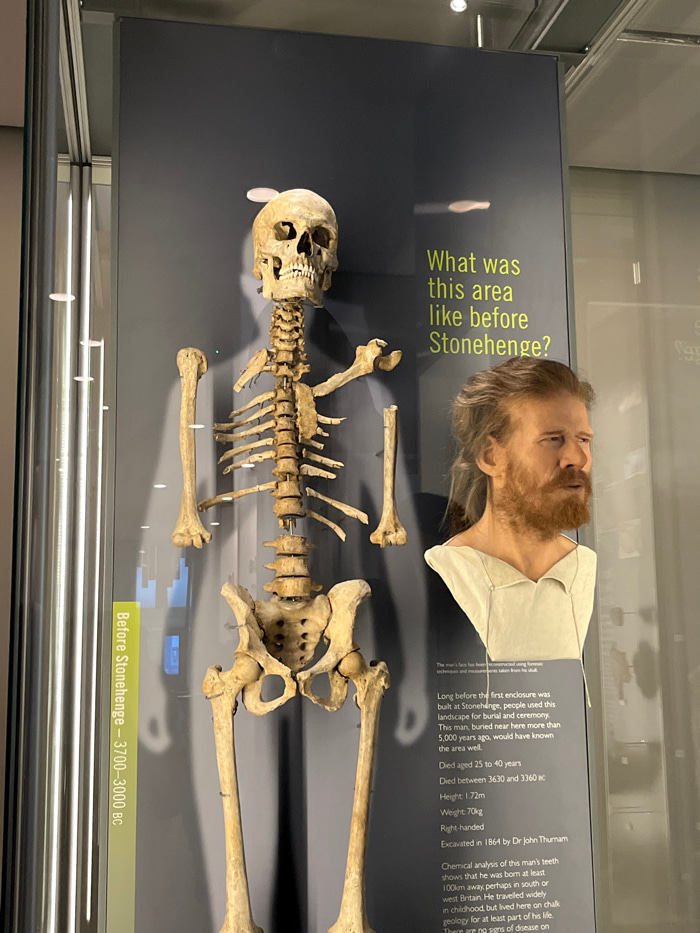
This image depicts an archaeological exhibit displayed within a glass case, likely in a museum or visitor center in the Winterbourne Stoke area of the United Kingdom, given its focus on the region's p…read more

Mortality
Curiosity
Intrigue
Mystery
History

Technical

ID

3fe2c9bd-ef77-4455-8

Usage Rights

This media is free for non-commercial use with proper attribution.

Commercial use, AI/ML training, and derivative works are prohibited without explicit consent from the creator.

Licensed under CC BY-NC 4.0 with additional AI/ML restrictions. Full terms →

This image depicts an archaeological exhibit displayed within a glass case, likely in a museum or visitor center in the Winterbourne Stoke area of the United Kingdom, given its focus on the region's prehistoric past. The exhibit features a largely complete human skeleton mounted vertically, alongside a forensic facial reconstruction bust of the same individual. The skeleton, composed of aged, yellowish-brown bones, presents a full skull, articulated vertebral column, rib cage, pelvis, and leg bones. The arm bones appear partially disarticulated and suspended beside the torso. To the right of the skeleton, the bust shows a male head and upper chest with fair skin, light brown hair, and a prominent reddish-brown beard. The bust is mounted against a dark grey back panel, which also serves as a display for informational text. A vertical green and white panel on the left side of the case reads "Before Stonehenge - 3700-3000 BC." Overhead on the dark grey panel, text asks, "What was this area like before Stonehenge?" Below the bust, a detailed text panel provides information about the depicted individual: * His face was reconstructed using forensic techniques from his skull. * He was buried near Stonehenge over 5,000 years ago, indicating he would have known the local landscape. * He died aged 25 to 40 years, specifically between 3630 and 3360 BC. * His height was 1.72m and estimated weight 70kg. * He was right-handed. * His remains were excavated in 1864 by Dr John Thurham. * Chemical analysis of his teeth indicates he was born at least 100km away, potentially in south or west Britain, and traveled widely in childhood, but lived on chalk geology for part of his life. * The bones show no signs of disease. The environment is an indoor, artificially lit exhibition space, with reflections visible on the glass case, indicating ambient lighting. No people are present in the immediate foreground of the image.