
Sign in
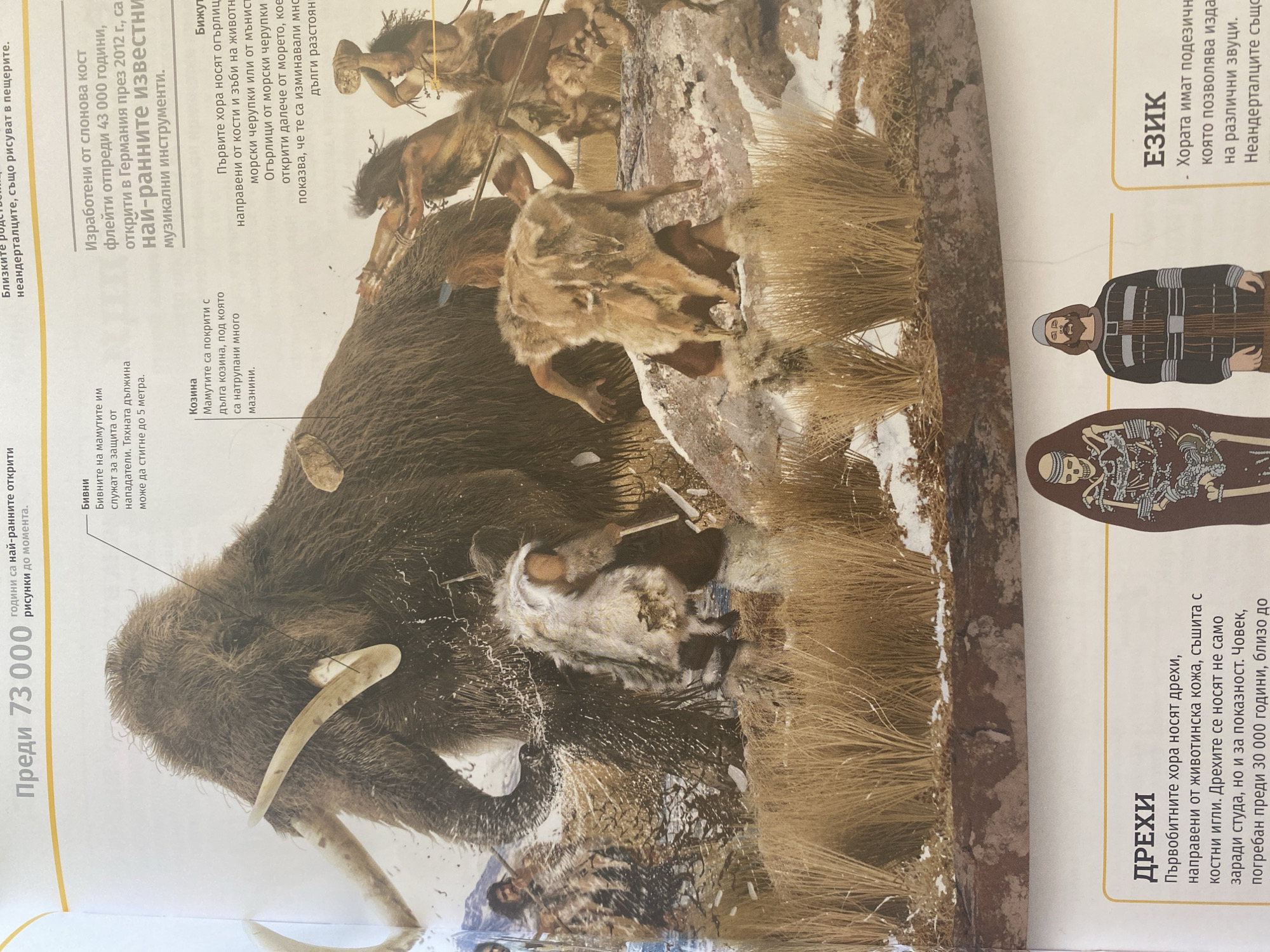
This is a scene depicting prehistoric life, likely a reenactment or illustration based on archeological findings. A large woolly mammoth is shown, with several early humans surrounding it, appearing to hunt or interact with it. The humans are wearing animal skins and furs for clothing. In the background, a rocky and snowy landscape is visible, suggesting a cold environment. There is text in Bulgarian that provides context: * "Преди 73 000 години са най-ранните открити рисунки до момента." (73,000 years ago are the earliest discovered drawings to date.) This suggests the illustration might be related to early art. * "Изработени от слонова кост флейти отпреди 43 000 години, открити в Германия през 2012 г., са най-ранните известни музикални инструменти." (Flutes made of ivory from 43,000 years ago, discovered in Germany in 2012, are the earliest known musical instruments.) This points to the development of tools and music in prehistoric times. * "Козина Мамутите са покрити с дълга козина, под която са натрупани много мазнини." (Fur Mammoths are covered with long fur, under which a lot of fat has accumulated.) This describes the physical characteristics of the mammoth for survival in cold climates. * "Бивни Първите хора носят огърлици направени от кости и зъби на животни. Морски черупки или от мъниста. Огърлици от морски черупки са открити далече от морето, което показва, че те са изминували много дълги разстояния." (Tusks The first people wear necklaces made of animal bones and teeth. Seashells or beads. Necklaces of seashells have been found far from the sea, indicating they traveled very long distances.) This describes early jewelry and trade/travel. * "ДРЕХИ Първобитните хора носят дрехи, направени от животинска кожа, съшита с костни игли. Дрехите се носят не само заради студа, но и за показност. Човек, погребан преди 30 000 години, близо до..." (CLOTHING Primitive people wear clothes made of animal skin, sewn with bone needles. Clothes are worn not only for the cold but also for show. A person buried 30,000 years ago, near...) This describes early clothing and burial practices. * "ЕЗИК Хората имат подезични кости, които позволява издаването на различни звуци. Неандерталците също..." (LANGUAGE People have hyoid bones, which allow the production of different sounds. Neanderthals also...) This touches on the development of language. There is no information within the image or its provided context that connects this scene to the city of Blagoevgrad, Bulgaria. It is a general depiction of prehistoric
Stanimira

Aug 4, 2026, 11:40 AM

Blagoevgrad, Bulgaria

Moment

Stake attention in this memory

survival
ancient
struggle
harsh
primitive

This is a scene depicting prehistoric life, likely a reenactment or illustration based on archeological findings. A large woolly mammoth is shown, with several early humans surrounding it, appearing to hunt or interact with it. The humans are wearing animal skins and furs for clothing. In the background, a rocky and snowy landscape is visible, suggesting a cold environment. There is text in Bulgarian that provides context: * "Преди 73 000 години са най-ранните открити рисунки до момента." (73,000 years ago are the earliest discovered drawings to date.) This suggests the illustration might be related to early art. * "Изработени от слонова кост флейти отпреди 43 000 години, открити в Германия през 2012 г., са най-ранните известни музикални инструменти." (Flutes made of ivory from 43,000 years ago, discovered in Germany in 2012, are the earliest known musical instruments.) This points to the development of tools and music in prehistoric times. * "Козина Мамутите са покрити с дълга козина, под която са натрупани много мазнини." (Fur Mammoths are covered with long fur, under which a lot of fat has accumulated.) This describes the physical characteristics of the mammoth for survival in cold climates. * "Бивни Първите хора носят огърлици направени от кости и зъби на животни. Морски черупки или от мъниста. Огърлици от морски черупки са открити далече от морето, което показва, че те са изминували много дълги разстояния." (Tusks The first people wear necklaces made of animal bones and teeth. Seashells or beads. Necklaces of seashells have been found far from the sea, indicating they traveled very long distances.) This describes early jewelry and trade/travel. * "ДРЕХИ Първобитните хора носят дрехи, направени от животинска кожа, съшита с костни игли. Дрехите се носят не само заради студа, но и за показност. Човек, погребан преди 30 000 години, близо до..." (CLOTHING Primitive people wear clothes made of animal skin, sewn with bone needles. Clothes are worn not only for the cold but also for show. A person buried 30,000 years ago, near...) This describes early clothing and burial practices. * "ЕЗИК Хората имат подезични кости, които позволява издаването на различни звуци. Неандерталците също..." (LANGUAGE People have hyoid bones, which allow the production of different sounds. Neanderthals also...) This touches on the development of language. There is no information within the image or its provided context that connects this scene to the city of Blagoevgrad, Bulgaria. It is a general depiction of prehistoric

Loading AttnAds…

transactions
revenues
stakers
Earliest
Latest
Highest stake

No transactions found

More from this user

More from Blagoevgrad

Stanimira

Aug 4, 2026, 11:40 AM

Blagoevgrad, Bulgaria

Licensed under Creative Commons Attribution 4.0 International License. You are free to share and adapt this content with proper attribution.