
Stake attention in this memory
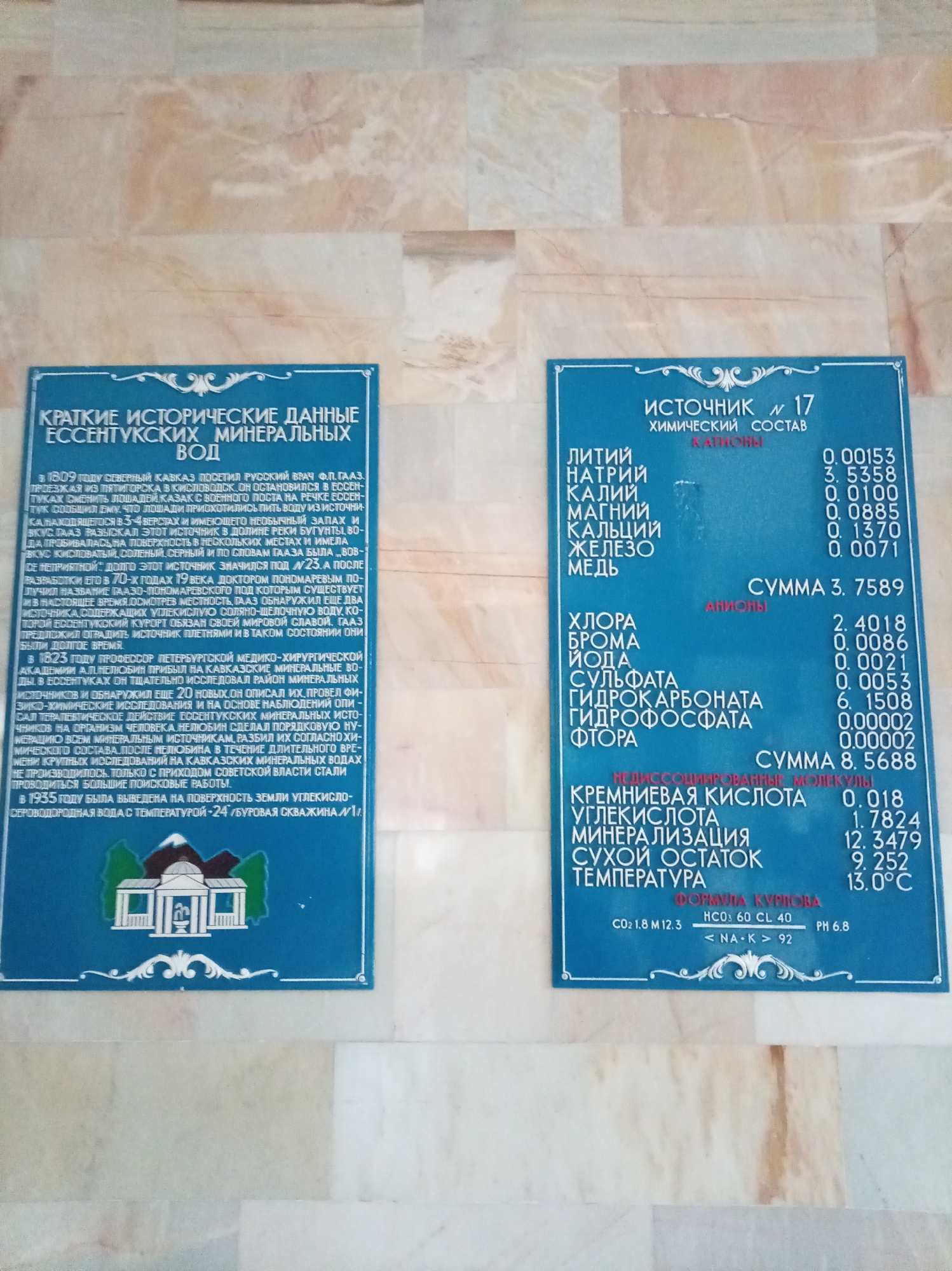
The image shows two blue informational plaques mounted on a light-colored, textured wall, likely in a public building in Yessentuki, Russia. The plaque on the left is titled "КРАТКИЕ ИСТОРИЧЕСКИЕ ДАННЫЕ ЕССЕНТУКСКИХ МИНЕРАЛЬНЫХ ВОД" (Brief Historical Data of Yessentuki Mineral Waters). It contains text describing the history of the Yessentuki mineral springs, starting from 1809 when a Russian physician visited the area. It mentions the discovery of springs, their medicinal properties, and their development over time, including scientific research and their designation as Soviet health resorts. At the bottom of this plaque is an illustration of a white building with columns and a dome, surrounded by trees and mountains, which is likely a representation of the Yessentuki balneological resort. The plaque on the right is titled "ИСТОЧНИК № 17 ХИМИЧЕСКИЙ СОСТАВ" (Spring No. 17 Chemical Composition). This plaque details the chemical composition of spring number 17, listing various cations (litium, natrium, kalium, magnesium, calcium, iron, copper) and anions (chlora, broma, ioda, sulfata, hydrocarbonate, hydrophosphate, ftora) with their corresponding amounts. It also lists non-dissociated molecules such as silicic acid, carbonic acid, mineralization, dry residue, and temperature. The bottom of this plaque includes chemical formulas and pH values associated with the spring. The plaques are designed with ornate borders and decorative elements. The wall appears to be made of large, rectangular tiles. There are no people or animals visible in the image. The lighting is even, suggesting an indoor environment. The overall impression is one of historical and scientific information being presented in a formal setting.
Loading AttnAds…
No transactions found