
Sign in
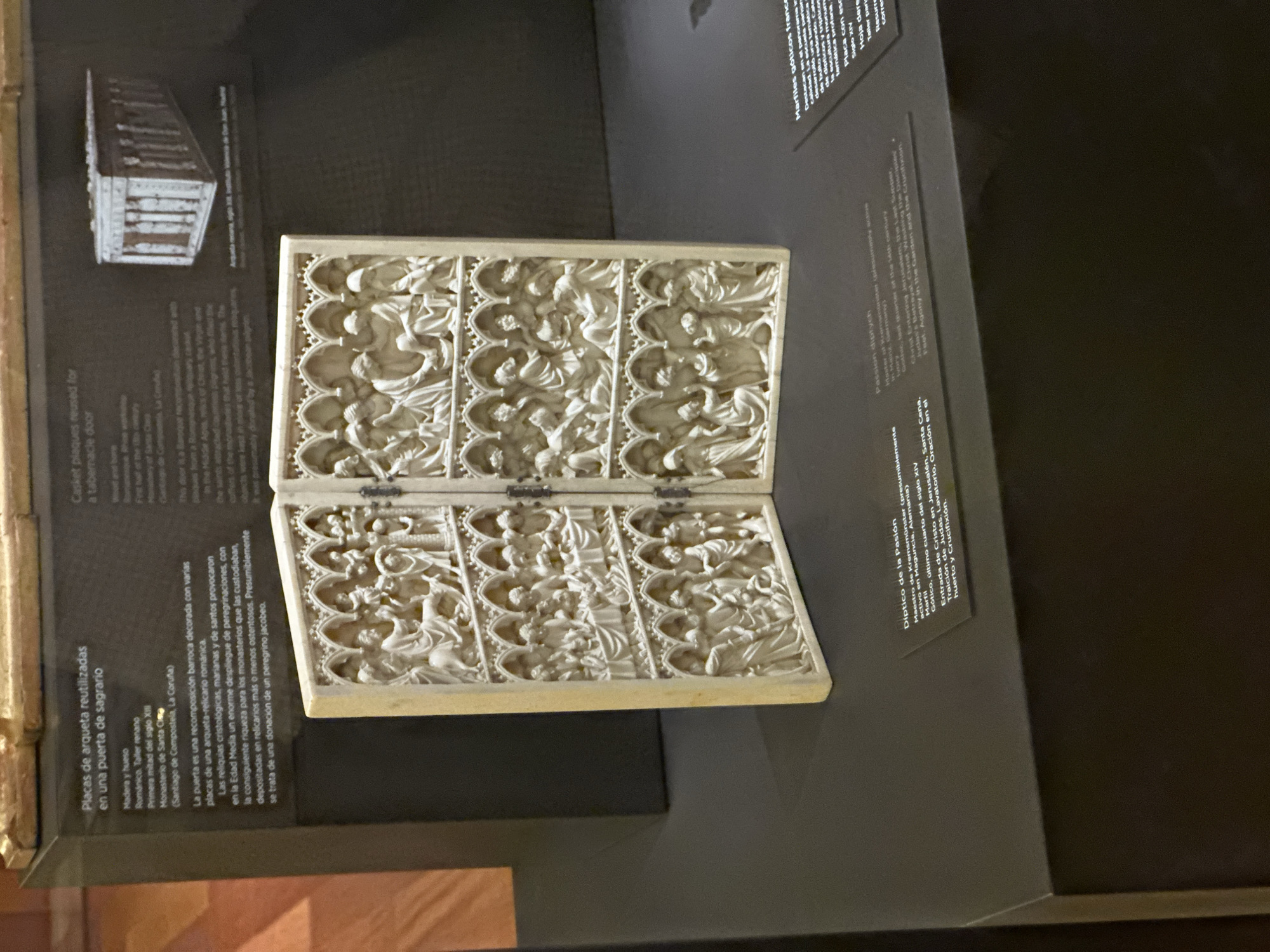
This media file showcases a museum display featuring two intricately carved ivory artifacts. The primary focus is an open, hinged diptych, likely a "Passion Diptych" given the visible text, made of ivory and dating to the Gothic period, specifically the last quarter of the 14th century. The carvings on the diptych depict various scenes, including "Christ Entering Jerusalem," "the Last Supper," "Judas's Betrayal," "Christ Washing the Disciples' Feet," "Agony in the Garden," and "the Crucifixion." The style is detailed, with multiple figures arranged in scenes set within arched frames.

To the left of the diptych, a larger display case holds what appears to be an artifact described as "Casket plaques reused for a tabernacle door." This piece is made of wood and bone, attributed to the Romanesque period, specifically the first half of the 13th century, with a workshop likely from the Rhineland. The text indicates it was formerly from the Monastery of Santa Clara in Santiago de Compostela, La Coruña, Spain. This artifact is also elaborately carved with figures, suggesting religious or historical scenes.

The overall setting is a dimly lit museum interior. The artifacts are presented on dark surfaces, with spotlights illuminating the carvings. The text is displayed on informational panels adjacent to the objects, providing details about their origin, material, period, and subject matter. The environment appears to be indoors, with the lighting suggesting a controlled exhibition space. The artifacts themselves are the sole subjects, with no people or external environmental elements visible in the immediate display.
Tati

Jun 30, 2026, 10:59 AM

Madrid, Spain

Stake attention in this memory

reverence
solemnity
awe
historical
contemplation

This media file showcases a museum display featuring two intricately carved ivory artifacts. The primary focus is an open, hinged diptych, likely a "Passion Diptych" given the visible text, made of ivory and dating to the Gothic period, specifically the last quarter of the 14th century. The carvings on the diptych depict various scenes, including "Christ Entering Jerusalem," "the Last Supper," "Judas's Betrayal," "Christ Washing the Disciples' Feet," "Agony in the Garden," and "the Crucifixion." The style is detailed, with multiple figures arranged in scenes set within arched frames. To the left of the diptych, a larger display case holds what appears to be an artifact described as "Casket plaques reused for a tabernacle door." This piece is made of wood and bone, attributed to the Romanesque period, specifically the first half of the 13th century, with a workshop likely from the Rhineland. The text indicates it was formerly from the Monastery of Santa Clara in Santiago de Compostela, La Coruña, Spain. This artifact is also elaborately carved with figures, suggesting religious or historical scenes. The overall setting is a dimly lit museum interior. The artifacts are presented on dark surfaces, with spotlights illuminating the carvings. The text is displayed on informational panels adjacent to the objects, providing details about their origin, material, period, and subject matter. The environment appears to be indoors, with the lighting suggesting a controlled exhibition space. The artifacts themselves are the sole subjects, with no people or external environmental elements visible in the immediate display.

Loading AttnAds…

transactions
revenues
stakers
Earliest
Latest
Highest stake

No transactions found

More from this user

More from Madrid

Tati

Jun 30, 2026, 10:59 AM

Madrid, Spain

Licensed under Creative Commons Attribution 4.0 International License. You are free to share and adapt this content with proper attribution.