
Stake attention in this memory
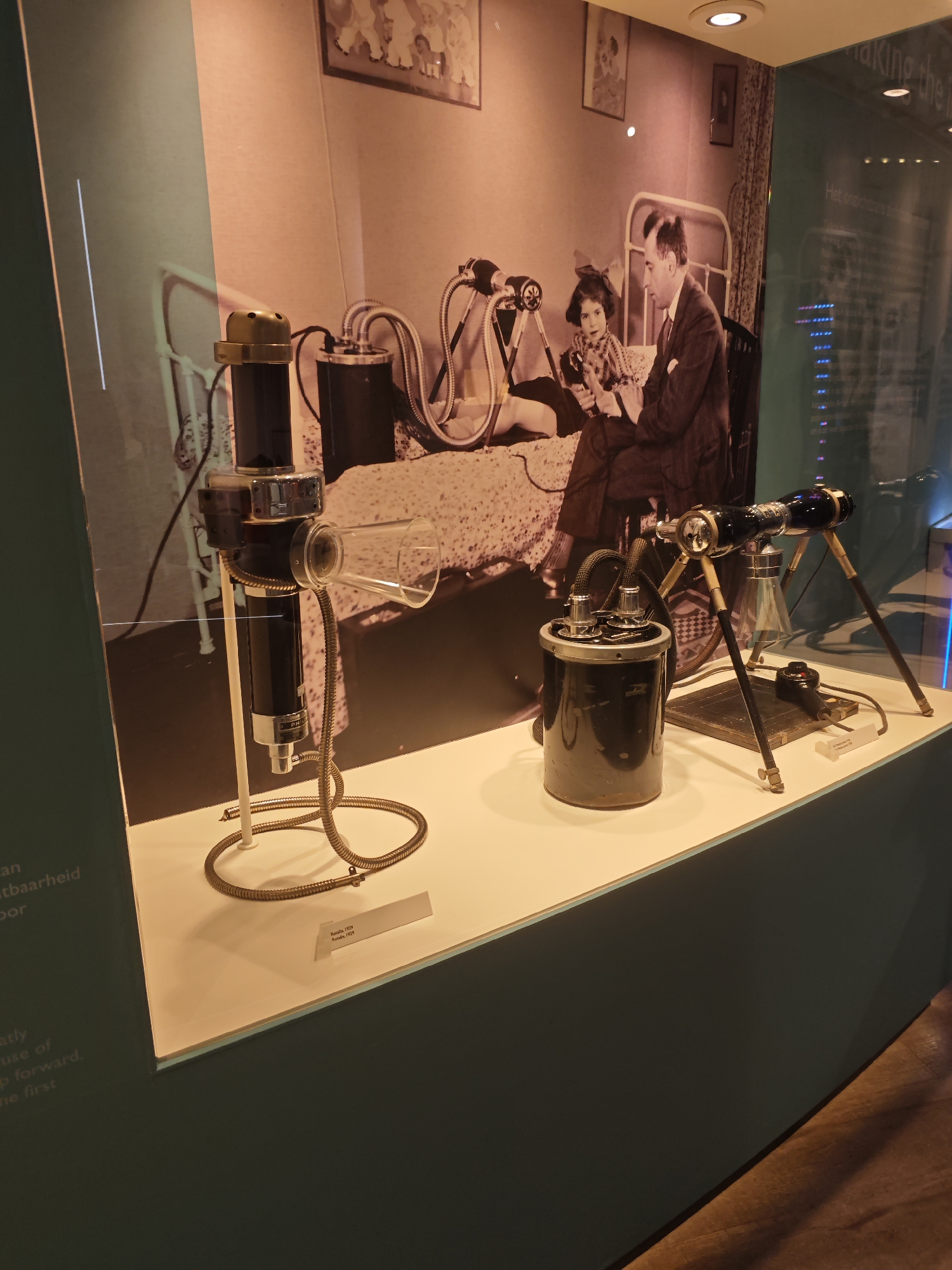
This image shows an exhibit inside a museum. The exhibit features historical medical equipment displayed on a white platform in front of a large photograph of a man and a child in a bedroom setting. The man is seated next to the child, who is sitting on a bed. The photograph appears to be from the early to mid-20th century. In the foreground, there are two distinct pieces of medical equipment. On the left is a tall, black and silver device with a brass cap and a glass funnel at the top, connected by a flexible metal hose to a smaller black cylinder at its base. On the right, there is another apparatus with a black cylindrical base, and a tripod-like stand supporting a glass tube with a light source inside. This device is also connected to the base via hoses. A small label is visible beneath the equipment on the right, which reads "Revox; 1939; Ronden, 1939." The background photograph depicts a room with a metal-framed bed, a window with curtains, and framed pictures on the wall. The lighting in the exhibit is warm and focused, highlighting the objects on display. The overall environment suggests an educational display about the history of medicine. The text on the left side of the image, partially visible, is in Dutch and discusses "vatbaarheid" (susceptibility) and "vooruit" (forward). The text on the upper right, also in Dutch, is cut off but appears to be part of a title related to "making the in" and "Het onzichtbare zichtbaar maken" (making the invisible visible). This likely refers to the historical context of the exhibited items. While the image itself does not explicitly state the location, a search of museum exhibits related to historical medical equipment and the phrase "Het onzichtbare zichtbaar maken" points to the Philips Museum in Eindhoven, Netherlands. The museum's focus is on the history of Philips, a company that has been involved in medical technology.
Symbol
B95B6
Volume
540
Creator
+$0.03
Revenue
+$0.00
TVL
$0.17
Loading AttnAds…