
Sign in
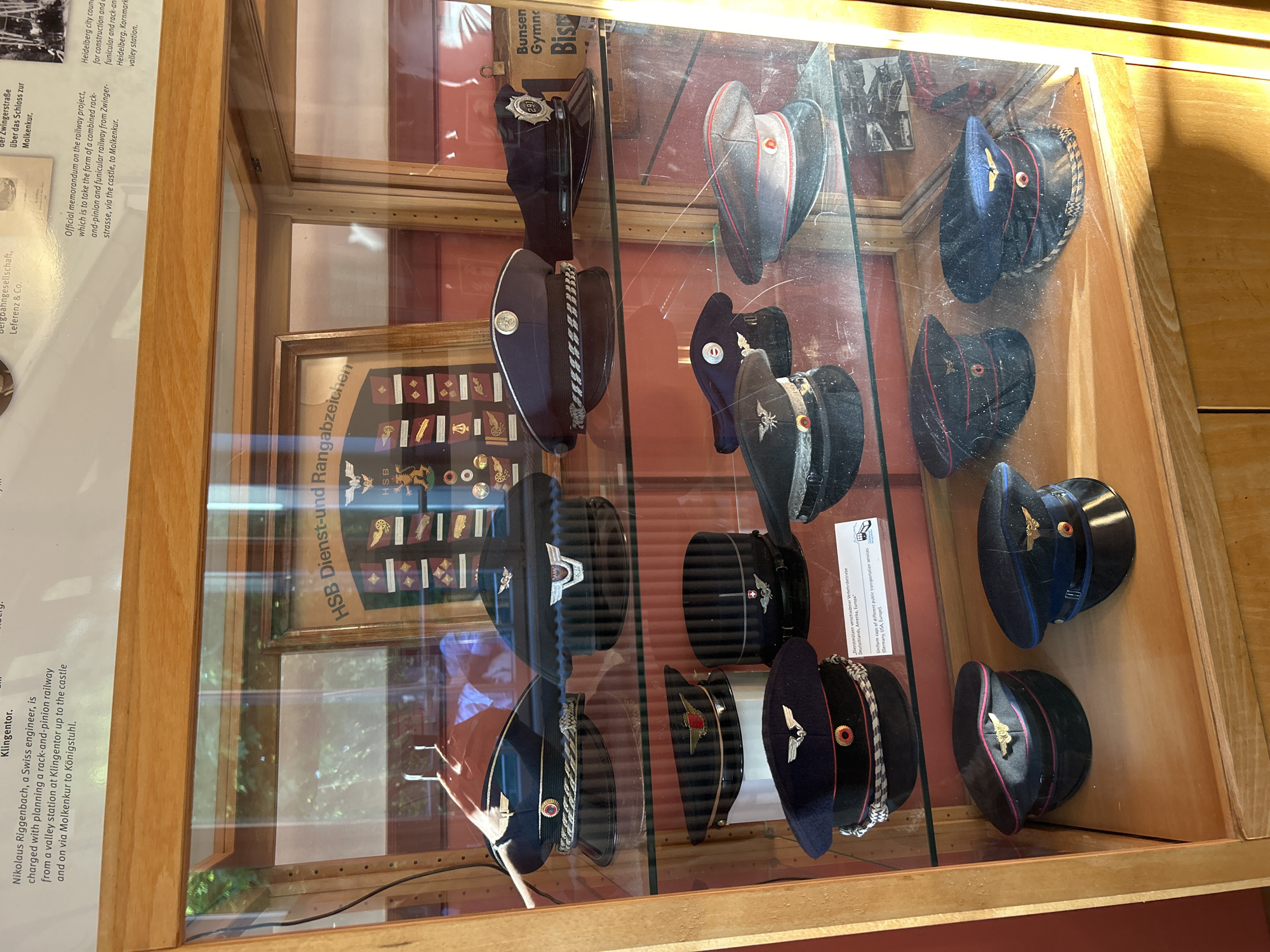
This media file captures an indoor museum display case, likely in Heidelberg, Germany, showcasing historical public transportation uniforms and insignia. The wooden-framed glass case is filled with various dark-colored uniform caps or hats, predominantly black and dark blue, arranged on multiple shelves. These caps feature different designs, visors, braids, and metallic insignia, suggesting a range of ranks or services. Some caps have prominent eagles, wings, or circular emblems.

In the center, behind the caps, a framed exhibit titled "HSB Dienst- und Rangabzeichen" (HSB Service and Rank Insignia) displays a collection of badges, epaulettes, and other rank-related emblems. A small white label inside the case further clarifies the display, stating: "Dienstmützen verschiedener Verkehrsbetriebe Deutschlands, Amerika, Europa" (Service caps of different public transportation services Germany, America, Europe), and "Uniform caps of different public transportation services (Germany, USA, Europe)."

To the left of the display case, printed informational texts are visible. These texts refer to "Klingentor," "Nikolaus Riggenbach, a Swiss engineer," and the "planning a rack-and-pinion railway from a valley station at Klingentor up to the castle and on via Molkenkur to Königstuhl." Another text mentions an "Official memorandum on the railway project, which is to take the form of a combined rack-and-pinion and funicular railway from Zwingerstrasse, via the castle, to Molkenkur." These details strongly suggest the exhibit is related to the history of the Heidelberg Bergbahn (funicular railway). Reflections of the room and parts of other signs ("Bunsen Gymna Bis") are visible on the glass. The scene is static, documenting the exhibited artifacts.
megs✨

May 1, 2026, 5:46 PM

Heidelberg, Germany

Stake attention in this memory

nostalgic
historical
formal
orderly
respectful

This media file captures an indoor museum display case, likely in Heidelberg, Germany, showcasing historical public transportation uniforms and insignia. The wooden-framed glass case is filled with various dark-colored uniform caps or hats, predominantly black and dark blue, arranged on multiple shelves. These caps feature different designs, visors, braids, and metallic insignia, suggesting a range of ranks or services. Some caps have prominent eagles, wings, or circular emblems. In the center, behind the caps, a framed exhibit titled "HSB Dienst- und Rangabzeichen" (HSB Service and Rank Insignia) displays a collection of badges, epaulettes, and other rank-related emblems. A small white label inside the case further clarifies the display, stating: "Dienstmützen verschiedener Verkehrsbetriebe Deutschlands, Amerika, Europa" (Service caps of different public transportation services Germany, America, Europe), and "Uniform caps of different public transportation services (Germany, USA, Europe)." To the left of the display case, printed informational texts are visible. These texts refer to "Klingentor," "Nikolaus Riggenbach, a Swiss engineer," and the "planning a rack-and-pinion railway from a valley station at Klingentor up to the castle and on via Molkenkur to Königstuhl." Another text mentions an "Official memorandum on the railway project, which is to take the form of a combined rack-and-pinion and funicular railway from Zwingerstrasse, via the castle, to Molkenkur." These details strongly suggest the exhibit is related to the history of the Heidelberg Bergbahn (funicular railway). Reflections of the room and parts of other signs ("Bunsen Gymna Bis") are visible on the glass. The scene is static, documenting the exhibited artifacts.

Loading AttnAds…

transactions
revenues
stakers
Earliest
Latest
Highest stake

No transactions found

More from this user

More from Heidelberg

megs✨

May 1, 2026, 5:46 PM

Heidelberg, Germany

Licensed under Creative Commons Attribution 4.0 International License. You are free to share and adapt this content with proper attribution.